
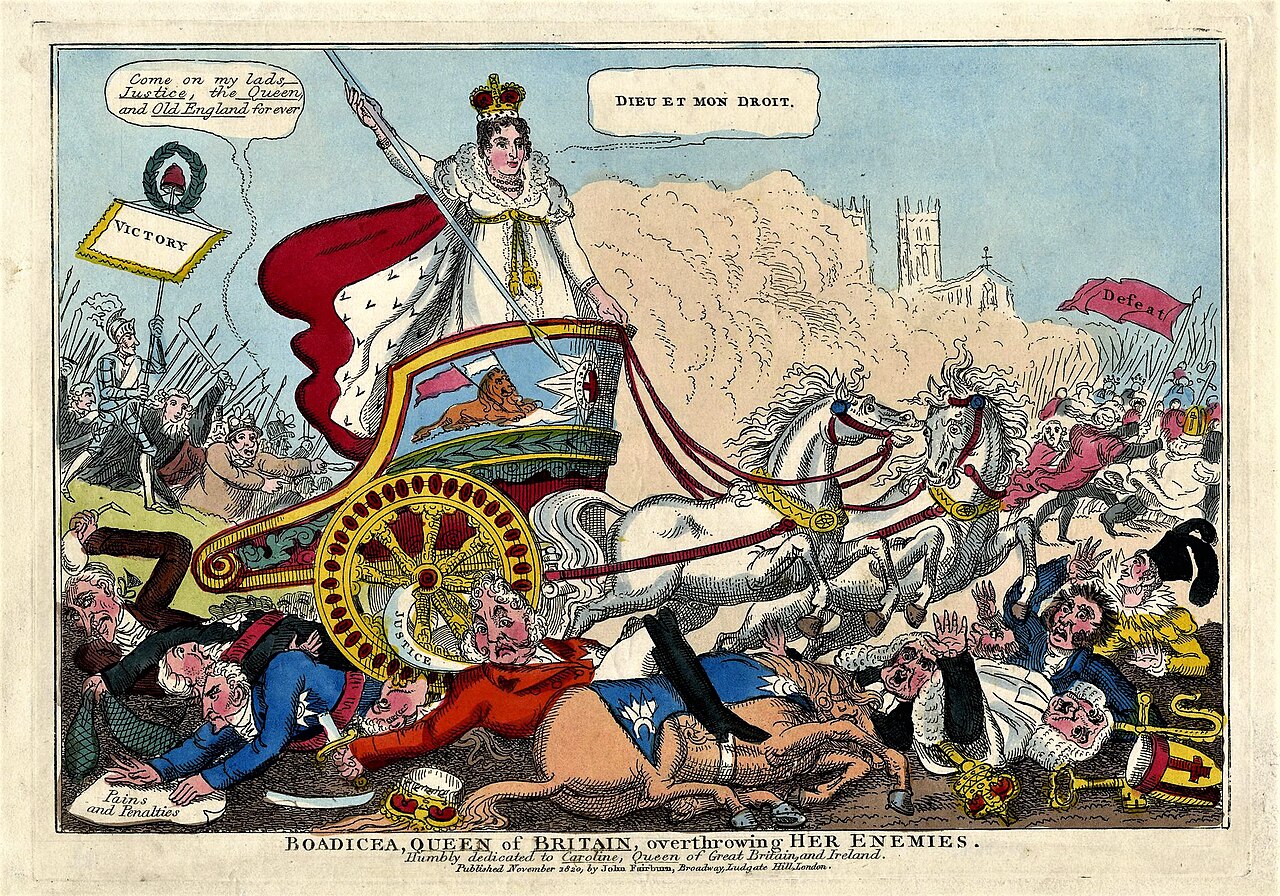
Queen Caroline was custom-made for the finest caricaturists who ever lived. Her husband, King George IV, decided to charge her with adultery shortly after becoming king in January 1820. The ensuing trial in late 1820 in the House of Lords was the sensation of the entire century.
Even though she was convicted, “the margin of victory was so slender that the government dropped its case.” George IV was outraged. In 1821, he infamously barred Caroline from entering Westminster Abbey to attend her own Coronation.
It turns out the victory was hers: a few days later, she went in state to St. Paul’s Cathedral, where “she was unofficially recognized as queen of England in a thanksgiving service. If the cultural symbolism and popular acclaim of this ceremony could be used as indicators of her legitimacy, Caroline had achieved her aim of gaining ‘nothing but a crown.”
I am quoting here from a delightful book by Ian Haywood, Professor of English at the Univ. of Roehampton. This slim book is packed full of illustrations, many in colour, that include some of the finest caricatures of royalty drawn in the Georgian era. Haywood’s description of some of them as “seditious revelry” give just a taste of what is in store. The most delicious one was published on the very day of the adultery trial verdict. It depicts Caroline seated on the throne of England (“ a bold statement” writes Haywood), but it also “provides an outrageously seditious vignette” showing her husband being transported out of England by “two grotesque demons.” Wow!
Haywood states that 1820 “was a momentous year in Europe” with a wave of liberal uprisings. A radical publication in England, Black Dwarf, stated “This year will certainly form a new era for the emancipation of the human race. Nothing can more forcibly argue the necessity of an immediate reform in the Parliament and Government of England, than the conspiracy against the Queen.”
The month of November 1820 saw the greatest expression of support for Caroline. “Across the land people expressed their joy, organizing parties, processions, marches, bell ringing, fireworks, gun salutes, and occasional outbreaks of intimidation and disorder. For the first time in its history, London was transformed into a spectacle of people power and triumphal public opinion.”
The Times waxed lyrical over the 4-day event. Haywood quotes from the newspaper. Compared to the “sumptuous, though tawdry” celebration of the defeat of Napoleon in 1814, the “defeat of domestic tyranny and flatigious persecution” had “ten times the glow of honest exultation than even the ruin of a thousand foreign tyrants.”
But Caroline’s jubilation was short-lived. “Just a few weeks after her exclusion from the coronation, the king’s adversary fell ill and died on 7 August 1821.”
Heywood concludes that “her decease was an even more dramatic event than anyone could have imagined,” and it was only that which finally put an end to the anti-government caricatures. My only regret is that the author gives little background on the publishers. His only comment on John Fairburn is that is he “now forgotten.” It is not always clear if the publisher was also the caricaturist.
For anyone offended by cartoons featuring members of the Royal Family in 2026, take a short history lesson by getting this book. Today’s offerings are treacle by comparison.
Illustrating: Caroline is portrayed victorious as the warrior Queen Boadicea (who fought the Roman army) in this caricature by John Fairburn in 1820.
Queen Caroline and the Power of Caricature in Georgian England is by Palgrave Macmillan (Springer Nature). It lists for $49.99.