
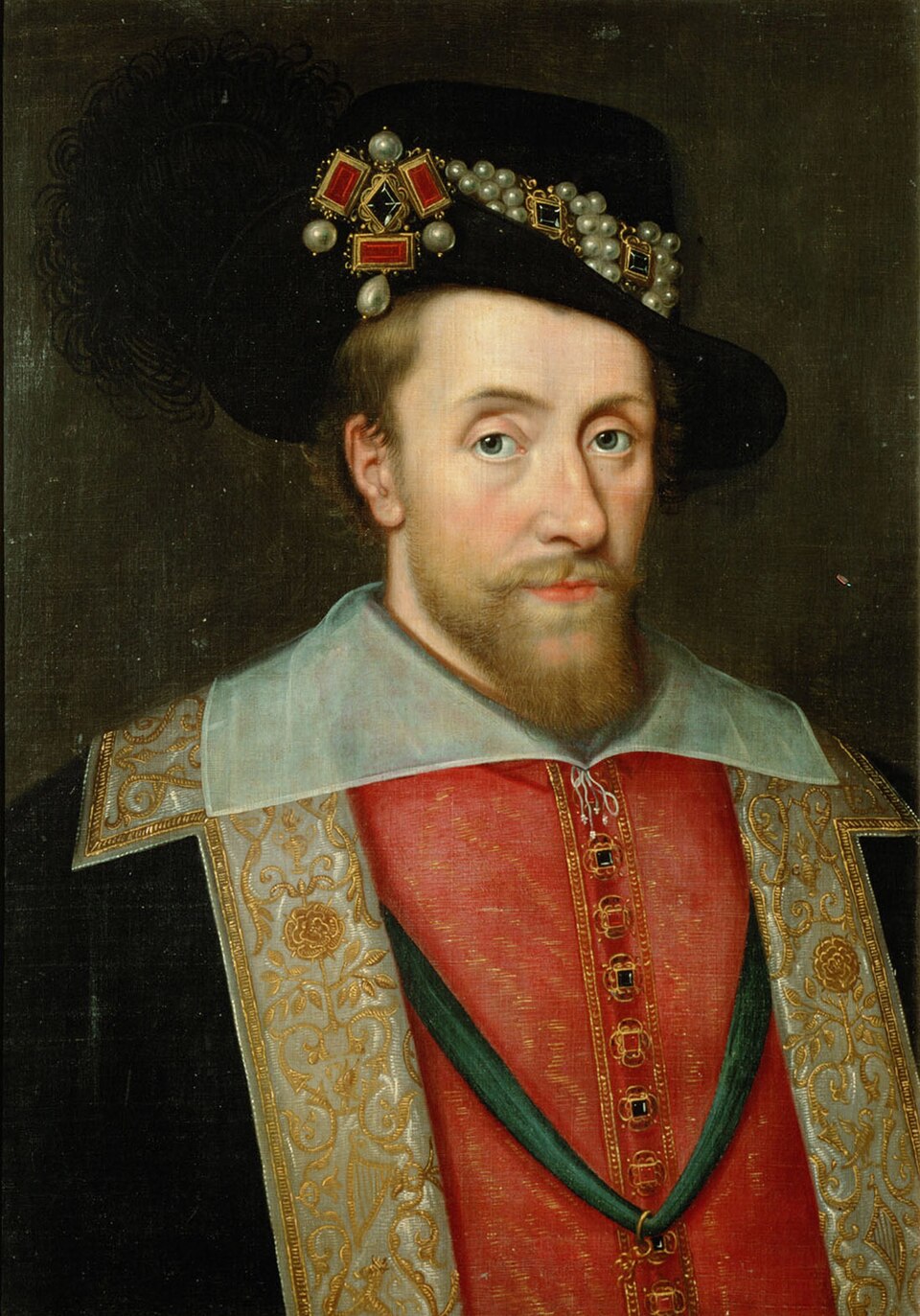
With the publication of 2 new books, the avid bookhound now has the opportunity of reading nearly 1,000 pages about King James I of England.
First under review here is The Six Loves of James I by Gareth Russell, who has a Bachelor of Arts in Modern History from St Peter’s College, Oxford, and a Master of Arts in History from Queen’s University, Belfast.
Before dipping my toes in a pool of mild criticism, I must state at the outset that this book is a delight: well-written, engaging, and – as one would expect from the title – quite titillating.
One would expect Russell to give us every existing tidbit relating to what people at the time were writing about their king and his loves. Alas, I must forewarn the reader disappointment is in store. Consider this quote from Sir Henry Widdrington in May 1582, when James was still only the King of Scotland as James VI, regarding the Duke of Lennox:
“The king altogether is persuaded and led by him, for he can hardly suffer him out of his presence, and is in such love with him, as in the open sight of the people, oftentimes he will clasp him about the neck with his arms and kiss him.”
Pretty racy stuff! And it did not go unnoticed by the clerics of the time. Just days after this, Widdrington wrote that the Church of Scotland ministers had been “informed that the duke goes about to draw the king to carnal lust.” This liason, if one may call it that, only ended that following year, when Lennox died in Paris during an epidemic of the flu. Since James was only 16 years old at this stage, and his love of men continued his entire life, one can only conclude his first preference was for handsome men, not gorgeous women.
Which brings me to where the information I just imparted came from. Even though Russell devotes a chapter to the Duke of Lennox, he does not quote from Widdrington (who does not appear in the book at all). Rather, it is from the second book under review here: The Mirror of Great Britain by Clare Jackson, Honorary Professor of Early Modern History, Cambridge University.
Even though her book only engages with the king’s sex life as needed to advance her largely political biography, it does offer such important insights missed by Russell. While his book is ostensibly about the six loves of James I, the reader who expects Russell to focus on the subject will be annoyed at getting bogged down in entirely peripheral issues such as witchcraft trials in Scotland, his trips around England, and the political machinations of his royal policies in Scotland and Ireland. Also titillating to be sure, but nothing to do with the ostensible topic at hand. A deft hand in the editing department would have counselled the author to exclude the dross (however intriguing it may be) and concentrate on James’s love interests. This would have made the book at least 100 pages shorter.
Russell also gets the only bit of astronomy wrong. He writes of Anna (the wife of James I, who counts as the only female amongst his six loves). “A comet streaked across the sky in September, which was held to presage the death of a great person – possibly Anna, probably James.” While there were two comets faintly seen in the autumn, the linkage of a comet to royal health rests with the Great Comet of 1618, which was only visible from England in November and December (Cunningham, 2026).
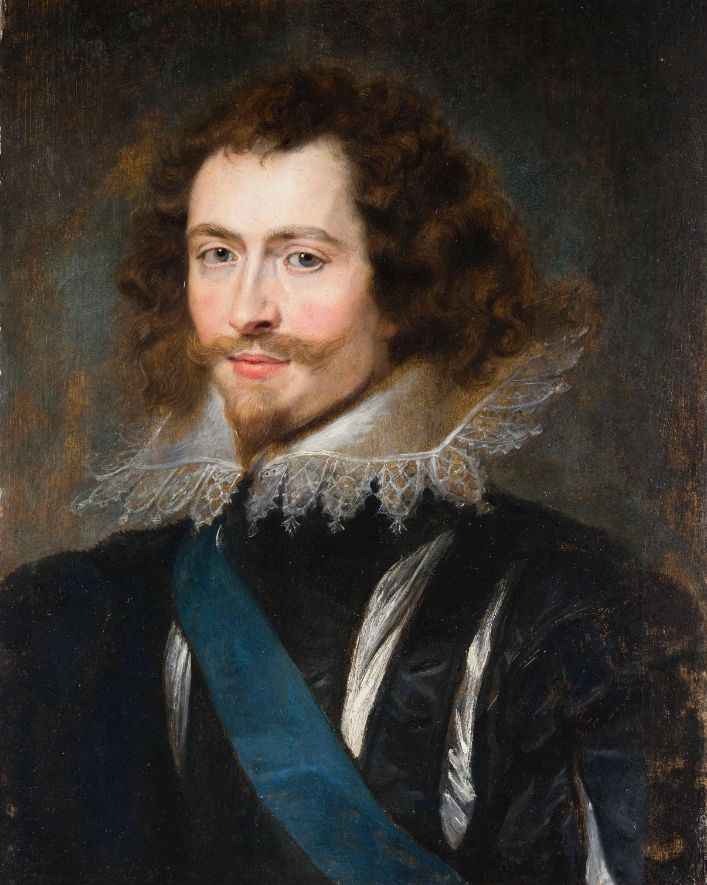
Without going into the details of all six of James’s love interests, the only one that has lasting historical repercussions was centred on George, the Duke of Buckingham (considered at the time as the most handsome man anyone had seen; pictured here). One should note here that both Lennox and Buckingham were made dukes by the king. Until then, the title was reserved only for members of the royal family in Scotland and England.
In Russell’s book, we learn that Queen Anna was hardly in her grave before James and Buckingham “went through a sort of ceremony.” After this, Buckingham often addressed the king as “my dear husband.” James in turn called him “my only sweet wife.”
Russell writes: “In the face of parliamentary criticism of George, James told him that he would ‘rather live banished in any part of the earth with you than live a sorrowful widow’s life without you.’” Quite Shakespearean, I think, which is perhaps not surprising since James met the Bard and attended his plays. In conclusion, Russell writes “I would describe James as bisexual.” He doesn’t put a percentage on it, but after reading his book I’d say it’s an 85/15 split. In any case, he handles the material judiciously, and maintains a proper historian’s attitude to the evidence. Very well done!
Jackson, author of the other book, only misses the mark in one area. In such a full-bodied effort to bring King James to life, she forgets about how he sounded. What is lost to ‘modern ears’ is how the words sounded four centuries ago. This ‘Original Pronunciation’ of the words, O.P., has recently been reconstructed (Crystal, 2016). Andrew Lipman (Columbia University) offers an example of how this can be usefully applied to a poem King James wrote about the Great Comet of 1618:
The poem gives us a literal sense of the monarch’s voice. One can ‘hear’ his Scots-inflected O.P. in the ways he rhymed ‘bloode’ with ‘good’ and ‘conceyte’ with ‘heighte.’ Both his verse and joke also captured James Stuart’s distinctively crass and pompous personality. (Lipman, 2024: 117)
Aside from that, this is a superior biography of James I, perhaps the best ever written. Jackson emphasizes the intellectual force James projected onto all of Europe. “Within two years of his accession as English king [in 1603], James’s works were printed in at least eleven cities, in Latin and a range of vernacular languages. After hearing aloud a Latin translation, Pope Clement VIII ‘could scarcely hold tears for comfort’ in hearing the new English king’s exhortations to virtue.’ Clement hoped that James might yet become ‘a Catholic, for he would be a mirror to all princes.’” Thus, Jackson derives the title of her book: The Mirror of Great Britain.
He is best known now for the King James version of the Bible. But with an extraordinary reign of 57 years, King James is the most worthy subject of these two books, published to coincide with the 400th anniversary of his death in 2025.
The Six Loves of James I (473 pages) is by Atria Books. It lists for $32.
The Mirror of Great Britain (494 pages) is by Liveright (W.W. Norton). It lists for $35. [it was selected as one of the best books of 2025 by The Times of London]
References
Crystal, D. (2016). The Oxford Dictionary of Original Shakespearean Pronunciation. Oxford, Oxford University Press.
Cunningham, C., editor (2026). Cosmic Events: The Three Comets of 1618. Cham, Springer.
Lipman, A. (2024). Squanto: A Native Odyssey. New Haven, Yale University Press. Images courtesy of Wikimedia Commons: King James and the Duke of Buckingham