
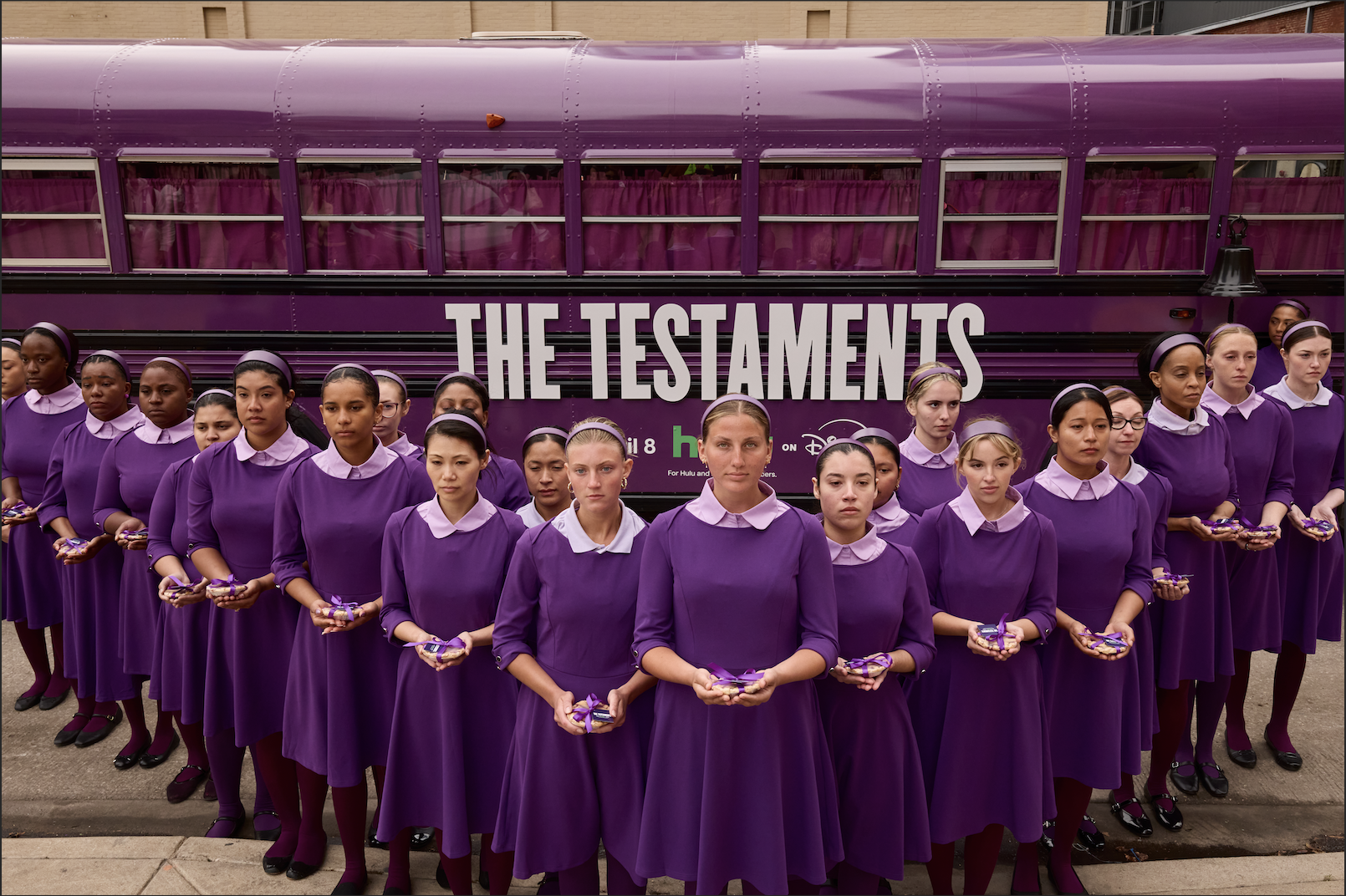
A purple bus, cryptic pies, and an army of purple-clad “Plums” signal the arrival of one of 2026’s most anticipated series.
If you were walking along South Congress Avenue or West 4th Street in Austin on March 16th and found yourself suddenly surrounded by a line of silent, purple-clad young women holding out tiny pies, you weren’t dreaming. You were inside Gilead.
Hulu launched an immersive street activation across Austin to announce the arrival of The Testaments, its highly anticipated sequel to The Handmaid’s Tale, and the experience was every bit as eerie, intriguing, and theatrical as the world it’s designed to evoke.
At the center of it all was a large purple bus, known in the series as Aunt Lydia’s prep school bus. At each stop, a group of young women called “Plums,” students from Aunt Lydia’s elite preparatory school for future wives, disembarked in a single-file line. A supervising Plum directed the procession. Then, at the ring of a bell, the Plums fanned out across the sidewalks, offering pedestrians small, hand-wrapped bumbleberry pies, a rare combination of blueberries, raspberries, blackberries, and strawberries, each one delivered with a bow of the head and a murmured blessing.
Hidden on the bottom of each pie tin was a secret message: “Things Are Not What They Seem.” Beneath it, a QR code linking to the show’s trailer and a deeper portal into the world of the series. At two sharp rings of the bell, the Plums fell back into formation, re-boarded the bus, and were gone.
The Austin activation marks the start of a multi-city tour, with the purple bus and its Plums set to make additional stops in Los Angeles and New York.
The Testaments is not a reboot. It is, as Hulu positions it, an evolution. The series serves as a narrative continuation of The Handmaid’s Tale (2017–2025), set years after the events of the original show, and follows a new generation of young women navigating the brutal, divinely justified world of Gilead. The premiere drops the first three episodes on April 8, with new episodes releasing weekly thereafter.
At the story’s center are two young women: Agnes (Chase Infiniti), dutiful and deeply indoctrinated, and Daisy (Lucy Halliday), a new arrival from beyond Gilead’s borders. As they move through the gilded, oppressive halls of Aunt Lydia’s preparatory school, a place that teaches obedience through fear and frames brutality as grace, their unlikely bond becomes the force that threatens to unravel everything. Returning to anchor the series is Ann Dowd, reprising her Emmy-winning role as Aunt Lydia, who now oversees a new social class of young women called the Pearl Girls. Unlike the Handmaids, these girls have come to Gilead of their own will, a distinction that is, for Lydia, of the utmost importance.
Elisabeth Moss, who played June Osborne across six seasons of the original series, is an executive producer on The Testaments. While she has not been confirmed as a cast member, June’s presence looms over the story, and the original show’s finale was written to feed directly into this sequel.
I first read The Handmaid’s Tale in 1986, the year after it was published. It produced something I can only describe as a physical response, a disruption in the nervous system, a crawling discomfort that didn’t leave when I put the book down. Atwood had written a horror story using nothing but recorded history and cold logic, and the body understood what the mind was still processing. Watching the series produced the same sensation, amplified. Because now it isn’t speculation. Watching it in Texas, a state whose legislative agenda over the past several years has tracked the Gilead playbook with a faithfulness that should alarm anyone paying attention, strips away whatever remaining distance fiction provides. The same is true across much of the South, where the architecture of control, the religious justification for it, and the targeting of women’s bodies and autonomy have moved from the realm of dystopian metaphor into law and lived reality. Fanatic regimes don’t always arrive in uniform. Sometimes they arrive in legislation.
The Handmaid’s Tale was published in 1985. Atwood built every element of it from documented history, and no scenario in the novel had not already occurred somewhere in the world. That was always the point. It was never really science fiction. It was an act of witness, written in future tense. The Testaments is adapted from Atwood’s 2019 sequel novel of the same name, which won the Booker Prize that year, sharing the award with Bernardine Evaristo’s Girl, Woman, Other, and was deliberately written in coordination with showrunner Bruce Miller while the television series was still in production. The two works were shaped to coexist, each informing the other’s ending and beginning. The result is a sequel with unusually solid structural foundations: the same showrunner, a Booker-winning source text, and an audience primed by six seasons of visceral, politically resonant television.
Chase Infiniti, a breakout following her role in Paul Thomas Anderson’s One Battle After Another, steps into the role of Agnes, also known as Hannah, the daughter June Osborne spent six seasons trying to reclaim. Lucy Halliday plays Daisy, a Canadian teenager whose world fractures when she discovers her unexpected connection to Gilead. The ensemble also includes Rowan Blanchard, Mattea Conforti, Isolde Ardies, Shechinah Mpumlwana, and Birva Pandya. The casting signals a clear generational shift. This is not June’s story. It is the story of what June’s world made, and what the next generation might unmake.
If Austin’s street activation is any indication, Hulu is not content to simply release The Testaments. They intend to bring it to you, one unsettling blessing and bumbleberry pie at a time. Keep an eye on the streets of Los Angeles and New York in the weeks ahead. The Plums are coming.
The Testaments premieres April 8, 2026, on Hulu, with the first three episodes dropping simultaneously. New episodes follow weekly. Bundle subscribers can also stream via Hulu on Disney+, and international audiences have access through Disney+ directly.
Blessed be the fruit.
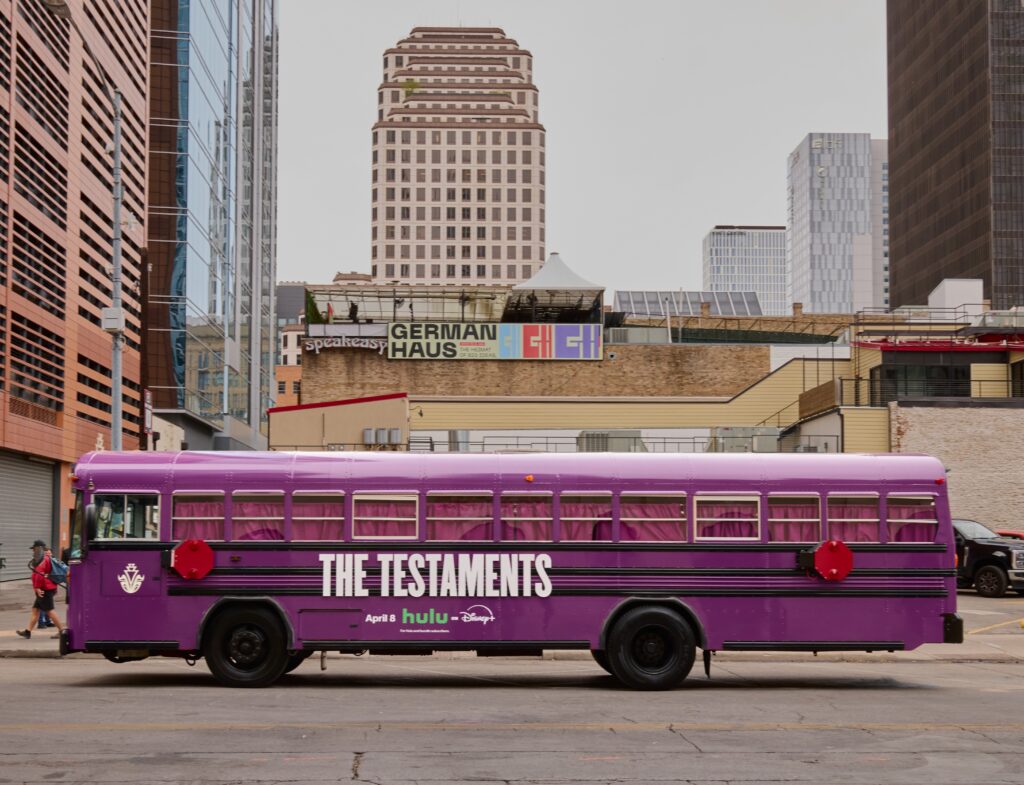
Second photo: The Purple bus parked by German Haus, a venue for German business and culture at SXSW 2026 in Austin.