
My pick for the Halloween book of 2025 is The Witch Studies Reader. It is a collaboration of 44 experts, mostly university professors.
This large book (500 pages) is broadly divided into six categories: The Colonial Encounter, Lineages of Healing, Killing the Witch, Protest and Reclaiming, and Witch Epistemologies. By and large, this is not a history of witchcraft; rather, it concentrates on the experience of what it means to be a witch in the 21st century. As the editors state in the Introduction:
“A central tension in this volume, and in feminist thinking about witches more broadly, is how to make sense of the countless ways that people have understood witches and witchcraft across time and place….Witch hunts are an ongoing, contemporary crisis.” An example is given in a chapter by Brandy Renee McCann, who writes about the Appalachian area of the United States. “A baneful witch might be an outside or a vulnerable woman in the community, but she could simply be a matriarch in another family, or a woman hired by anyone with whom the supposed victim did not get along. In that way, any woman could be subjected to accusations of witchcraft.” Even though the books adopts a feminist look at witchcraft, author Adrianna Ernstberger tells us that between 1500 and 1660, and again from 1700 onward, most executed for witchcraft in Finland were men. Unfortunately, the details and reasons for this fascinating association are not explored in these pages.
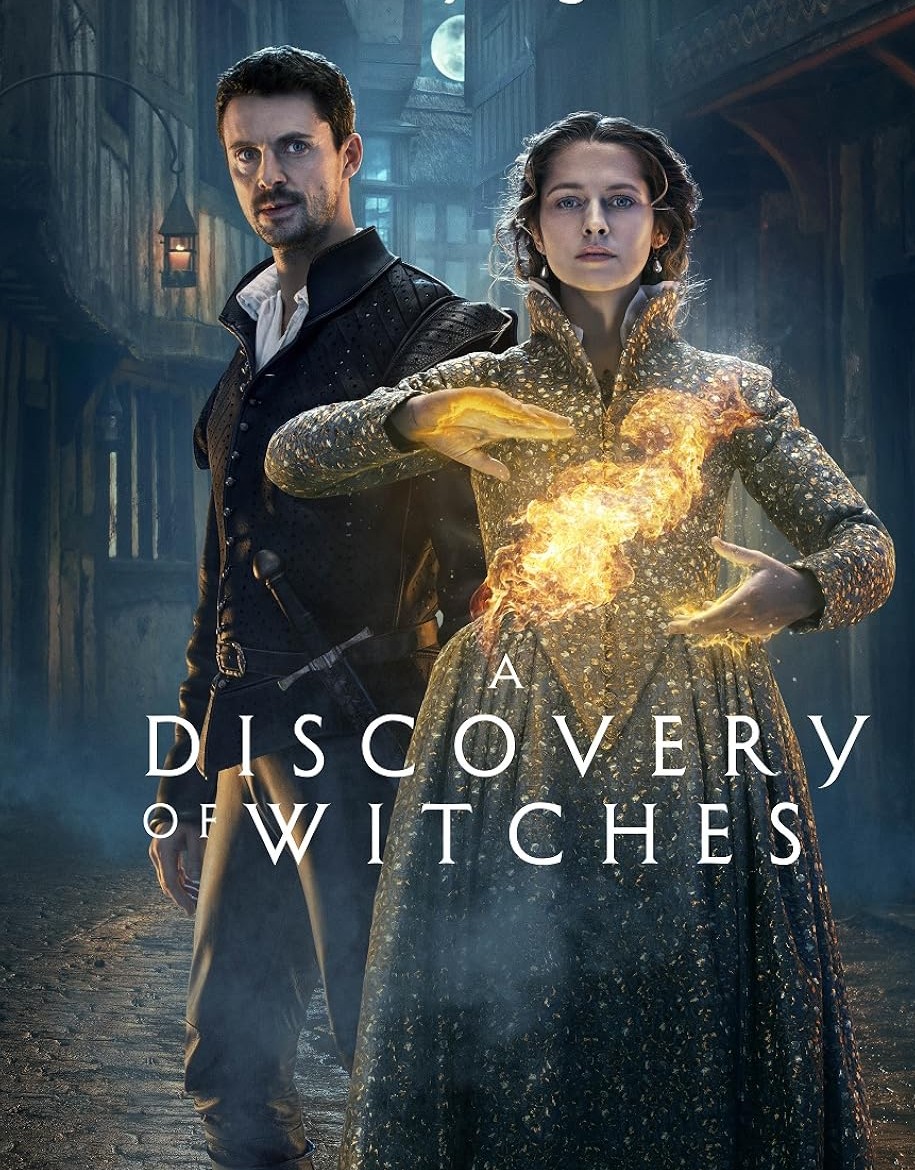
Let’s start with A Discovery of Witches, which (pun intended) ran on TV from 2019 to 2022 (lead photo). This British fantasy series was based on a book trilogy by Deborah Harkness, and featured a reluctant witch, Diana Bishop, and Matthew Clairmont, a vampire. In the series, Diana was actually a scholar. In this book, we read on page 1 that “Scholars and witches are sometimes the same.” Chapter 28 (by Ruth Charnock and Karen Schaller) devotes a couple of pages to the novel by Harkness, but curiously its adaptation as a 3-season TV show is not mentioned anywhere. There is a list on page 327 giving witch films and television shows, but this most important and popular show is missing!
The two authors go on to discuss an exhibit at the Univ. of Oxford (the setting for the TV show). In 2018-19, the Spellbound exhibit featured “a collection of English artifacts from the 12th century to the present.” But rather than venerating them, the exhibit set out to “break the spell of these artifacts: they are not magical…Visitors were invited to experience how compelling magical thinking is and recognize its lingering in the 21st century psyche, yet also recognize that fascination itself as a border zone between the irrationality of magical thinking and the rationality with which one should view it.”
That pretty much sums up the approach of the entire book. This is not really a haven for those believe in the powers if witchcraft. Being written mostly by academics, it is clear-eyed look at what witchcraft really is. Luckily, Halloween does get several mentions, although entire chapter devoted to it would have been welcome. Mention is made of a show in San Francisco in late October 1970: The Cockettes staged an original Halloween production that encompassed dancing tombstones, a parody of 1935’s film Bride of Frankenstein, and a show-stopping “Mick Jagger”-fueled finale. Les Ghouls, as it was termed, was accompanied each night by a screening of George A. Romero’s film Night of the Living Dead.
One of the chapters that will be widely studied is by Simon Clay & Emma Quilty. They make a bold declaration on the first page of the chapter: “witchcraft is unbridled sexuality.” They tell “about how women are drawn to witchcraft because of their essential licentiousness. Their uncontrollable sexual desires push them to fly through the night, looking to drain sleeping men of their semen and steal their penises for sorcerous purposes.” Well, that would make for quite a TV show! One ‘modern’ group was started in 1979 entitled Reclaiming Witchcraft, Clay & Quilty write that its “rapid popularity was partly due to its unique approach of using sex and eroticism as powerful sources of magic.”
Aside from the prurient aspects, being a witch these days can be as dangerous as centuries ago. In India, a headline in a major newspaper in 2013 read “Mass Hysteria over Witchcraft Grips Madhya Pradesh.”
In the Indian state of Chhattisgarth, cases of beheading of suspected witches has been reported. This was after a 2005 law was enacted there: the Witchcraft Atrocities Prevention Act. Others have been stoned to death. In one village there, several “accused asked for water. They were tied to an electric pole, and then some men urinated on them to send electric chocks through their bodies.” The situation is no better in Tanzania. Between 1995 and 2004, 6,680 killings have been documented. Pre-colonial courts there punished murder with fines, but witchcraft by death.
A far cry from the TV show Bewitched. As Jaime Hartless and Gabriella Smith write in their chapter of the 1960s show that “introduced the world to Samantha Stevens, a witchy suburban housewife,” Samantha “is the prototype for a breed of witch that would become inescapable by the millennium – one born with morally neutral magical powers.” The safe and lovely witch!
Jacquelyn Marie Shannon, a PhD candidate in New York City, offers ritual movement workshops based on her thesis research, The Witch’s Dance and dramaturgies of magic and witchcraft in contemporary performance and ritual praxis. (website given below). I found her assessment to be a suitable summation of the entire book:
“I believe that witchcraft, in its tangle with reality, its offering of structure, of motivation, its refusal to concede in the face of death, danger, failure, in its capacity for doing and dreaming in the dark, allows people to access a sense of magic through loss; and by doing so, it capacitates them to act, somehow, in the service of a life worth living.”
A truly fascinating book about modern witchcraft, it will make a great Halloween gift for anyone on your list. Why give a friend candy when you can give this instead? It will likely appeal to witches, warlocks and even vampires!
[note on full disclosure: the author of this review was born on Halloween, under a Full Moon]
The Editors:
Soma Chaudhuri is Associate Professor of Sociology at Michigan State University.
Jane Ward is Professor of Feminist Studies at the University of California, Santa Barbara.
listen to an interview with the Editors:
https://newbooksnetwork.com/the-witch-studies-reader
The Witch Studies Reader is by Duke University Press. It lists for $29.95 (softcover) or $119.95 (hardcover)
https://jacquelynmarieshannon.com