
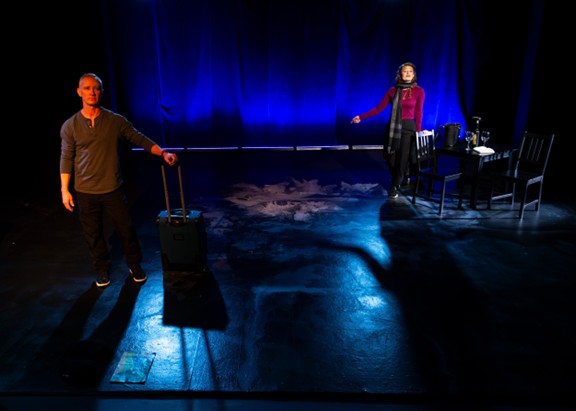
It begins deceptively simply — a minimalist stage, shadows stretching across an almost bare room, the air charged with unease. The absence of clutter sets the tone: something tense, intimate, and faintly dangerous is about to unfold. Mirror Lake opens like a slow shiver, its stillness daring you to look closer. For the first several minutes, the stripped-down setting works perfectly — a psychological mirror that reflects what the characters refuse to confront.
Those characters, Dinah (Juliet Robb) and Phil (Bryan Bradford), are a married couple in a setting somewhere north of Madison, Wisconsin — that kind of remote terrain where even the quiet seems to echo. Their anniversary tradition is as strange as it is unsettling: each year, one designs a mystery for the other to solve — an elaborate psychological game alternating between them. In even years, Dinah gets to choose the mystery she will present to Phil; odd years go to Phil. No previews, no boundaries, no safety nets. What begins as ritual quickly mutates into ritualized cruelty. Their marriage, upheld by performance, thrives not on affection but on interrogation. Pain becomes their love language.
The attraction between Dinah and Phil screams trauma bonding — a loop of need and punishment that binds them together without ever setting them free. What they call romance is really compulsion: two people orbiting their own wounds, unable or unwilling to step outside it.
This is no tender love story; it’s a study in mutual masochism disguised as devotion — a duet of suspicion and control. Fascinating is the premise: how far will two people go to stay connected when curiosity has replaced compassion?
The production’s first act sustains this tension beautifully. The minimalist design leaves just enough negative space for the mind to project its own dread. As the stage gradually fills with props and detail, some of that elegant discomfort disappears. The emptiness, at first so effective, had been doing the heavy lifting — letting space, not scenery, dictate the terms of suspense.
The ritual at the center of Mirror Lake isn’t about discovery so much as domination. Each “game” the couple invents (now in their tenth year together) exposes another fault line in their relationship. They don’t play to entertain — they play to wound, to probe, to test the limits of endurance. Their so-called mysteries function like emotional interrogations: one partner sets the trap, the other must walk willingly into it.
Dietz writes about psychological unease. Beneath the banter lies something unspoken — the sense that daring, and curiosity itself can become cruelty.
Juliet Robb (fresh from Hyde Park Theatre’s Betrayal) delivers an unsettling Dinah. She pivots from tenderness to threat in a breath, like a candle flickering between warmth and warning. Opposite her, Bryan Bradford — known to Jarrott audiences as a director (Seminar, Prodigal Son) — plays Phil with coiled precision. His precise stillness suggests that silence may conceal more than meets the eye. Together, the couple create a rhythm of revelation and recoil, each feeding the other’s paranoia. Their chemistry is undeniable; their disintegration is almost tender.
This marks the Austin directorial debut of Caroline Cearley (Assistant Director on last season’s Dial M for Murder). Suspense is kept at a simmer, not a boil — the right choice for a relationship thriller. If the production edges toward over-explanation at moments, that’s a forgivable temptation when the text is this cerebral.
The show is strongest when it trusts the minimalism it starts with. The first twenty minutes prove how potent absence can be; later embellishments inevitably pull focus outward when this play’s terror is inward.
Mirror Lake isn’t a whodunnit; it’s a what-are-we-doing. The thrill here is the seesaw between reality and unreality, life, and death, sanity, and dream — and above all, paranoia.
If you’re a Lars von Trier devotee — Dancer in the Dark’s habit of speaking every action aloud — you’ll appreciate the method here. Personally, I find too much talk about what is happening removes the tension of what is actually happening and reveals a wee too much about the plot. I’d rather figure that out for myself. But that may be the point: language becomes a trap, a way to avoid feeling by describing it.
About the final reveal: it arrives late, explains a lot, and perhaps explains too much. Did we need it? Would the play have been stronger if it had trusted ambiguity and let the unease stand? These are fair questions some audience members discussed afterwards.
What also feels under-leveraged are the unseen neighbors — figures invoked throughout by Phil and Dinah. We hear about them constantly; they haunt the margins of the story. The invisible Victor character begs for embodiment. A single voice from him offstage might have added connective tissue without spoiling the enigma.
Still an imperfect ending can be provocative. If the goal is to make us interrogate our appetite for reason, Mirror Lake succeeds.
Playwright Steven Dietz is among the most produced living American dramatists, with over forty plays and adaptations staged Off-Broadway, at more than a hundred regionals, and in twenty-five countries; he splits his time between Austin and Seattle. That pedigree shows in the tensile structure and the mordant wit: a thriller’s engine yoked to a philosopher’s questions.
Production Team: Will Gibson Douglas (producing artistic director); David R. Jarrott (founder); Jennifer A. Anderson; Astrid A. Rangel; MacKenzie Mulligan; Kaitlyn Hartnagel; Craig M. Brock; Brooke Sauerwein; Daniel A. Hernandez; Janelle Buchanan; EnHaus Design; Nick Capelle (graphics).
Trinity Street Playhouse, 901 Trinity Street (inside First Baptist Church, Austin TX)
From Oct 16–Nov 2, 2025
Showtimes: Thu–Sat 7:30 p.m. | Sun 2:30 p.m.
Tickets: $15—$35 | Reserve at Jarrott Productions’ www.jarrottproductions.com/mirrorlake