
The making of a great play, or novel, or any art form that is based on words contains several elements: character development; what is said and what is not; expression and movement in three dimensions (in the case of live theatre); and the precision with which the words are delivered. The stage props and setting must also matter — do they inform, distract, contribute, or detract from the actors onstage?
And finally, there’s the audience: does each audience member go away with their own interpretation of the characters’ psychology, motivations, actions, and intentions?
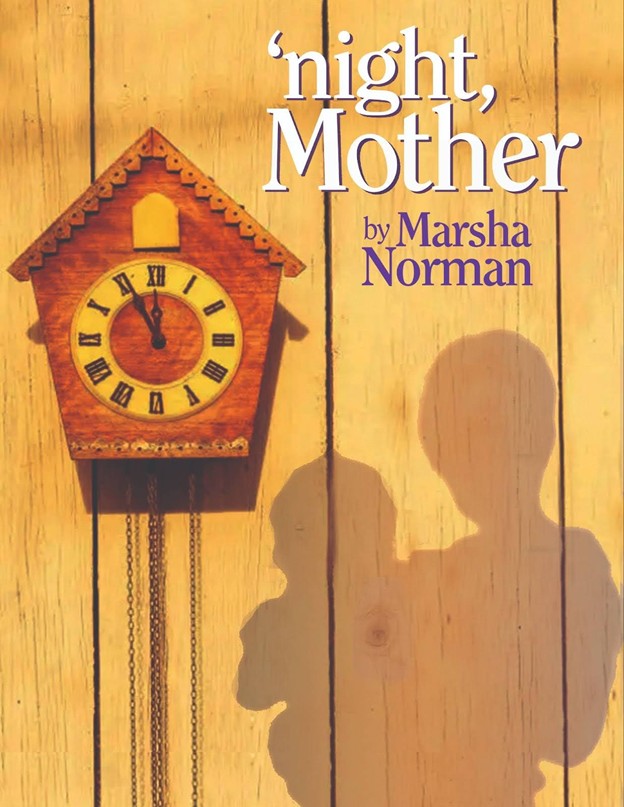
When dialogue, space, and background converge, a play transcends performance and becomes transformation. That’s what happened in The Alchemy Theatre’s production of ’night, Mother by Marsha Norman, produced by Marie Near and directed by Michael Cooper.
The Characters — Gravity and Vacancy
Sarah-Marie Curry as (“Jessie”) and Johanna Whitmore as Thelma (“Mama”) embodied two lives wound around each other like a double helix of dependency and denial. Curry’s Jessie was a marvel of control — calm, deliberate, and frighteningly self-contained. She filled the stage not with movement, but with the weight of intention. Her stoic glances and unmoving expressions conveyed an exhaustion far beyond words. It was a performance of gravitas and extraordinary complexity, her logical precision playing against Whitmore’s volatility.
Whitmore’s Mama was the mirror opposite: a vacuous, almost empty vessel — a woman without curiosity, intellect, or self-awareness, living a dreadfully dull and superficial life. She filled her void with chatter, gossip, and cocoa, mistaking noise for connection. Mama is emotionally unstable, narcissistic, selfish, and terrified of introspection. Jessie compensates for it all — her mother’s dutiful slave, housekeeper, manicurist, and list keeper of to-dos. Together they inhabit a dynamic as old as motherhood itself: one woman performing care, the other performing need, both trapped in the same house of ghosts.
The Whisenhunt’s intimate black-box octagonal setting amplified the claustrophobia. They recreated the set with exquisite accuracy: a small black-and-white television, a rotary phone, a TV Guide, and an orange-and-brown crocheted throw. The kitchen floor gleamed with the wrapping of pink coconut Twinkies, milk in a quart-sized bottle, and labels from a bygone America. Though the play is set in 1981, the details evoked earlier decades — textures that, for me, recalled growing up in the 1960s New York City. Every object was a time-stamped relic from my life. The set wasn’t nostalgia; it was embodiment. An era when ERA was in full swing, but not for every woman, and certainly not for women in the countryside or other states in this country.
The Audience – the Unnamed Third
This play doesn’t let you sit safely in your seat. Its silence pulls you in, forces reflection, and makes you complicit. Afterward, I spoke with several audience members whose reactions revealed the emotional toll.
One woman, who cried through half the performance, confided that her 11-year-old had once voiced suicidal thoughts. “It struck a chord of fear and trepidation,” she said. “Like Mama, I hide fear behind irritation.”
Another woman related to Jessie’s isolation: “I totally relate to her because I have a disability and often felt helpless.” A third viewer took the opposite stance, calling Jessie selfish for her choices, believing Mama was “trying to help, in the best or worst way she knew.” That range of reactions — empathy, identification, judgment — is what the best plays ignite. ’night, Mother doesn’t hand you meaning; it reflects you back to yourself.
Though specific to these two women, ’night, Mother reaches beyond them. It reflects and intensifies our private realities. Our allegiance shifts fluidly — from one woman to the other, then to both — as we recognize fragments of ourselves in each. The play feels like the aftermath of two lives being deliberately disentangled — a lifetime of denial, and endurance condensed into ninety minutes. It is both neat and unbearably messy, like life itself.
I related to Mama’s denial — her blindness to her child’s pain and her own — because my mother lived inside that same avoidance. My brother, who overdosed after years of sobriety, shared Jessie’s quiet recognition of futility. On that level, I related to both characters — yet it was their toxic dynamic that most intrigued me: love warped by obligation, tenderness eroded by guilt and shame. The play left the audience reflecting not only on their unraveling, but on any unfinished business — on how to move forward now that we’d witnessed theirs.
Norman’s text is spare but ruthless — every line a pressure point. The direction was equally disciplined: no indulgent sentimentality, no false catharsis. Curry and Whitmore met the austerity head-on. Their performances existed in perfect tension: one internal, one external. The space between them became the play’s bloodstream. Even the props seemed sentient — the clink of a cup, the lighting of a cigarette — contributing as much as any spoken line. This is theatre reduced to essence: dialogue, space, and background in perfect alignment.
The 1986 film adaptation of ‘night, Mother, starring Sissy Spacek and Anne Bancroft, kept its emotional precision and claustrophobic power. Yet live on a small Austin stage, its impact was something else entirely — personal, communal, and unrelenting.
Marsha Norman once said she wanted to write a play where the tragedy wasn’t a surprise but a decision. This production honored that vision — showing that the most devastating stories often take place within four walls and two hearts. Without revealing its ending here, let it be said that it lands like an emotional trigger — a moment that leaves the audience breathless, stunned into reflection. The conclusion is not spectacle but recognition, a muted implosion that continues to echo long after the lights fade.
In a culture addicted to noise, this was art as stillness — a meditation on endurance, denial, and the catastrophic quiet of misguided love.
What a play. What courage to stage it this way!
Kudos to Sarah-Marie Curry and Johanna Whitmore for their fearless performances, to director Michael Cooper for his unwavering precision, and to producer Marie Near and the entire team of The Alchemy Theatre for bringing such painful truth to life with grace, grit, and honesty.
The Alchemy Theatre’s ’night, Mother runs October 17–26, 2025, at The Whisenhunt at ZACH Theatre, 1510 Toomey Road, Austin, Texas.
Performances are Fridays through Sundays. Tickets are available now through The Alchemy Theatre’s website at thealchemytheatre.org or at the ZACH Theatre box office.
Recommended age is 16+ due to sensitive content.
Parking is available on-site and nearby via Park ATX.
Founded in 2017, The Alchemy Theatre produces theatre for the Austin community that is, above all, honest and true. By telling stories that are meaningful and lasting, the company seeks to create a community of artists and audiences who celebrate the human experience together.