
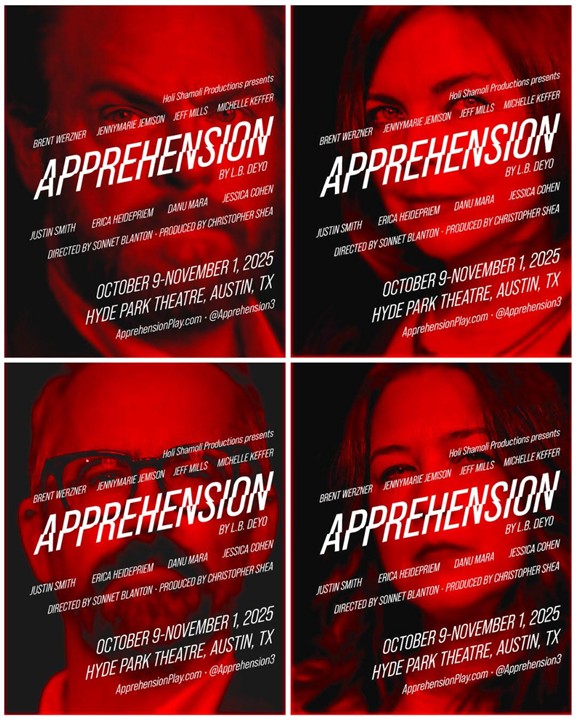
The world premiere of Apprehension, dares to explore the slippery terrain between perception and madness. Even its title carries multiple meanings — fear, comprehension, or the act of being seized — by guilt, memory, or one’s own spiraling mind. That ambiguity is both the play’s fascination and its stumbling block.
Written by L.B. Deyo and directed by Sonnet Blanton, Apprehension centers on Joe, a man unraveling in real time. Portrayed by Brent Werzner with riveting physical and emotional authenticity, Joe trembles, sweats, and convulses through his inner storm with such intensity that one can’t help but wonder how the actor survives this descent night after night. His performance anchors the chaos — the rawness of a breakdown rendered so viscerally it borders on invasion.
Around him orbit figures who may or may not be real — his wife, her friends, and a pseudo-psychiatrist whose intentions blur between help and harm. We see only what Joe perceives, and what he perceives is unstable. The question becomes: are we watching memory, fantasy, or hallucination? The play’s fractured storytelling intentionally mirrors Joe’s disordered mind, though at times the fragmentation feels more confusing than revelatory.
The ensemble — Jennymarie Jemison (Ava), Jeff Mills (Dr. Wozis), Michelle Keffer (Charlotte), Justin Smith (Charles), Jessica Cohen (Katie), Erica Heidepriem (Lisa), and Danu Mara (Woman) — performs with haunting precision. Particularly memorable is Jessica Cohen as Joe’s daughter, who speaks little yet expresses everything through her eyes. Her quiet stillness contrasts sharply with the chaos around her — the one presence that feels unquestionably human.
Yet the world surrounding Joe feels oddly retrograde. The women are portrayed with a 1950s-style passivity — compliant, decorative, and trapped within the orbit of male collapse. Whether this was a deliberate commentary on gender roles or an unexamined carryover from another era remains unclear. The play’s social atmosphere, in fact, evokes a twisted Peyton Place or an episode of Mad Men — suburban perfection cracking under psychological strain. The friends, like philosophical zombies, echo one another’s hollow gestures of empathy while revealing an unsettling vacancy of consciousness. Are they real? Or are they extensions of Joe’s guilt and paranoia?
Visually, the production’s minimalism works; sonically, it falters. The sound design often clashes with the play’s emotional register rather than enhancing it. The choice of “Hail, Hail, The Gang’s All Here,” a jaunty 1917 marching song, jars against the somber tone. It’s unclear whether the dissonance is intentional irony or simply tonal confusion. Either way, it momentarily breaks the tension rather than deepening it.
At nearly two hours — about twenty minutes longer than billed — Apprehension sometimes lingers in its own abstraction, circling ideas that beg for sharper definition. The pacing wavers between urgency and inertia, leaving the audience unsure whether their confusion is part of the design or a byproduct of too many loose threads.
Still, Deyo’s ambition deserves credit. The play tackles the complexities of trauma and mental disintegration with courage. It doesn’t handhold the viewer, nor does it provide comforting resolution. The experience is meant to unsettle — to make us question what’s real, who we can trust, and how easily perception fractures under pressure.
But the lingering question remains: when ambiguity becomes the entire architecture, does meaning slip away? Is the disorientation meant to mirror Joe’s madness, or has the narrative itself lost its compass? In Apprehension, the missing thread may not just be story — it may be the bridge between concept and feeling.
Tickets are $32.00, not including fees & taxes. Thursday evenings are pay-what-you-can. The show runs until November 1, 2025. Chris Shea’s production runs at The Hyde Park Theatre.
Ticketing info and online sales: https://www.apprehensionplay.com