
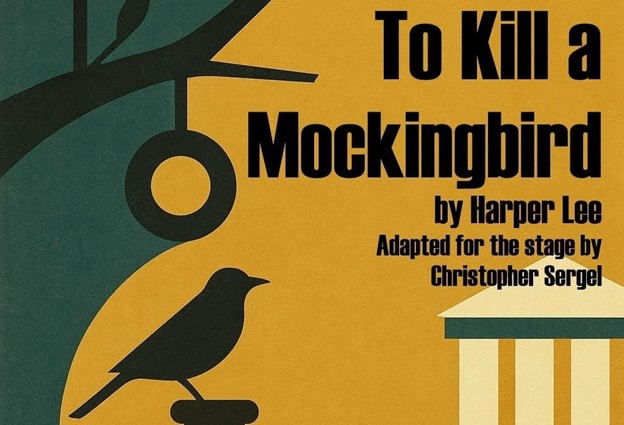
Opening night of City Theatre’s 20th anniversary season was To Kill a Mockingbird. Adapted from Harper Lee’s Pulitzer Prize-winning novel, this is the story and riveting stage production of the seminal American classic about childhood innocence, social inequality, and racial injustice.
Racism, rot, superiority complexes, and good ol’ boy network still haunt the American South, and the new Austin production of To Kill a Mockingbird makes this clear with a fury that feels contemporary. The atmosphere on stage is rigged and rigged again, because it is not merely a historical artifact but a mirror of the present, where such injustices are man-made today by government officials who want blood between the people.
Neighbors’ ignorance and entrenched ideologies, based on nothing at all, drift across the set like a noxious fog. The South’s insistent cruelty hangs like a Confederate flag on the consciousness of those who believe themselves far beyond that mentality. In this staging of Harper Lee’s classic, Maycomb, Alabama, 1935, is no quaint relic but a living indictment.
The production opens with Stephanie Nelson’s Jean Louise Finch, recalling the summer when childhood ended. Through her narration, Scout—played on alternating nights by Rosalind Grace and Dagny Bisett—scrambles across the edge of the stage, barefoot and sharp-eyed, still believing the world can be deciphered by fairness and decency. Harrison Moore’s Jem stands as her shadow, the boy whose idealism begins to crack with each new revelation. Kevin Gates as Atticus Finch inhabits decency not as a costume but as a burden. His courtroom speech lands not like a sermon but like a question he fears he already knows the answer to: who will stand for what’s right when standing has a cost?
Olivia Jamison’s Calpurnia runs the Finch household with warmth and command, but her eyes, often directed beyond the stage, tell a parallel story of the women whose labor upheld white families while their own hopes were diminished.
Roxanne Strobel’s Maudie Atkinson offers humor as a shield and empathy as a quiet rebellion, while Mollie Kirby’s Stephanie Crawford sprinkles gossip like sparks over dry grass. Judith Sloan’s Mrs. Dubose trembles on the porch, morphine in her veins and prejudice on her tongue, a portrait of addiction to both.
Kyle Wilke doubles as Nathan Radley and Boo Radley, shifting from enforcer to phantom with a precision that leaves the audience unsettled. Noah Robbins’s Dill carries the ache of an outsider who senses more than he can say. Brian Price’s Heck Tate, Robert Stevens’s Judge Taylor, and Majesty Trahan’s Reverend Sykes orbit the trial like reluctant planets, their moral gravity never strong enough to pull the town off its course.
Eugene Camren Smith as Tom Robinson stills the theatre. His folded hands seem to carry every generational burden. Across from him sits Chloe Swindle’s Mayella Ewell, trapped between her father’s malice and her own shame. Heath Thompson’s Bob Ewell drips entitlement and desperation, a man too small for his hatred but too proud to let it go. Their confrontation renders the tragedy unavoidable: guilt assigned not by deed but by skin.
Ethan Jude Simpson’s Walter Cunningham, Patrick Schmidt’s Mr. Gilmer, Kendra Franklin’s Helen Robinson, Leon Clinton’s “Big Man,” and Renee Skoog, Emily Ward, and Ieleen Cerda as townspeople embody the collective conscience: fearful, curious, complicit. Their glances and muttered lines show a community that knows the verdict before the trial begins. Director X refuses to let nostalgia soften the edges. Lighting shifts from amber childhood to cold blue judgment; silence becomes a character, louder than the dialogue.
This Mockingbird rejects the safe distance of history. It exposes how easily moral courage curdles into complacency. Atticus’s quiet dignity here is not celebrated but interrogated—does his restraint become another mask for cowardice? In Nelson’s narration we hear the ache of a child who once believed that goodness was enough.
What keeps the story alive is not its plot but its question: how does a community built on decency permit cruelty to bloom unchallenged? The director’s refusal to romanticize Maycomb reminds us that civility can be another name for complicity. The cast’s chemistry sustains the illusion of small-town intimacy while revealing its fault lines. Neighbors greet, children play, church bells toll—yet beneath the hum lies a drumbeat of fear. When Scout finally meets Boo Radley, the audience exhales a relief that feels almost guilty. Redemption arrives, but it is fragile, like the mockingbird Atticus warns not to kill.
By the curtain call, the applause carries a complicated rhythm—part admiration, part discomfort. The actors bow, the lights rise, and Maycomb dissolves, but its ghosts remain seated among us. This production is not just a retelling of a classic but a provocation: a demand to look at who we are, not who we think we were.
Cast Credits
Jean Louise Finch – Stephanie Nelson
Scout – Rosalind Grace & Dagny Bisett
Jem – Harrison Moore
Atticus – Kevin Gates
Calpurnia – Olivia Jamison
Maudie Atkinson – Roxanne Strobel
Stephanie Crawford – Mollie Kirby
Mrs. Dubose – Judith Sloan
Nathan Radley / Boo Radley – Kyle Wilke
Dill – Noah Robbins
Heck Tate – Brian Price
Judge Taylor – Robert Stevens
Reverend Sykes – Majesty Trahan
Mayella Ewell – Chloe Swindle
Bob Ewell – Heath Thompson
Walter Cunningham – Ethan Jude Simpson
Mr. Gilmer – Patrick Schmidt
Tom Robinson – Eugene Camren Smith
Helen Robinson – Kendra Franklin
“Big Man” & Townsperson – Leon Clinton
Townspeople – Renee Skoog, Emily Ward, Ieleen Cerda
The show runs until 19, 2025
Thursday – Saturday, 8:00 p.m. | Sunday, 3 p.m. Genesis Creative Collective, located at 1507 Wilshire Blvd. Austin, TX 78722
Get Advanced Tickets or Make a Reservation