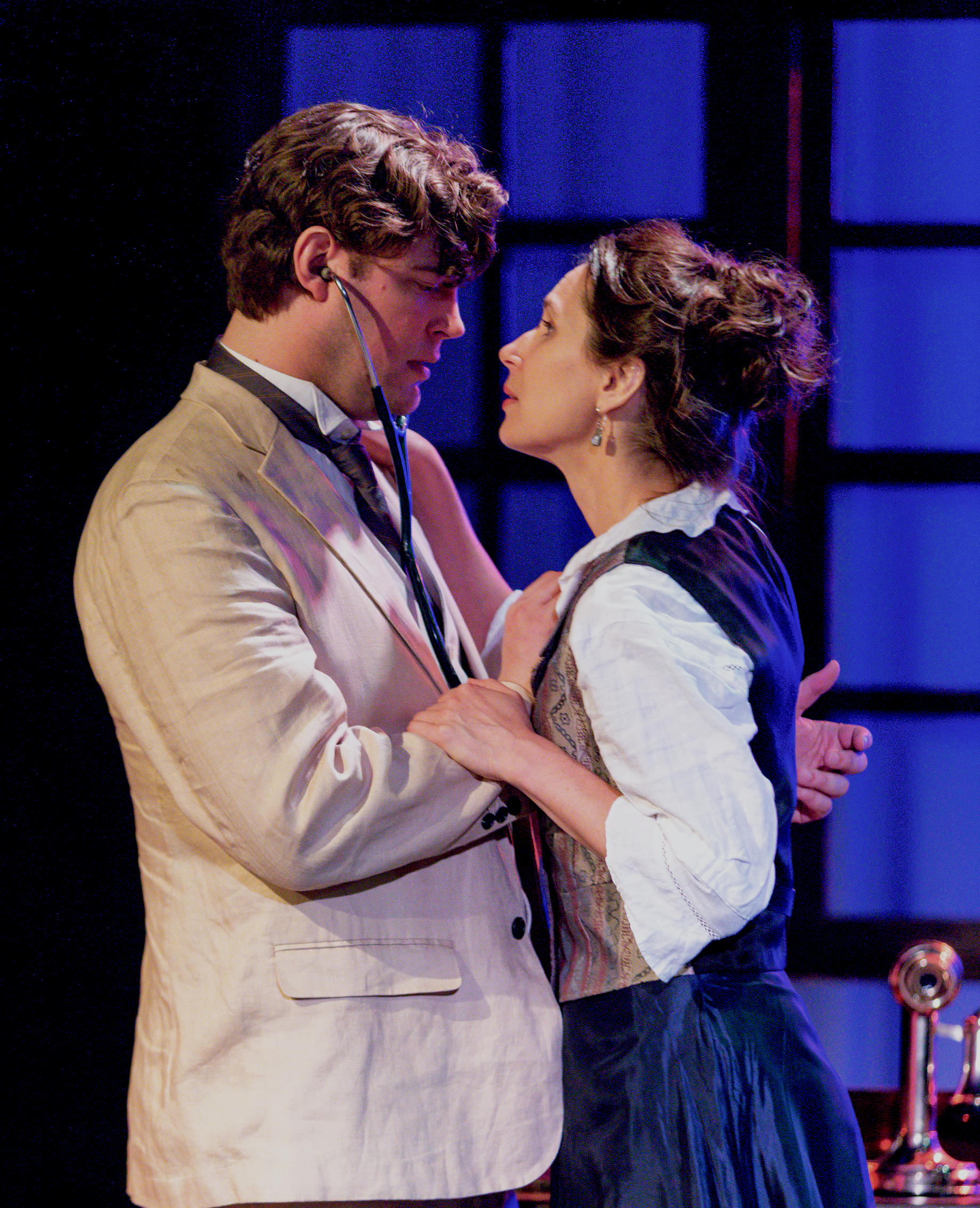
The air in New Orleans hangs heavy, the kind of muggy heat that clings to your skin and thoughts alike. Tennessee Williams felt oppressed by that weight — the suffocating weather, the stifling codes of Southern propriety, and the grinding atmosphere of a mind caught between purity and desire. Out of that crucible came Summer and Smoke (1948), a play of aching restraint.
In the Filigree Theatre’s rendition, directed by Elizabeth V. Newman, lead actor Alma Winemiller, who plays the minister’s daughter, wrestles with the collision of spirit and flesh.
Williams was writing in the long shadow of his own oppressions: guilt over his homosexuality, grief that never left the city, and the rigid morality of his Mississippi upbringing pressing in like iron bars. He lived with an almost claustrophobic awareness that both family and culture wanted him confined to roles that did not fit him or his world view. In New Orleans, the weather was more than mere weather. The fevered humidity was the weight of oppression itself, the sweat of repression, the inescapable reality that passion simmered from a raging boil to a whimper.
In Summer and Smoke, Alma is caught in orbit around John Buchanan Jr., played by the young doctor next door. He is all appetite, flesh, and earthiness, while she lives in air, spirit, and the cage of self-restraint. Their tragedy is not merely that they miss one another, but that they cross trajectories too late: Alma awakens to passion when John has turned toward discipline. The play aches with the truth that human beings are often out of sync with their own deepest longings.
For Williams, the play’s themes weren’t abstract. They were his life. He once wrote that “the human heart is always on trial,” and in his world that trial was conducted under the suffocating eyes of church, family, and the gossiping culture of the South. The climate itself added its own pressure. In New Orleans summers, the heat is not gentle — it overwhelms, it saturates, it oppresses. Williams internalized that weather as metaphor, writing characters who could scarcely breathe under its weight.
It was this atmosphere of oppression — mental, cultural, and meteorological — that gave Summer and Smoke its airless urgency. Alma’s spiritual longings and thwarted desires were Williams’s own. His diary entries from the period speak of yearning and paralysis, of an inner life burning with visions and an outer life hemmed in by expectation. To watch Alma is to watch Tennessee Williams wrestle with himself.
What Williams captured was not simply one woman’s private repression, but a broader cultural disease. The rigid morality that shaped Alma’s world — rooted in a Southern religiosity that demanded silence on sexuality, obedience to patriarchy, and submission to appearances — did not vanish with time. Instead, it metastasized. The same puritanical forces that once policed Williams’s own desires have today given rise to forms of Christian nationalism that repress public and private life.
In the South especially, this legacy of moral rigidity has not only constrained individuals but also stifled growth — morally, philosophically, artistically, and even economically. Where openness could have bred creativity, repression has calcified tradition. Where honesty might have nurtured compassion, denial has spawned hypocrisy. Alma’s suffocation in 1948 is not so distant from the suffocations felt in the South today: a struggle to breathe freely in a climate still heavy with the weight of rigid (some radical) religious beliefs and morality.
Tennessee Williams knew well the slippery terrain of addiction. Alcohol, barbiturates, and even gambling were both his refuge and his undoing, a way to drown the oppressive voices of culture and family, even as they deepened his despair. In the play, John Buchanan Jr. embodies that shadowed world. He is a charlatan, a gambler, a drunk, a lady’s man — and yet he is not a villain so much as a symptom. His recklessness, his indulgence, his defiance are the flipside of Alma’s repression.
Williams understood that when societies smother desire under rigid codes, they do not purify the soul; they drive its hungers underground. And what lives underground returns in distorted forms. John is that distortion — the son of a respectable family who reveals the hypocrisy beneath Southern gentility. He drinks too much, he gambles, he seduces, because he has never been allowed to integrate his appetites into a healthy whole.
Through Newman’s keen direction, Williams suggests, through John, that repression breeds its own monsters. Some people, like Alma, turn the violence inward, suffocating themselves in self-denial. Others, like John, turn it outward, testing limits until they shatter. Neither is free. The tragedy of Summer and Smoke is that both characters — the saint and the sinner — are deformed by the same oppressive culture.
To see the play staged today is to feel those same tremors in the body, especially in a city like Austin where the weather can sometimes echo the swelter of Williams’s South.
The Filigree Theatre’s current production delivers a luminous, heart-rending revival under the direction of Elizabeth V. Newman. Newman’s vision does not update Williams unnecessarily but leans into his lyricism, giving the text space to breathe and suppress in equal measure.
At the center, Kate Glasheen as Alma Winemiller gives a performance of exquisite fragility. Her Alma is not merely prim and repressed; she is painfully human, caught between a fluttering delicacy and a breaking storm. Glasheen’s voice and posture trace Alma’s journey from tightly wound restraint to tremulous confession, until the final moments, when her acceptance of passion comes too late.
Opposite her, Brennan Patrick as John Buchanan Jr. radiates charisma and physical presence. His John is no simple cad but a man carrying his own confusion, one who embodies flesh not because it is easy, but because spirit has failed him. The chemistry between Glasheen and Patrick simmers — always a half-beat away from ignition, always shadowed by inevitability.
The supporting cast fills Williams’s Mississippi town with texture and tension. Allison Paranka as Nellie Ewell offers a vibrant counterpoint to Alma’s restraint — youthful, lively, and unburdened by shame. Michael Morse doubles memorably as both Roger Doremus and the Reverend Winemiller, embodying both the romantic rival and the oppressive father. Idelisse Collazo as Rosa Gonzales infuses the play with a raw sensuality, and Shannon Grounds as Mrs. Bassett provides comedic relief laced with sharp social …
Other cast members — Michael C. Costilla, Meredith O’Brien, Beau Paul, Devon Ragsdale, Chase Bolnick, and Bryan Headrick — round out the ensemble, ensuring that every corner of Williams’s world feels inhabited, every side glance or whispered remark contributing to the web of gossip and expectation that closes in around Alma.
Elizabeth V. Newman’s direction deserves particular praise. She leans into the play’s lyricism, staging it like a symphony of repression. Silences stretch, heat rises, and the unspoken is given as much weight as the spoken. The staging captures not only the central romance but the atmosphere of a society pressing down on individuals, the way Williams himself felt pressed and stifled in his New Orleans years. Newman seems to understand that Summer and Smoke is not just a drama between two people.
Seen in 2025, the play resonates in unexpected ways. Alma’s journey speaks to anyone who has felt oppressed by circumstance, denied their desires by timing, culture, or fear. The Filigree Theatre’s production makes Williams’s confession our own. The audience breathes the same heavy air, feels the same ache of yearning delayed, and walks away haunted by Alma’s voice.
Summer and Smoke is more than a period piece. It is a reminder that desire, denied too long, becomes smoke that chokes; that the human spirit, pressed too tightly, either cracks or soars. And under Newman’s direction, the play’s voice is as alive as the cicadas in a Southern summer, insistent, restless, unforgettable.
filigreetheatre.com for tickets and information. The show runs until October 12, 2025.
Location:
The Linc (Kid’s Theatre next to AFS Cinema) 6406 North Interstate Highway 35 Suite 2150
Photo credit: Steve Rogers Photography