
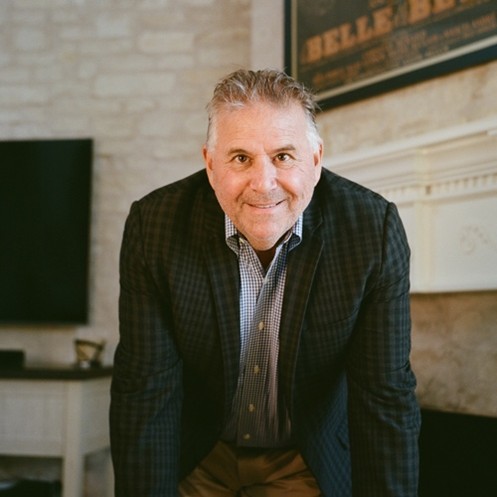
Ralph Yznaga never seems to lose his sense of curiosity. When he talks about creativity, it’s with the spark of a lifelong experimenter, someone who still believes imagination is the best business plan. Sitting in his Austin office surrounded by Edible Austin back issues and glowing laptop screens, he laughs at the notion of slowing down.
At sixty-five, Yznaga is not retired — he’s reinventing. After decades in marketing, publishing, and storytelling, he has turned his attention to the next big frontier: helping others, especially older professionals and small business owners, understand and embrace artificial intelligence.
““People are terrified of AI, but they shouldn’t be,” he says. It’s just another tool, like Photoshop, or a pen. It won’t replace creativity; it extends it.”
He’s begun advising longtime clients and colleagues on how to integrate AI into their work. Some are real-estate developers, others are consumer products, and health providers. Through his company, ATX Nation, he creates social media strategies, newsletters, ad campaigns, and everything else increasingly with AI’s help.
“I use AI for almost everything now — planning, copywriting, newsletters, social, visuals, even ad concepts,” he explains. “It saves my client’s time, and I can deliver big-agency quality to small businesses that could never afford that level of service.”
Unlike many in his generation, Yznaga doesn’t see AI as something to resist. He sees it as a partner in discovery. “I don’t call myself a teacher,” he clarifies. “I’m learning right alongside my clients. We’re experimenting together.” His process is collaborative and open-ended. “When we use AI,” he says, “we’re not asking it to do our work. We’re asking it to expand what we can imagine.”
He is considering developing webinars and a course on AI for small businesses and creative professionals, but those projects are still taking shape. “I don’t have anything formal yet,” he says. “But I want to share what I’ve learned — especially with people my age who think this technology isn’t for them. It is.”
“AI isn’t replacing people,” he says. “It’s making people think differently.”
His creative philosophy has always been rooted in storytelling. Before AI became the new frontier, he was already building bridges between communication, design, and human connection.
After twenty years in New York’s advertising world and another decade in Austin agencies, Yznaga and his longtime friend and business partner Monique Threadgill bought Edible Austin magazine in 2019. The magazine, part of the Edible Communities network, was a local institution — celebrating Central Texas food, farms, and culture.
“We had no idea what we were doing,” he recalls, laughing. “We’d both been in marketing forever, but publishing was another universe. Still, we thought, well, storytelling is storytelling. We’ll figure it out.”
They did. Edible Austin is a vibrant showcase for local farmers, wineries, breweries, restaurants, and food artisans — the people behind the food movement that defines the region. Yznaga and Threadgill brought their advertising instincts to a community-driven publication, blending business sense with creative vision.
Then, just months after they took over, the pandemic hit.
“We bought the magazine in December 2019,” he says. “By March, everything stopped. We lost every advertiser within weeks.”
Instead of folding, Yznaga and Threadgill turned their magazine into a community hub. “We started posting lists of small businesses that needed help,” he says. “Black-owned restaurants, breweries still selling online, farmers who could deliver. We just kept publishing, because that’s what people needed — connection.”
The effort wasn’t just survival; it was purpose. “We realized the magazine mattered more than ever,” Yznaga says. “People wanted stories of hope and resilience. They wanted to know their community was still out there.”
In 2021, they expanded, purchasing Edible Houston and Edible San Antonio. Suddenly, they were producing three editions — a regional ecosystem of food storytelling spanning Central to South Texas.
“If one magazine was hard, three were impossible,” he says, laughing. “But we made it work. We could give advertisers visibility across multiple cities — wineries, markets, restaurants — all with the same shared values.”
Each magazine had its own voice, but the mission was consistent: to highlight the people who fed their communities. Yznaga speaks fondly of the writers and photographers who made it possible. “They didn’t do it for money,” he says. “They did it for love-of-story. They were professionals with heart.”
Outside publishing, Yznaga continues to run ATX Nation, the marketing company he started over a decade ago. His work ranges from social media management to PR, ad design, newsletters, and digital branding. “Whatever a client needs,” he says simply. “My partners and I do the full-course of marketing/advertising/pr including billboards, flyers, websites, events, press releases, etc.”
What sets his work apart is flexibility. “Small companies can’t afford big ad agencies,” he explains. “So I bring them agency-level results without the cost. I do it in partnership with my clients — writing, design, graphics, strategy — and now AI makes that even more efficient.”
He emphasizes AI doesn’t replace human intuition. “You still have to know your audience,” he says. “AI can give you data or drafts, but you have to provide the judgement and execution.”
Yznaga has also integrated AI into his interns’ work. “They’re required to use it,” he says. “Every assignment involves AI because that’s the world they’re entering.”
Talking with Yznaga, what stands out is not his technical skill but his mindset. He approaches technology like an artist confronted with a blank canvas — curious, not intimidated.
He has no patience for those who see technology as the end of creativity. “It was a common belief in the late 19th century that the typewriter would ruin the art of writing,” he says. “AI is a tool — no different than a camera or a typewriter. What matters is how you use it. I love watching people light up when they realize oh, I can do this too.”
For Yznaga, AI represents not a break from his past but an extension of it — another chapter in a lifelong story of adaptation. From New York ad campaigns to Texas food magazines to AI consulting, every shift has been guided by the same instinct: stay curious, stay relevant, stay creative.
When asked what drives him after so many pivots, he smiles. “I still get excited by ideas. That’s what keeps me going.”
For Ralph Yznaga, that’s the future: not machines replacing artists. He says, “AI is another kind of storytelling partner. And storytelling — that’s never going away.”