
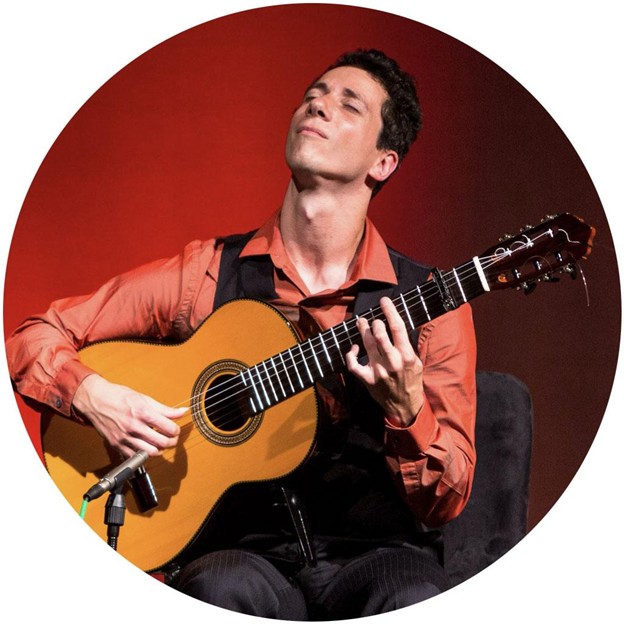
Robert Rodriguez, the legendary Austin filmmaker, opened his Troublemaker Studios for ACG’s 35th Season. They filmed Alita: Battle Angel there. At the open-air set, I felt as if I was roaming the streets and alleyways of a fading, long-forgotten town in Spain. We savored complimentary sangria and paella from Flavor Co. and saw live performances by the Austin Flamenco Academy (see photo below) and music by Mariachi de Oro from Crockett High School’s band before the main act: Grisha.
As ACG traditionally does, we heard from the youth first. The ACG Youth Orchestra, directed by Alex Lew strummed in unison a cacophony of guitars that sounded like a full-throated orchestra. Arranged and conducted by ACG’s passionate Joe Williams, their performance exceeded all expectations and we wish them success every next step of the way in their musical careers.
The Program
Grisha stared the set with Malagueña de Lecuona, by Paco de Lucia. Next up was Ímpetu (Bulerías) by Mario Escudero, then Los Caireles (Zapateado) by Manolo Sanlúcar. Guajiras de Lucía (Guajira), also by Paco de Lucía and Aires Choqueros, Monasterio de Sal, La Barrosa and Almoraima. There were two more numbers, Ventanas al Alma by Vicente Amigo and Piedras Negras by Gerardo Nuñez. There was a standing ovation and Grisha performed an additional number for the enthralled audience.
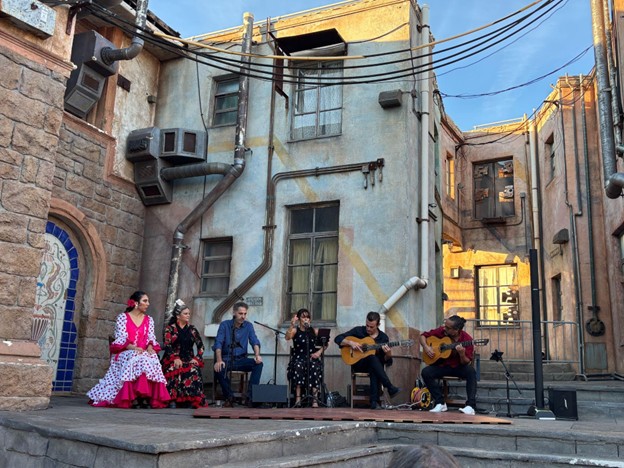
After years of listening, I’m still fascinated by flamenco musicians’ incredible speed and precision. How complex flamenco guitar is with its multiple 5×7 rhythms, drumming-like taps on the body of the instrument, various chord changes all the while creating what is ten different melodies going on simultaneously.
For most of the performance, I needed to close my eyes to hear better every note and chord. In my reverie, what did I hear and see Grisha say through his guitar?
Sad notes wafted across the Tabernas Desert as one lonely man trudged along to find his way back to his homeland. Exiled and forlorn, he gathers enough courage to make the trek, as thirsty for water as he is for life.
Sunrise at dawn, the orange and red hues peek through the wash hanging out of the windows in the barrio’s alley. A woman reminisces in a daydream about her lover, who works in another city to make ends meet. While children played in the courtyard, laughing in the concrete heat of the morning, little hibiscus, and birds of paradise brought color to yet another dreary day.
And then the thunderous applauds shakes me out of these visual vignettes and I too find myself in rapture.
Grisha is one of the great flamenco virtuosos. And he’s of Russian and Ukrainian roots! As there are no coincidences in life, I found myself enchanted yet again by an ACG performance for several reasons. Recently I began learning Spanish and while hanging around with my Mexican-born friends, asked them to stop speaking English with me. My ancestral roots are Russian. When I first learned acoustic guitar at 6 years old, I studied flamenco until I was 12. So there you have the background.
It seemed unusual that Grisha Goryachev, born in St. Petersburg in 1977, was attracted to flamenco. Descended from Russian and Ukrainian roots, his lineage was worlds away from Andalusia’s sunbaked plazas where Romani musicians shaped flamenco centuries ago. Yet from the moment he first heard Paco de Lucía perform, the spark leapt across continents and caught in the heart of a young boy. He ran home after that concert and begged his father—his first teacher—to show him how to summon such sound from six strings.
His apprenticeship was old-world in its devotion. Guided by his father, Dmitry, a Segovia devotee, Grisha learned less by written notes than by touch—his father’s hand shaping his fingers against the guitar until technique and tone became second nature. During a time when people smuggled flamenco recordings into the Soviet Union like contraband, a father, and son painstakingly recorded every passage they found. What began as imitation turned into mastery, and soon the boy from Russia kept pace with his hero Paco.
By his teens, Grisha already astonished audiences with a precision that never sacrificed beauty for speed, and people knew him as a prodigy. An invitation to play for Paco de Lucía himself at his Madrid home sealed his destiny. Paco recognized in him the rare mix of talent and dedication, and later, in a gesture of generosity, wrote the recommendation that allowed Grisha to immigrate to America. In Boston, he studied with virtuoso Eliot Fisk, who helped him shed his shyness and risk vulnerability on stage. It was during those years that his playing transformed from flawless to fearless.
Today, Goryachev is one of the few artists keeping the tradition of solo flamenco guitar alive at the highest level. He has performed in over 30 countries, dazzling audiences with rasgueados like sheets of fire and tremolos that melt into air. Yet beyond the fireworks lies his greatest gift: an honesty that pulses through every note. Each performance is a high-wire act—sometimes triumphant, sometimes precarious—but always suffused with passion, daring, and soul.
https://austinclassicalguitar.org/ for season tickets, programming and information
second photo: The Austin Flamenco Academy; Photo credit: Elise Krentzel