
Once a Eurovision cynic, I walked out of ABBA Voyage stunned, converted, and grateful for the wake-up call.
About 49 years ago, in Tokyo, I first heard ABBA. I wasn’t impressed. Eurovision pop felt too sugary for my taste — bubble‑gum melodies piped into elevators or blasted in arenas where people stomped in flat one‑four time with zero nuance.
Meanwhile, the Swiss guy I was dating worshipped them. I was in the music business then, getting stacks of LPs, branded jackets, and three tickets to almost every show that came through town. One day he made me an offer: “If you give me your ABBA tickets, I’ll buy you anything you want.”
“Fine,” I said. “I need a kitchen table and two chairs.”
Done deal. I walked away with furniture; he walked away with the tickets. At the time, it felt like a perfectly rational trade: let the fanboy have his glittery pop night, I’ll take somewhere to eat my dinner.
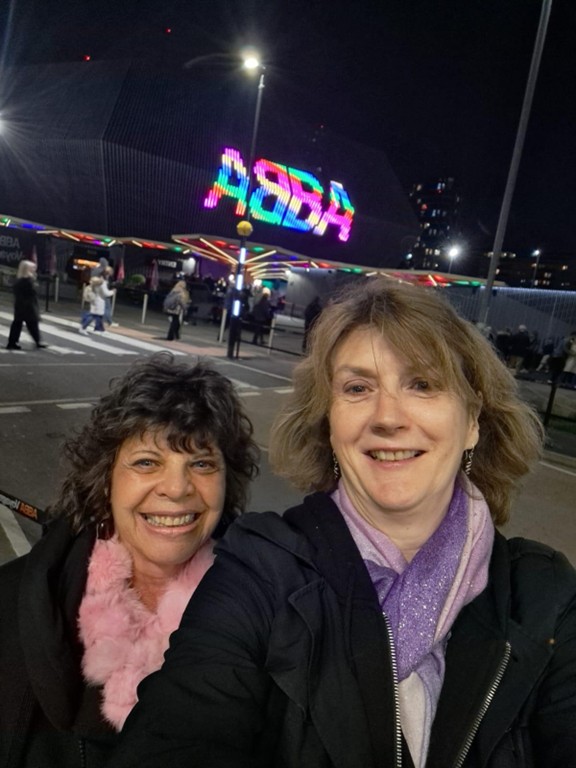
Fast‑forward to October 24, 2025 in London, decades later. A crisp autumn night. My friend Emma — whom I met 25 years ago when we were both living in Amsterdam — and I stepped off the Tube at Pudding Mill Lane and into a different universe entirely: the ABBA Arena, a venue that didn’t exist a few years ago and now stands as a monument to what happens when nostalgia collides with bleeding‑edge technology.
Even if you never considered yourself an ABBA fan, their songs have a way of infiltrating your life. Mamma Mia, SOS, Waterloo, Knowing Me, Knowing You, Dancing Queen — they seep into supermarkets, taxis, weddings, radios, bad cover bands, and your subconscious. They become part of your internal jukebox whether you like it or not.
A Venue That Breathes Color
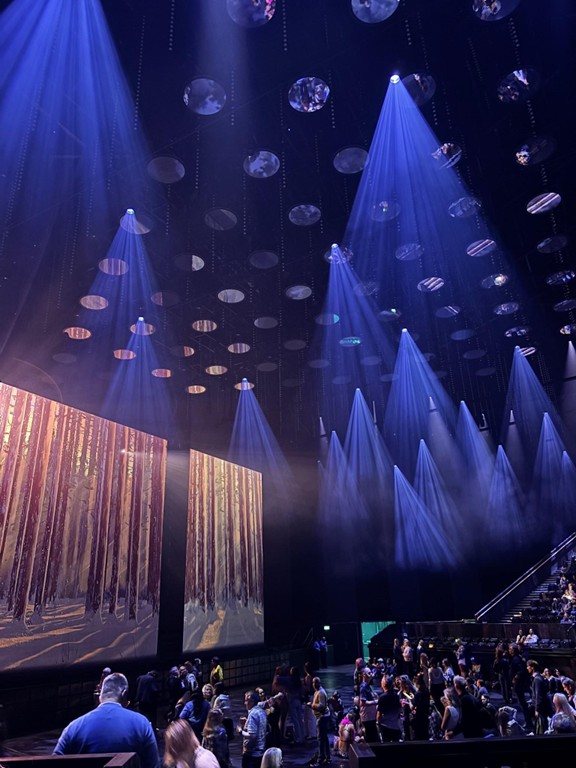
Walking into the ABBA Arena feels less like entering a concert hall and more like stepping inside a living, humming machine made of light.
The space is bathed in shifting color: deep violets pooling across the ceiling, streaks of sapphire and indigo cutting along the walls, warm ambers rippling around the balconies, gold slicing across the stage like sunrise, emerald sweeps rolling through the audience. Nothing is static. Every hue seems tied to an emotional beat in the music.
These colors don’t just decorate the show; they storyboard it. As tempos rise, the palette sharpens and intensifies. When the set dips into melancholy, the light softens, washes out, or dissolves into blues and silvers. The arena doesn’t just host the performance — it reacts to it. It feels, quite literally, like the building is breathing along with the crowd.
The Voyagers — The Live Band Behind the Magic
For all the talk about holograms and artificial intelligence, the heart of ABBA Voyage is human. Tucked into the staging is a live band known as The Voyagers, and they deserve just as much applause as the digital avatars.
The Voyagers include guitarists, a bassist, a drummer, keyboard player, strings, and backing vocalists — a rotating group of top‑tier musicians who keep the music grounded and alive. Their playing gives grit to the rock‑leaning numbers, warmth to the ballads, and real‑time energy that a backing track alone could never replicate.
They handle the riffs, fills, and harmonies with the kind of confidence that tells you they’re not just following a click track; they’re inhabiting these songs. Without them, this would be a clever tech experiment. With them, it’s a full‑blooded concert.
A 3‑D World You Don’t Watch — You Enter
People keep calling ABBA Voyage a “hologram show,” which is technically true and completely misleading.
What unfolds on that stage is not a flat projection. It’s a fully engineered 3‑D world.
The four ABBA members appear as digital avatars — younger versions of themselves, rebuilt using motion‑capture performances and CGI. Industrial Light & Magic, the company behind Star Wars and half your sci‑fi childhood, captured the band in mo‑cap suits and transformed their movements into lifelike “ABBAtars.” These figures appear on a colossal ultra‑high‑resolution screen that wraps into the stage design so seamlessly you stop thinking about what’s “screen” and what’s “real.”
Hydraulics silently raise and tilt parts of the stage. LED panels slide into place and then vanish, becoming portals rather than props. At times the “screen” feels like a window into another era; at others it feels like the walls of the arena have dissolved and you’re floating in a cosmic disco cathedral somewhere between 1977 and a future we haven’t quite invented yet.
The visuals tell their own story. One moment you’re in a classic concert setting: lights, band, crowd. The next, the ABBAtars are framed in a shifting universe of stars, geometric patterns, and imagined landscapes. During certain songs, the imagery drifts into full‑on sci‑fi fantasy — ships, galaxies, shimmering cosmic dust — yet it never feels like gimmickry. It’s more like a subconscious narrative running parallel to the music, turning each track into its own little universe.
Crucially, this world feels dimensional. The lighting designers use beams, haze, and layered depth so that objects don’t just sit “on” the screen — they seem to extend out into space. At times even the panels themselves appear to reach towards you, gripping your peripheral vision and pulling you into the scene. There was only one fleeting moment when a gesture or angle broke the illusion and reminded me I was looking at an image. The rest of the time, my brain happily accepted that ABBA was right there, on that stage, singing to us.
The Setlist: A Time‑Traveling Mixtape
The show runs about an hour and a half with no interval, and it’s wall‑to‑wall music. No monologues. No indulgent breaks. Just one song after another, stitched into a carefully plotted emotional arc. On our night, the set included:
1. The Visitors
2. Hole in Your Soul
3. SOS
4. Knowing Me, Knowing You
5. Chiquitita
6. Fernando
7. Super Trouper / Take a Chance on Me (rotating slot)
8. Mamma Mia
9. Does Your Mother Know
10. Eagle
11. Lay All Your Love on Me
12. Summer Night City
13. Gimme! Gimme! Gimme! (A Man After Midnight)
14. Voulez‑Vous
15. The Name of the Game
16. Don’t Shut Me Down
17. I Still Have Faith in You
18. Waterloo
19. Money, Money, Money
20. Thank You for the Music
21. Dancing Queen
22. The Winner Takes It All
What struck me wasn’t just the hits themselves — it was how physically embedded they are in the audience. You could feel it. People around me weren’t just singing along; they were accessing memories. Weddings, breakups, road trips, bad discos, better discos, childhoods, parents, kids. Every chorus pulled up some private little film reel in people’s heads.
Because ABBA Voyage only exists in London, the audience comes from everywhere. Behind me: Germans. To my left: Hungarians. In front: Italians. Brits scattered all around. You feel like you’re standing in a strange, glittering United Nations of ABBA fandom.
And they dress for it. There were thousands of people done up in ’70s‑style sequins, flared pants, fringed jackets, platform boots, glitter eyeliner — myself included. It was like walking into a mass costume party where everyone already knew the soundtrack.
The atmosphere before the show even started felt charged, like a festival compressed into a single building. By the time the first song kicked in, the energy level was already set to “euphoric.”
The Turning Point
Here’s what I didn’t expect: emotional whiplash.
I went in the door with my old story running in the background — the scrappy Tokyo journalist who once traded away her ABBA tickets for a kitchen table and two chairs, a person who saw ABBA as pleasantly disposable pop. I walked out feeling like I’d just attended a futuristic ritual devoted to memory, music, and the very human need to feel something together.
The show didn’t convert me into an unquestioning ABBA disciple. It did something more interesting: it forced me to admit how deeply their songs had embedded themselves into my life anyway. How much of our shared cultural fabric is woven out of things we once claimed to dismiss?
By the time Dancing Queen exploded across the arena, with the dance floor bouncing, lights going full kaleidoscope, and the ABBAtars moving with impossible youthfulness, I stopped analyzing. I just danced. When The Winner Takes It All arrived near the end, it hit with the weight of a closing chapter — not just in the show, but in the long private argument I’d been having with ABBA in my own head since the 1970s.
Sometimes you don’t realize a story’s been running for 50 years until something — or someone — writes the last act.
Practical Details: If You Go
ABBA Voyage takes place at the ABBA Arena in East London, near Pudding Mill Lane DLR station, close to Queen Elizabeth Olympic Park. The arena was purpose‑built for this show and seats roughly 3,000 people per performance, with a mix of seated sections, dance‑floor standing, and private “dance booths.”
The show runs about 90 minutes with no interval. Multiple performances are scheduled each week, and many dates sell out well in advance.
My advice? If your body can handle it, book the dance floor. This isn’t a night for sitting politely with your hands in your lap. It’s a night for surrendering — to the lights, the sound, the shared memories, and the strange fact that sometimes the pop you once sneered at ends up becoming part of the architecture of your own life.
Decades ago, I traded away my ABBA tickets for a kitchen table and two chairs. In London, standing in that arena with Emma, glitter on my outfit and tears pricking the corners of my eyes, I finally got my show.
Tickets, dates, and full details are available at: www.abbavoyage.com
Lead photo by E. Krentzel
second photo:
Me and my friend Emma arrive in our glittery outfits