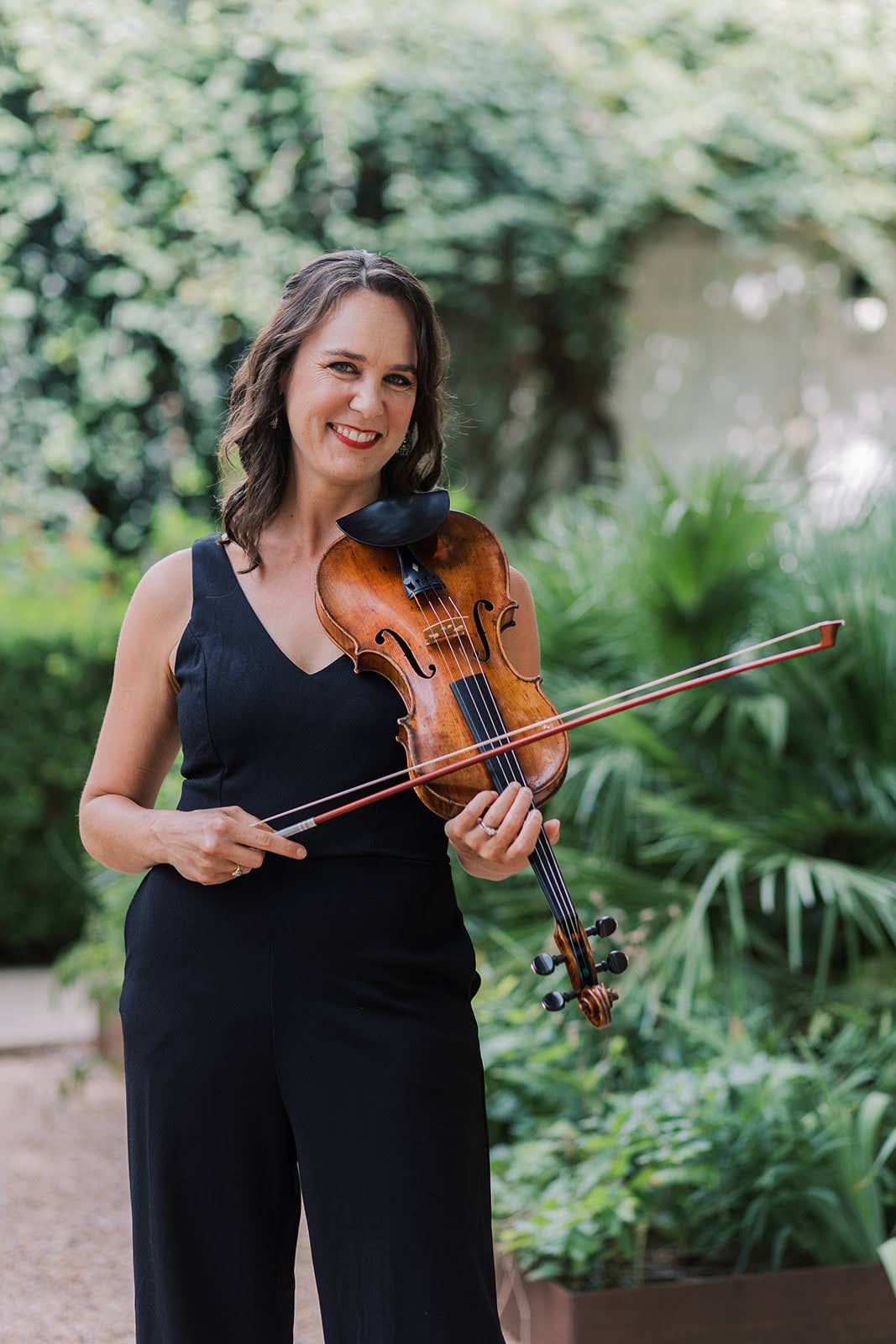
When I first met violinist Alexis Buffum, she appeared calm, grounded, and quietly radiant—the kind of musician whose artistry doesn’t shout but hums with depth. Behind that calm exterior lies a fierce curiosity: a violinist who refuses to be boxed into a single genre or tradition, a woman who has turned musical exploration into both vocation and calling.
Buffum’s path began on the narrow road of classical education but widened almost immediately. “I did the normal university music school education,” she told me, “which for the most part is restricted to classical playing—your normal orchestra, symphony, solos. But once I got to college, there was all this other music available. I couldn’t help it.”
As she describes it, her professors at Florida State University didn’t exactly approve of her wanderings. “They thought it distracted from what we were working on. But I was taking Irish ensemble, jazz, voice lessons—everything I could.” She laughs, recalling the tension between youthful appetite and academic focus. “You can’t do it all, they said. I wanted to try everything.”
It reminded me of someone who’s been starving and then discovers food for the first time—savoring each new taste, unsure which flavor will become her favorite.
Buffum grew up in Daytona Beach, far from the eclectic musical smorgasbord of Austin where she now thrives. “I didn’t see live music besides the occasional orchestra concert,” she says. “We didn’t have a symphony in town, but the London Symphony Orchestra made Daytona Beach their summer home. Every two years they’d come, and I’d get two weeks of amazing performances. Then, the rest of the year—nothing.”
She shrugs at the memory. “I didn’t grow up in a town like Austin at all.”
### From the Conservatory to the Crossroads
After graduating from Florida State, Buffum moved to Austin for her master’s at the University of Texas, continuing to balance discipline with curiosity. She joined jazz ensembles, took lessons with pianist Jeff Helmer, and explored what her professors still called “alternative styles.”
Her parents worried. “They were concerned because it’s hard to make a life as a musician,” she admits. “But I’m glad I followed my heart. I get to do a little bit of everything now—and I didn’t have to commit to just one thing.”
Those “little bits of everything” have evolved into a dazzlingly versatile career. Since moving to Austin twenty-one years ago, Buffum has performed with Stevie Wonder, Wynonna Judd, Smokey Robinson, Kristin Chenoweth, Josh Groban, Willie Nelson, Frank Sinatra Jr., and Andrea Bocelli. Her film credits include Mud, Bernie, Loving, Sister Aimee, Where’d You Go, Bernadette?, Their Brand Is Crisis, and Life in a Day. Onstage, she’s performed at Austin City Limits alongside Adrian Quesada of the Black Pumas for Boleros Psicodélicos, and she’s recorded with groups including Okkervil River and Paula Nelson.
In addition to performing, she has worked with Austin Opera, the Austin Symphony, the Central Texas Philharmonic, and the Austin Chamber Music Center, both as performer and educator. More recently, she’s scaled back orchestra work to focus on recording, events, and new creative projects. “I even dance and play violin with the Sienna String Quartet,” she says, grinning. “And I’ve added a pedal setup so I can loop or alter my sound—mostly for Graham Reynolds’ shows.”
### The Long Collaboration
Buffum speaks of Reynolds with both admiration and affection. “We’ve worked together for 17 years,” she says. “We’ve done Ballet Austin shows, Forklift Danceworks productions, all kinds of adventures. Graham’s a chameleon—he can write for film, ballet, anything. He nails it every time.”
I first heard Buffum’s name after a Ballet Austin performance scored by Reynolds. “The music was the best part,” I tell her, recalling that night. “I wasn’t a fan of the ballet itself, but his score carried it.”
She nods, laughing. “That show was unique because it combined live players and electronic tracks. It was the first time we’d done something that big—maybe fifteen musicians, all syncing with prerecorded material. It was wild. When it’s just our small team—four or five of us—we can follow Graham’s lead easily. But with a big ensemble, it’s a challenge.”
Seventeen years on, Buffum is still part of what she calls “the Graham Reynolds Band.” “Sometimes he doesn’t need violin,” she says. “Sometimes I’m busy. But we’ve done so much together. He gave me an outlet for all these musical experiments I’d been storing up.”
### Teaching, Parenting, and the Rhythm of Austin
Buffum balances her professional life with teaching. “I spend about half my time teaching and half performing,” she says. She runs a studio of twenty violin and piano students, guiding young musicians through both classical foundations and creative exploration. “Some of my students are natural improvisers. We write songs together. It’s so fun to explore.”
Her enthusiasm for cross-genre learning extends to her teaching philosophy. “Classical is where you learn technique,” she explains, “but I encourage them to try everything. I like to sample the menu.”
That metaphor resonates with me. In art, as in music, focusing on a single discipline can be limiting. I told her: “Whether it’s surrealism or pointillism, it’s only one point—a point of departure, not the destination.”
She smiled. “Exactly.”
Buffum’s curiosity has clearly rubbed off on her son, an eleven-year-old drummer and pianist. “He’s learning Radiohead and Beethoven,” she laughs. “I waited for him to ask me to teach him piano. I didn’t want to force it. When he was five, it didn’t work. But later, he wanted to learn. Now he’s soaring.”
As a mother and teacher, Buffum knows the delicate balance between exposure and pressure. “Sometimes a parent wants the child to play because they did, or because they never did,” she says. “But music shouldn’t be forced. It’s great for the brain, but not everyone needs to do it.”
I mention my own son’s brief violin, clarinet, and drum phases—the challenges of practice, the push-and-pull between parental encouragement and autonomy. She listens closely. “You did the right thing,” she says. “You let him explore.”
### A City Changing Its Tune
Buffum has witnessed Austin’s metamorphosis from quirky haven to booming tech capital. When I ask what she wants to preserve, her expression turns serious.
“I’ve seen musicians leave because it’s too expensive to live here now,” she says. “Post-COVID especially. I was lucky—I kept my students on Zoom—but a lot of performing friends couldn’t make it.”
I note how in New York, when one borough becomes unaffordable, artists migrate to another. “Exactly,” she agrees. “But here, it’s different. Yes, people talk about Lockhart or Bastrop, but there’s not one central hub or infrastructure for artists. That’s what’s missing.”
She’s particularly candid about Austin’s most famous music festival. “South by Southwest is great for tourism and exposure,” she says, “but most musicians hardly get paid. There’s been a push to change that, but we’re not there yet.”
Her comment hits home. I tell her how, as a New Yorker, I find it outrageous that so many Austin clubs pay little—or nothing—while branding themselves as music-centric. “In New York, no one plays for free,” I say. “You either get a fee or a percentage of the door. You can’t live otherwise.”
Buffum nods. “Classical musicians are a bit protected—weddings, orchestras, those have fixed rates. But for bands or jazz gigs, it’s tough. Friends of mine at the Elephant Room, they’re making far less than a classical player earns for the same hours.”
### The Royalty Gap
Our conversation turns to royalties—an issue that clearly frustrates her. Buffum has recorded for major films and albums, yet royalties are rare. “Sometimes I don’t get any,” she admits. “It’s not mandatory. Labels say they don’t have to pay performers. They call them ‘mechanical royalties,’ but we end up with nothing.”
I press the point: isn’t that what unions are for?
“I joined the musicians’ union for a few years,” she says. “They tried to help, but there’s only so much they can do. You can use their contracts, but the production has to agree to sign—and many won’t. I was told, basically, you either do the gig or you don’t.”
I can’t help reacting. “If they’re a union, isn’t that their job—to protect you?”
She sighs. “It’s complicated. Some of the big studios just refuse. But our local Austin union has done good work lately. For example, the Austin City Limits Moody Theater is under a contract that guarantees royalties to performers for livestreamed shows. That’s huge progress.”
Years ago, I was a songwriter myself. Of course, I received royalties—no one would imagine not paying a composer. “Exactly,” she agrees. “Composers are always protected. Performers, not so much.”
Despite the inequities, she stays optimistic. “I love my students,” she says. “They keep me grounded. Performing can be feast or famine, but teaching gives balance.”
### The Next Movement
So what’s next for this multi-genre crossover gal? “I’ve never done a project completely on my own,” she says thoughtfully. “I’m a collaborator. But now I’m setting up to record at home. I’d like to start composing—something with piano, violin, and viola. In ten years, I hope I have my own music out there.”
I can’t resist quipping, “I hope it sounds good.”
She laughs. “I hope it sounds good!”
It undoubtedly will. Buffum’s career has been one long improvisation, a melody shaped by instinct, open ears, and courage. In a city that calls itself the Live Music Capital of the World, she stands as a quiet emblem of what that phrase really means: adaptability, dedication, and the endless urge to keep creating.
For now, between teaching, performing, and raising her son, Alexis Buffum continues to live the life of a modern Austin musician—anchored in craft, open to everything.
Or, as she might put it: always ready to sample the next dish on the menu.