
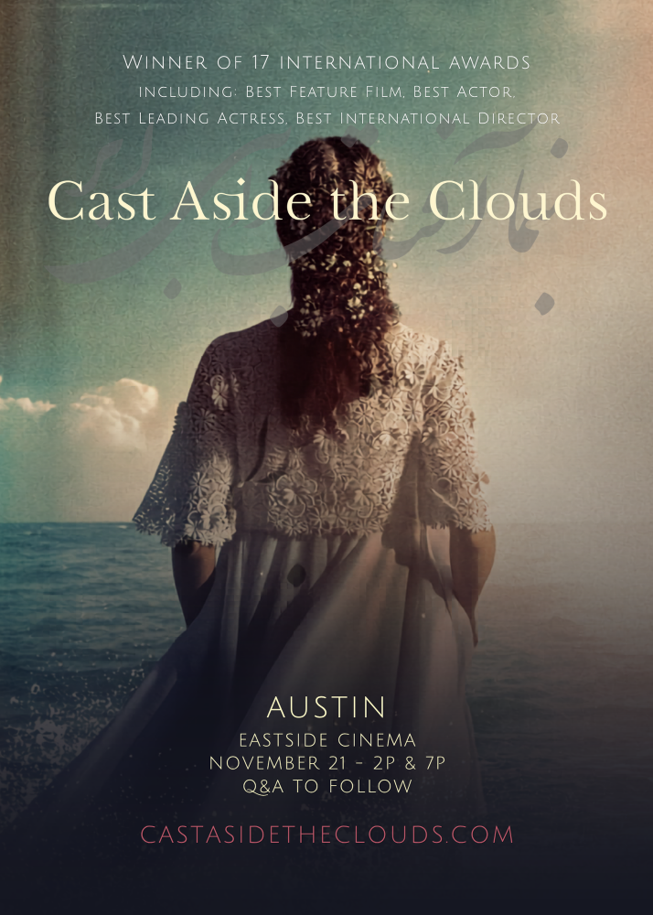
There are films we watch and forget, and then there are those that stay with us long after the screen goes dark. Cast Aside the Clouds, written and directed by Mary Darling, belongs to the latter category. This was not simply a film about a forbidden romance. The film delved into the effects of society attempting to dictate whom we love, what we believe, learn, and, in the end, who we can become.
Set in contemporary Tehran, the film follows Layla, a young Bahá’í woman whose faith prevents her from attending university in Iran. She continues her education through an underground university, determined to pursue a life of intellectual independence. Her path crosses that of Sasan, a Muslim physician whose future appears comfortably mapped out. Their attraction develops into a relationship that challenges the assumptions and prejudices each has inherited. The state’s machinery challenges their love when it arrests Layla and views her religious identity as a threat.
Darling has described the film as a love story, and that distinction matters. During the post-screening discussion, she said she hoped audiences would see it as a mainstream human story rather than simply a “Bahá’í movie.” The circumstances surrounding Layla’s life are particular to her, she explained, but the emotional structure is familiar: two people fall in love and discover that the world around them has other plans. Through that relationship, the audience is invited to understand a reality that many people outside Iran may know little about.
The film presses that reality into view without turning its characters into symbols. Layla is a woman with a mind, a heart and a future she wants to shape for herself. Sasan is confronted with the distance between the beliefs he has accepted and the person he is becoming. Their story gives the political and religious persecution a human face. It also asks a question that reaches well beyond Iran: how much of what we believe is genuinely ours, and how much have we simply inherited?
One of the most difficult sequences to watch is the imprisonment and interrogation of Layla. During the Q&A, Darling explained the painstaking research behind those scenes. The production interviewed former prisoners, many in Persian, and paid attention to details that might seem insignificant to an audience unfamiliar with the experience: the furniture, the color of the walls, the pipes, the sink, the placement of the light and even the small button a prisoner must press to request a bathroom visit.
One former prisoner, an architect, helped the filmmakers establish the dimensions of a solitary confinement cell by using his own body to measure it. The set had to be made slightly larger to accommodate the camera, director, cinematographer and actor. Even so, the dimensions conveyed the claustrophobia of a space designed to strip a person of control.
There was another unexpected contribution. An Iranian man who had worked as a prison guard and had left Iran only three months before filming was involved in the production. He had delivered food to prisoners held in solitary confinement in section 209 of Evin Prison, a place Darling described as especially difficult to access. He was able to check the filmmakers’ recreation against his own experience. When he saw the set, he told her it felt like being back there.
The significance of that research became especially clear when an Iranian woman in the Austin audience spoke. She said she had been born and raised in Iran and had been arrested three times. The prison scenes, she told Darling, were extraordinarily accurate. She recognized the details of the interrogation room and wanted to know how a filmmaker who had not lived through those experiences could have recreated them so convincingly.
Darling returned to the interviews with former prisoners. There were few photographs available to guide the production, she explained, so the filmmakers relied on the people who had actually been inside. They listened, asked questions and tried to get the details right. The woman’s response was one of the most affecting moments of the discussion. What might have been merely convincing production design to one viewer was, to her, a representation of something she had personally endured.
The conversation then turned to the treatment of Bahá’í women in Iran. Darling said the situation had become worse, not better, and referred to observations made by the United Nations Special Rapporteur on human rights in Iran. She described the disproportionate targeting of Bahá’í women and the disturbing reality of women being taken from their homes while their children are left behind.
That statement stayed with me. I found myself asking a question that I cannot claim to answer on behalf of the Iranian regime, but one that seems impossible to ignore. Why are women targeted so systematically? Is part of the strategy to attack the very capacity to create and sustain future generations? Women give birth. They raise children, transmit knowledge and shape the values of the next generation. By imprisoning and persecuting women, a regime attacks not only individuals but families, communities, and the continuity of a culture. Which, of course, is the point!
The Bahá’í faith itself is central to the story, but the film does not require viewers to share that faith to understand what is at stake. I have long regarded it as one of the most peaceful and inclusive of the world’s religions. Its teachings emphasize the unity of humanity, the equality of women and men, independent investigation of truth and the harmony of science and religion. It does not demand that people convert in order to be welcomed into conversation or community. Its fundamental premise is one of human connection rather than division.
That inclusiveness is important in a film about a religious minority whose members are denied basic rights in the country where they live. The Bahá’ís are not seeking to impose their beliefs on others. They have faced systematic discrimination in Iran, including exclusion from higher education, restrictions on employment and imprisonment. The film makes those realities visible through Layla’s experience, while reminding us that persecution of one group is never an isolated matter. As Darling suggested during the Q&A, when one part of the human family is oppressed, all of us are diminished.
The discussion also brought me back to a group I participated in for several years in Austin: Meaningful Conversations. These Sunday-afternoon gatherings brought people together to discuss questions that rarely find room in ordinary social exchanges. Participants came from different backgrounds and beliefs. Short selections from Bahá’í teachings sometimes served as a starting point, but the purpose was not conversion or religious instruction. It was to listen, question, reflect and discover what might emerge when people with different perspectives take one another seriously.
I found those gatherings valuable precisely because they made room for disagreement without turning it into combat. In a world where people increasingly reduce conversation to slogans, positions, and declarations, practising listening can itself constitute a radical act. Anyone interested in learning about the Austin group can find its current information and events through Meaningful Conversations Austin on Meetup. The group welcomes people of all backgrounds and beliefs.
I asked Darling about the film’s music. I found the soundtrack haunting and brilliant, and wanted to know whether it was traditional Iranianmusic, contemporary music, or a mixture of the two. She explained the score was composed specifically for the film, except for a couple of songs. The Athens-based composer worked with Persian musicians and singer-songwriters to bring together contemporary sounds that echoed traditional Iranian music.
Since the filmmakers shot the film in Athens, the production team accessed certain funding opportunities that required cultural elements, including music. Darling admitted that the soundtrack had been one of her concerns. Would a composer working in Athens be able to create music that felt authentic to the story and its Iranian setting? The collaboration, she said, brought together different musicians and voices, and the result was a contemporary score with the resonance of traditional sounds. It worked. The music does not simply accompany the images; it deepens the atmosphere and gives the story another emotional language.
The production itself was international. Filming in Iran, would have been impossible and potentially dangerous. The two leads, Parmiss Sehat and Behtash Fazlali, are Canadian actors from Vancouver, selected through an open casting call. Other performers came from the United Kingdom, Canada, and the United States.
The film had also reached an international audience before arriving in Austin. It was screened at the Permanent Mission of Canada to the United Nations in October, in collaboration with the Bahá’í International Community. Darling described the event as an opportunity to bring attention to human rights abuses in Iran and to keep international pressure on a government whose treatment of prisoners and minorities remains a serious concern.
The film’s honors include Best Feature at the Rotterdam Independent Film Festival, Best Narrative at the Teaneck International Film Festival, Best Leading Actress and Best Faith-Based Feature at the Women’s International Film Festival, and Best International Director recognition for Darling at the Istanbul and Golden Rod festivals. It has also received awards at the Religion Faith International Film Festival, Awareness Film Festival and other events.
What stayed with me after the screening was not a list of accolades, nor even the technical accomplishment of recreating a prison cell. It was the testimony of the woman who had been arrested three times in Iran, and the way the film had allowed her to recognize something of her own experience on screen. A film cannot undo an arrest, open a university to a young woman who has been excluded, or release someone from solitary confinement. But it can make indifference more difficult to ignore. It can take something that happens far away and bring it close enough that we can no longer dismiss it as someone else’s problem.
Cast Aside the Clouds asks us to look beyond the beliefs and prejudices we inherit. Its title suggests that the clouds are the barriers that prevent us from seeing clearly. In Austin, the film did more than tell a story. It opened a conversation that continued after the credits and left its imprint where it mattered: in the human heart.
Film Information
Writer and director: Mary Darling
Production: WestWind Pictures and GravityBreath Pictures
Official film website: www.castasidetheclouds.com
Official trailer: Watch the trailer
Press, reviews and awards: Film press and awards