
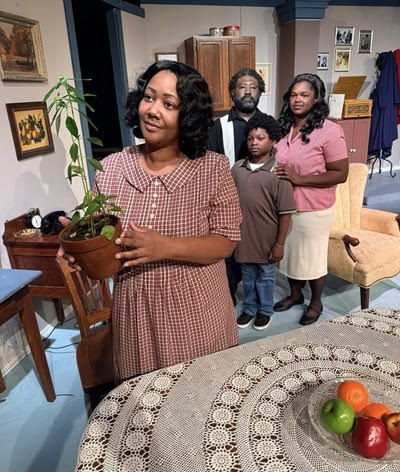
Although the show closed at the end of June, City Theatre’s production of Lorraine Hansberry’s A Raisin in the Sun deserves a standing ovation.
A landmark of American theater, this classic drama follows the Youngers, a Black family in late-1950s Chicago’s Southside, the roughest neighborhood notorious for its poverty and later crime, as they grapple with the possibilities and tensions created by an unexpected insurance payout. As each family member envisions a different future; their shared dream of homeownership becomes a catalyst for conflict, sacrifice, and hope, exploring enduring themes of race, family, identity, and pursuing the American Dream. The 2026 Austin Juneteenth Celebration was the catalyst for the production.
The poet Langston Hughes wrote, “What happens to a dream deferred? Does it dry up like a raisin in the sun? Or fester like a sore – And then run? Does it sink like rotten meat? Or crust and sugar over – like a syrupy sweet? Maybe it just sags like a heavy load. Or does it explode?
The play addresses themes like greed, women’s independence, altruism, family, racism along with redlining neighborhoods, and fear, which sadly continue to persist decades after the play’s creation. What happens when a family who live together in a tight space have little to no privacy? Mother micromanages behavioral expectations of her intellectual and freedom-seeking daughter, giving way more lenience to her son to screw up, even though he’s the last thing from a businessman (although he has delusions of grandeur) and a drinker.
“Seems like God only gave Black people dreams and lots of children to pass on those dreams” is one of the morose comments. The denial of emotions is obviously damaging to the members of the Young household, who feel denied and overlooked. It’s all very puritanical, 1950s, very churchy, preachy, but still holds sway over a segment of the population in the USA today. And the anti-intellectualism expressed by the brother to his smart sister still permeates the less educated in America today, no matter the race. This attitude traces back to superstitious beliefs and mistrust of the educated who wield power. Rightfully so, but the play asks you to question all these beliefs.
A mother’s love becomes a burden of defeat. “Those who see the future are the givers – they see the future in a long line that we don’t see, but the line is there.”
The director asks the audience to envision a long future where a world without racism, conmen, false hope, and exclusivity might exist.
Kudos to the director Andy Berkovsky and the actors – Oilvia Jamison who played Ruth Younger, Nathaniel Jamison playing Travis Younger, McArthur Moore playing Walter Lee Younger, Abigail Egbujor as Beneatha Younger, Kendra Franklin as Lena Younger, Elijah Johnson as Joseph Asagai, Justen Roberts as George Murchison, Bernardicus Jackson as Bobo, Leah Barnes Jasso as Mrs. Johnson, and finally Roger Estrada as Karl Lindner.