
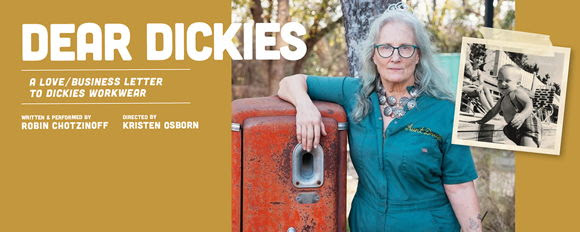
Dear Dickies is an original comedic one-woman performance worth changing your clothes for.
Robin Chotzinoff wrote and performed this hilarious autobiographical show, directed by Kristen Osborn. As a member of the audience, the stage set: a woman’s closet or bedroom immediately strikes you. Designed by Valerie Fowler, the room includes racks of clothes – some crumpled, and others on hangers, some in baskets to be thrown away, stored or given away.
What’s all this about, you wonder? Is it a live flea market, or a used clothing drop? No clue, and then Robin launches into her love of work clothes, in particular the brand Dickies, whom she believes she could be the perfect brand ambassador.
I wish Robin becomes a Dickies spokesperson for senior women, who are, after all, the largest group of consumers in America today. She’s humorous and, as a brand spokesperson, speaks to the qualities of Dickies, a brand I had never heard of!
Over the next forty-five minutes, we travel with her, vicariously revisiting her childhood. Her mother was a clothes horse and wanted her to dress “like a girl”; she only wanted work-clothes. Mom fantasized about Bloomingdale’s and shopping all the time. I related to this as my mother, born of the same generation as Robin’s mother, would visit another New York City institution of the time, Lord & Taylor’s. Every Saturday we’d schlepp into Manhattan from Queens for an outing.
One big difference between our mothers is that Robin’s suggested she have a breast reduction while mine bought me a trainer bra before I needed one so we could burn it at a women’s march in Washington D.C.
From the grind to the glam, Robin explores women’s emotional attachments, memories, and societal compartments related to their clothing. She also examines the expectations surrounding these outfits, as they reflect attitudes, particularly patriarchal ones, which many women of her mother’s generation fully accepted, and unfortunately, many still accept fifty years later.
She throws out dresses that are form-fitting and sexy in favor of shapeless, bag-like shapes to throw over her body. Perhaps this is an act of teenage rebellion which lasts her entire lifetime, but it feels more like Robin sought comfort and individuation than anything else. Shame may have prompted her to choose nondescript coverings to hide this emotion. We may never know her reasons, but that is beside the point. Her detailed analysis of her life’s wardrobe gives one pause and causes us to rethink calmly our relationship to what hangs in our closets.
Audience members could choose or trade their unwanted garments after the show. I brought nothing because I had already emptied my closet six months earlier and only have what I know I’ll wear.
This was performed at the Hyde Park Theatre, 511 W 43rd St, Austin.