
This book by Dan Edelstein (Professor of French at Stanford Univ.) surveys the concept of what a revolution meant from ancient to recent times. A key finding he makes is that the ancients did not think consensus was possible.
Edelstein writes what Plato thought: “Democracies are just as unstable as other forms of government. Excessive freedom makes the people ungovernable. The wealthy class inevitably pushes back, leading the masses to elevate a ruthless leader as their defender.” Sound familiar? The wisdom of Plato perfectly explains 2026. Even more ominously, Plato has Socrates proclaim this in The Republic: “Not even a constitution such as this will last forever.”
Our author is able to prise the real meaning of the works of both Plato and Aristotle because he is attuned to the nuances of the ancient Greek language. “When Plato turned to the question of regime change, he adopted a different vocabulary. Modern translations typically gloss over this difference.”
In Book 8 of The Republic, a key passage is typically translated as this: “Is this the simple and unvarying rule, that in every form of government revolution takes its start from the ruling class itself?” But the Greek term used here is a more neutral term that that used to signify revolution; rather, it means a metamorphosis, when a constitution moved past itself into another form.
Similarly, Aristotle (in Book V of his Politics) is usually translated “the number and nature of causes that give rise to revolutions in constitutions,” but he adopted the same terminology as Plato. He did not write about revolutions, but rather regime change. “How and when did these separate categories become fused into the single phenomenon of revolution? asks Edelstein. In Latin, French, Italian and English, the distinction was maintained “well into the seventeenth century,” he tells us. In a very finely composed sentence, he writes “The heavy armature of Aristotelian terminology helped preserve the classical outlook on revolutionary change for nearly two millennia.”
In an intricate study that cannot easily be summarized here, Edelstein identifies the work of the ancient Greek writer Polybius as the origin of the modern usage of ‘revolution.’ Our author uses key phrases in various languages to “analyse the dissemination of Polybian thought and of the political language of revolution.” This began in the 1500s, but again due to a disputable translation. The Greek word that scholars of the time translated as ‘revolution’ actually referred to the overall cycle of regime changes. “This difference might seem negligible, yet it had oversized effects. To start with, ‘revolution’ soon displaced the Aristotelian vocabulary of political change. A new vocabulary opened up new possibilities in the history of ideas.”
That history is beautifully explored in this book. Fast forward to the English Civil war period. Edelstein looks at what another scholar has called “the most influential statement ever made on the nature of the English government.” The exact text does not concern us here: the point is “it described the English constitution in a Polybian fashion, as the perfect balance of monarchy, aristocracy, and democracy.” The 1642 text, released under the name of King Charles I, “was a risky theory for Royalists to adopt, as it placed the king on a more or less equal footing with the two Houses of Parliament. Unsurprisingly, Parliamentarians were perfectly happy to run with this Polybian reading.” But as we know now, it eventually led to a real revolution, and the temporary end of the monarchy itself. Edelstein notes that the “Revolution of 1688 put to a close 50 years of revolutions” in the British Isles.
This naturally leads Edelstein to examine the American Revolution. I will just mention one salient point here. Many scholars, gushing like 9th graders writing an essay on the topic, have actually stated the American Revolution was “breathtakingly novel” (it was not), and “the end of classical politics.” (The last canard has been perpetrated by Gordon Wood at Brown University). By dismissing the classical learning that all the founders were thoroughly steeped in, these flag-waving scholars deliberately distort history, presumably to make modern Americans feel exceptional. Edelstein is having none of this academic bullshit. Such an account, he writes, “misses important features of both ancient and American politics. On the ancient side, it reduces classical political thought to the balancing of social orders, ignoring how Polybius and his successors sought to balance political powers as well.”
In what I regard as Edelstein’s most important analysis, he makes us understand that the American constitution is a Polybian one. John Adams, Benjamin Franklin, Thomas Jefferson, James Madison, and James Monroe, among others, were very keen on reading Polybius, tracking down various translations, and getting their relatives to read it too. “The framers,” Edelstein writes, “found in Polybius the principles for establishing a lasting government.”
The author moves on to a most insightful study of the French Revolution (Diderot looked forward to a revolution that would overthrow Christianity!), the revolutions of 1848, the Russian Revolution, and the revolution that brought to Mao to power in China. Tracing a direct link between the writing of Hobbes in the 1600s and these more modern revolutions, Edelstein concludes that they crave a Leviathan. And so, we see Leviathans controlling Russia and China, and another trying to achieve the same level of total state control in another country I won’t mention. Modern revolutions have “ushered in an age of nightmares.”
Brace yourself for the revolution to come.
An essential book: Read It !
The Revolution to Come: A History of an Idea from Thucydides to Lenin, is by Princeton Univ. Press. It lists for $35.
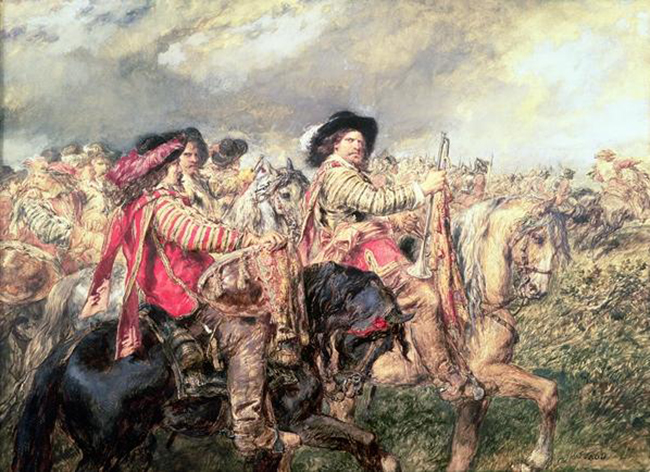
Image: An artistic rendering of The Battle of Naseby, in the English Revolution.