
Anyone with even a passing interest in ancient Greece, or the foundation of Western literature, has read Homer’s Iliad. That original, from the mists of time more than 4,000 years ago, is version 1.0. I guarantee no one reading this review has ever encountered the Iliad version 2.0.
This is the Ilias Latina, a condensed version spanning just 1,070 verses (7% of the original). It was likely composed during the reign of the Roman emperor Nero, between 60 and 65 CE. It is a common assumption that the Loeb Classical Library has published everything from Classical times into English. However, the Ilias Latina has so far escaped the welcome embrace of the Loeb. That is why I’m quite sure no one has ever read version 2.0 of the Iliad.
That version is the subject of a magisterial study by Steven J. Green, Associate Professor in the Dept. of English at the National University of Singapore and Yale-NUS College Singapore.
It has been known since at least the 11th century, when it was attributed to Pindarus, “but this attribution has been roundly dismissed.” Whoever the poet was, his eminence did not rise to the greatest heights: “The poet is no Virgil or Ovid,” Green comments dryly.
He writes that near the end of the poem, its progress is compared to the voyage of a ship. “But it is an original touch to identify the harbour with a literary figure–Homer–a move that invites us to consider more nuanced programmatic messaging.” Green suggests the vision of the ship “skimming the shores” is “a spatial representation of the poet’s strategy of staying close to, but always at some distance from, the Greek model.”
Some departures from Homer are radical. One in particular Green cites relates to Agamemnon convening two assemblies; in one Hera bids Athena to intervene to restrain the Greeks from going home. Odysseus, taking Agamemnon’s sceptre, successfully appeals to both the elders and the men to return to the assembly. In Ilias Latina, this entire scene is removed. Green states the removal “makes the story flow in a more straightforward fashion.”
In the line immediately before calling the chieftains together, we have an unusual statement: “Meanwhile the fiery torch gave light to the lands.” Our author notes that the two words translated as ‘fiery torch’ are ignea lampas, which only appears one other time in all of Greek literature as a reference to a comet. “This raises an intriguing secondary (and non-Homeric) possibility that this verse be read as an astronomical confirmation of the divinely sent message” for Agamemnon “to give order to your allies to fit arms on their shoulders and to seek out the plains of Troy.” (quoting here from the Ilias Latina) Exciting stuff!
A few other notable changes: In the original by Homer, Helen had 5 speaking parts. In 2.0, she has just one. The heroic stature of Aeneas is enlarged (not surprising, as he was the founder of Rome, and this was written by a Roman); and in 1.0 there are 40 lion similes, but this poem has only one.
From pg 34-93, the author presents the text with the original Latin at the left, English at right. This is followed by a line-by-line commentary from pages 98 to 388. The notes get grammatically challenging, such as “syncopated perfect subjunctive” on page 129. In this same note, Green dismisses the interpretation of the passage in question by four leading scholars. Thus, we get not only analysis, but correctives to the misinterpretations of others, which is the book’s great value.
Version 2.0 is a truly amazing poem: Greek heroes are seen in a negative light, the Homeric gods are dismantled, and it has a distinctly erotic agenda! “The poet not only condenses the Homeric narrative but reorients its message.” In a key passage, Green states the “Entire sentiment bears witness to Romans reducing complex heroes to emotionally-driven characters.”
A tremendous contribution to the study of ancient poetry, this is a truly landmark book.
Ilias Latina: Introduction, Text, Translation, and Commentary is by Oxford Univ. Press. It lists for $230.
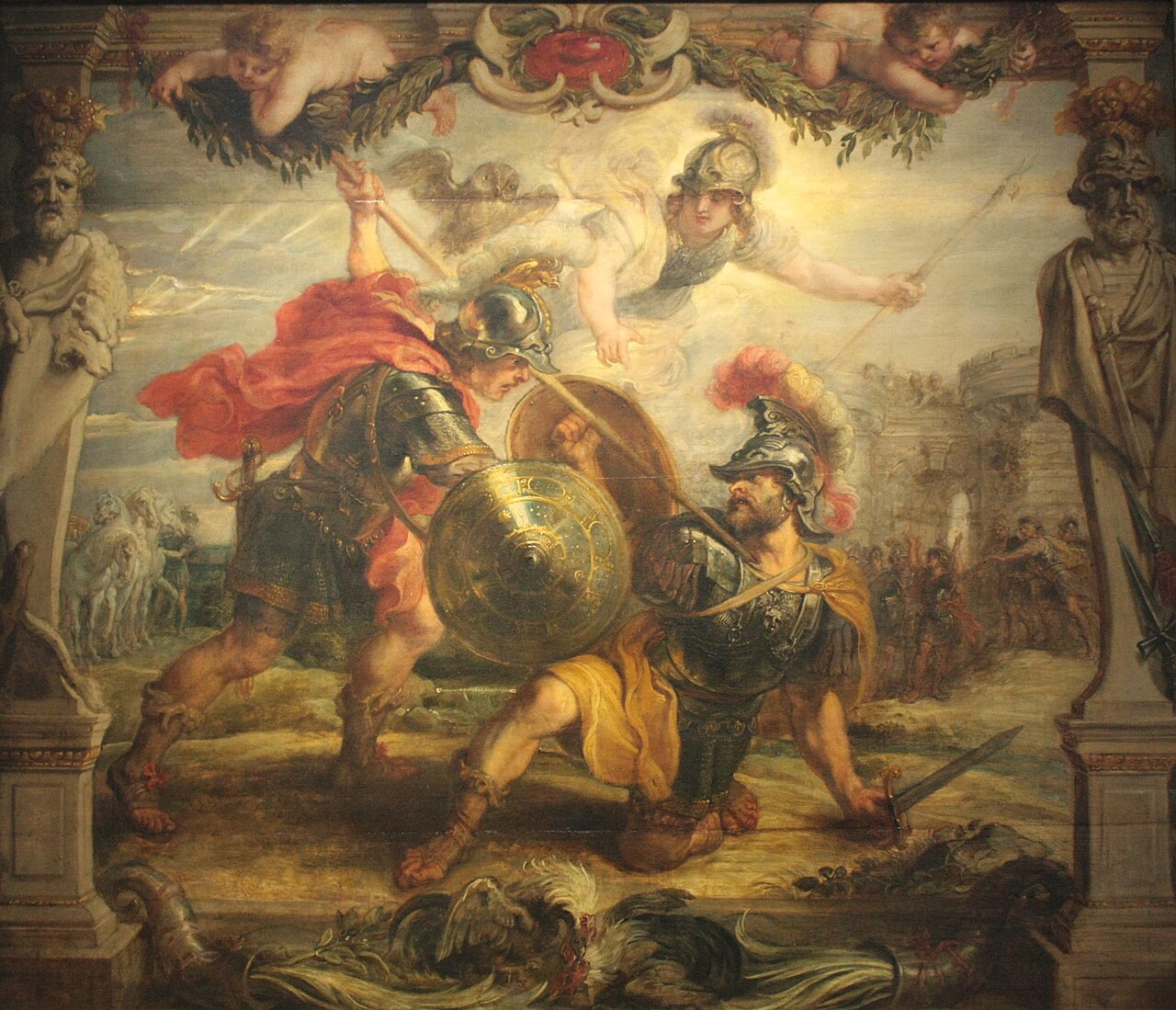
Illustration: This painting by Rubens is the front cover of the book. It depicts Achilles Defeating Hector. By Rubens, 1630.