
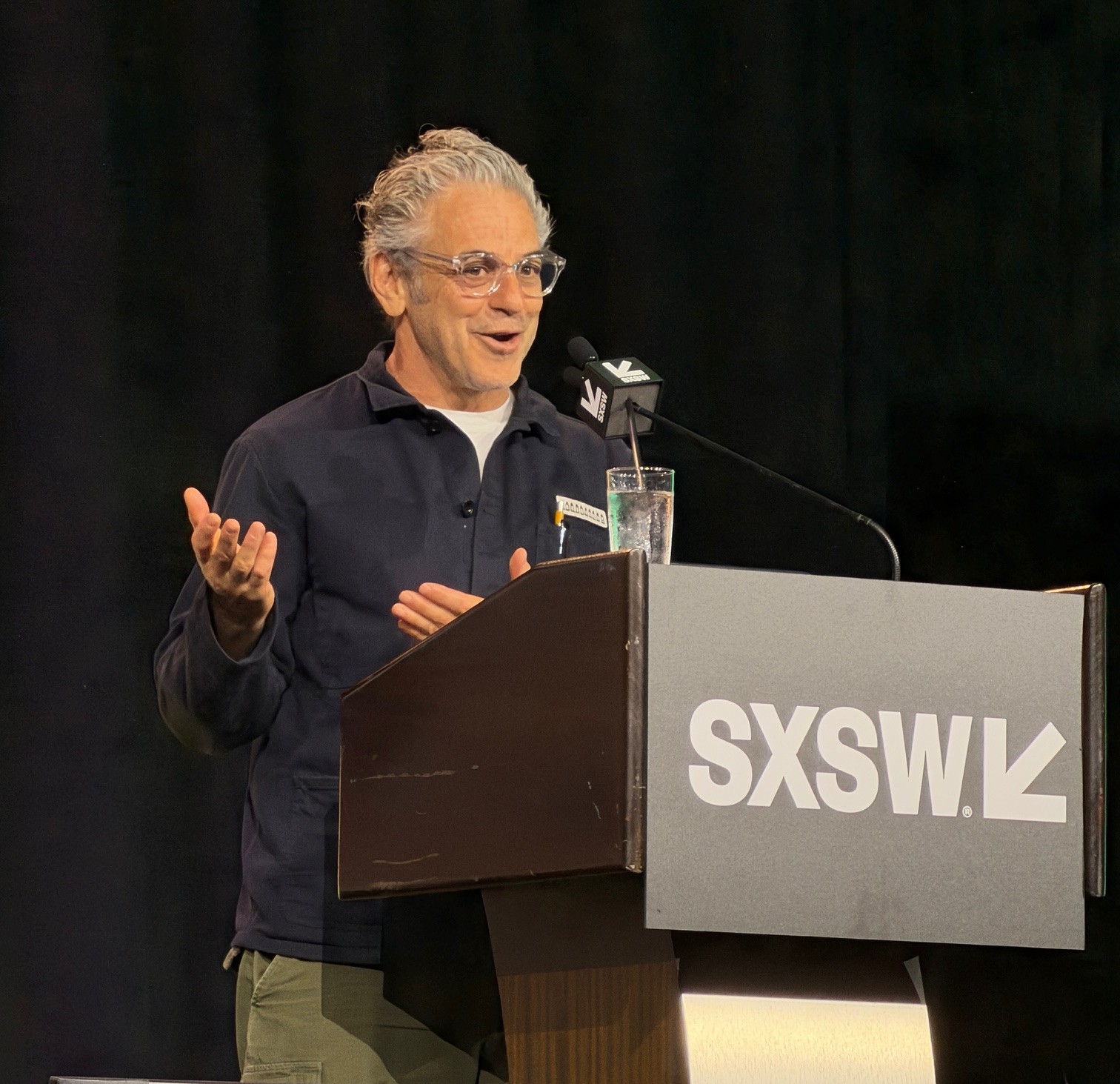
At SXSW, where ideas are supposed to feel ahead of the curve, Tom Sachs delivered something closer to a time capsule.
Not entirely irrelevant. Not entirely compelling either.
Sachs, the artist known for bricolage aesthetics and obsessive reconstruction, built his keynote around what he calls “sympathetic magic.” His premise is simple: if you build the thing, model the thing, inhabit the thing, you can become the thing. Make the world you want at a smaller scale and, somehow, reality follows.
It sounds mystical. It isn’t.
It’s mindset dressed up as ritual.
The Core Idea: Build It to Become It
Sachs traced this philosophy back to childhood. He couldn’t afford what he admired, so he recreated it. A knife for his father. A Mondrian painting built from tape. Later, entire worlds: NASA missions, space programs, architectural icons.
The method is consistent. Study something obsessively. Rebuild it. Own it intellectually if not materially.
He frames this as empowerment.
And to a point, it is.
There’s discipline in replication. There’s intimacy in reconstruction. You learn structure by taking something apart and putting it back together again.
But let’s not pretend this is revolutionary.
Every serious creator does this.
Where It Falters
Sachs leans heavily on metaphor. Cargo cults. Anthropologists. Ritual belief systems. The idea that imitation can summon reality.
The problem is not the references. It’s the framing.
The metaphors feel inherited, not interrogated. There’s a masculine, conquest-driven undertone: absorb, replicate, dominate the object. Even “sympathetic magic” is framed through control rather than relationship.
And in 2026, that lens feels dated.
We are no longer in an era where material aspiration drives meaning. Sachs still circles luxury objects, design icons, branded status. Kelly bags, Porsche logic, museum ownership versus access.
But culturally, that hierarchy has cracked.
People don’t want the object. They want agency, experience, authorship.
Art, Advertising, and the Chanel Guillotine
One of his strongest examples, the Chanel guillotine sculpture—collected by the Centre Pompidou—lands because it does something sharper.
It exposes contradiction.
Luxury and violence. Desire and execution. Branding and power.
Here Sachs is at his best: when the work cuts, not when it explains.
Because when he explains, he drifts into something almost promotional. “Art as advertising” is not a critique if it stops at recognition. It becomes participation.
The Real Tension: Originality vs. Reconstruction
Sachs insists that rebuilding the world is a path to ownership.
But there’s an uncomfortable question underneath it:
If your process is reconstruction, where does authorship actually begin?
At what point does study become mimicry?
He would argue that the transformation happens through labor. That obsession converts imitation into identity.
Sometimes that’s true.
Other times, it’s just a highly refined echo.
The Most Honest Moment
Oddly, his most grounded insight had nothing to do with magic.
It was failure.
Professional baseball players fail most of the time. The best simply fail less. Sachs frames his life the same way: sustained disappointment, tolerated long enough to produce something meaningful.
That part lands.
Because unlike “sympathetic magic,” failure doesn’t need mythology.
What Actually Matters
There was one line worth keeping:
Educate and entertain yourself.
Strip away the rhetoric, and that’s the real engine behind his work. Not magic. Not ritual. Not anthropological metaphor.
Curiosity, sustained over time.
Final Read
Tom Sachs is not wrong.
He’s just not new.
His process—study, replicate, internalize—is foundational to any creative practice. What he calls “sympathetic magic” is, in practice, disciplined immersion.
At SXSW, that distinction matters.
Because the audience isn’t looking for mythology anymore.
They’re looking for what comes after it.
Photo by C. Cunningham