
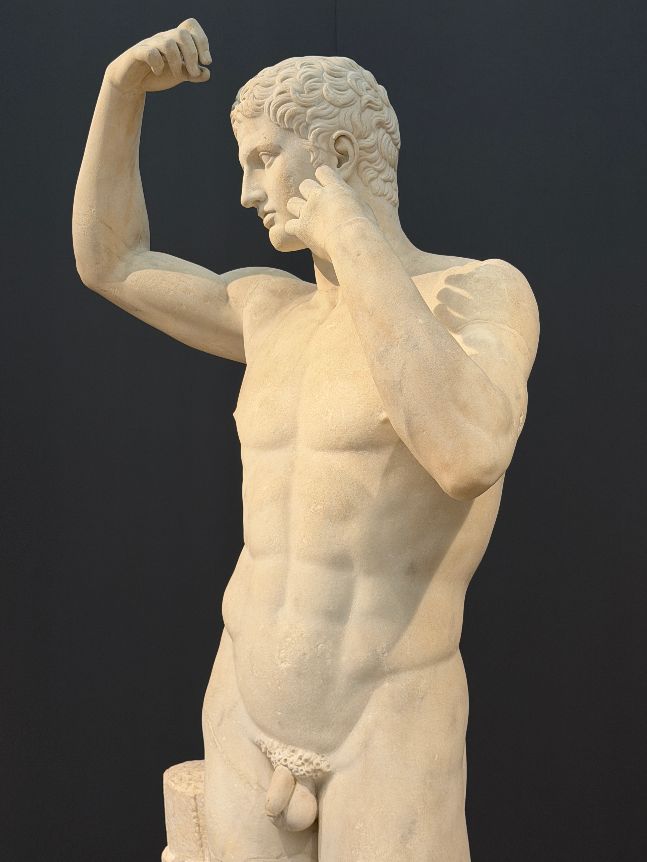
The Torlonia Collection is the most important private collection of Roman marble sculptures in the world. Comprising more 622 works and a wide range of sculptural types and subjects. A selection from this vast treasure trove is now on display at the wonderful Kimbell Art Museum in Ft. Worth.
This veritable “collection of collections” was formed in the nineteenth century by Prince Giovanni Torlonia (1754–1829) and his son Prince Alessandro (1800–1886), primarily through the purchase of several groups of ancient sculpture assembled in early modern Rome, as well as through extensive archaeological excavations on Torlonia estates. In 1876, Alessandro opened the Museo Torlonia, a pioneering private museum in Rome dedicated to classical antiquity. In the wake of World War II, Alessandro Torlonia’s museum closed, and the collection went unseen for generations.
Portions of it went on display in Rome in the Capitoline Museum in 2020, and at The Louvre in 2024. Just prior to its display at the Kimbell, the 58 objects were at the Art Institute in Chicago: all were flown to the United States on a single airplane. It is the only time they have left Europe!
Of the 622 sculptures, only 150 have been ‘conserved’ so far, meaning that they have been thoroughly studied, cleaned and given proper attributions. On view are 19 portrait busts, but it was only as they were being studied by the American conservators that it was realized many of the female figures were actually unnamed patrician ladies, not specific members of the Roman Imperial family as previously believed.
It is really powerful to see the dynamic of how some of the items have been restored over the centuries. For each sculpture, there is a visual key that shows which parts are original, which are ancient but not original to the sculpture, and which are modern recreations. By modern, I mean typically late 18th century, when the rage was to have completed marbles, not fragmentary ones. Noses typically got knocked off from ancient times, so anytime you see a bust with a completed nose, it’s a nearly sure sign of restoration. At least one full-length female goddess here has, over the centuries, had three different heads placed upon the torso, which is original.
For those who prefer animals, there is something here for you too. A large seated statue of a male figure representing the Nile features a very hungry alligator. A perky Bacchus rides on a ram in a marble from the 1st-2nd century; a statue of a girl holds a bird; and there is a charming sculpture of a boy with dogs. The most amusing is a marble of Odysseus beneath a ram. He is holding on for dear life as he escapes the murderous clutches of the blind Cyclops, who can only sense the furry back of the ram as it whisks the hero to safety.
There is one, and only one, bronze on display here: a life-size statue of Germanicus, a general from the 1st century (shown below). It was found in 1874 on the estate owned by the Torlonia family.
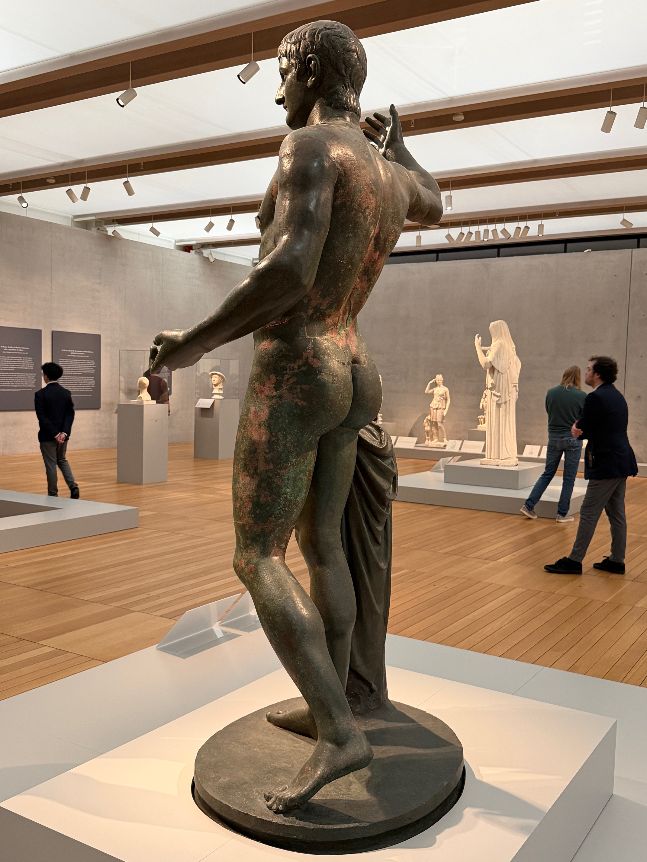
I really appreciated not only the artifacts, but how there was a design and how they were set up. The organization of everything was in sync: it seems like it is telling a story. Just knowing that it’s been in seclusion for most of the past 80 years is breathtaking in itself. Most visitors will feel privileged to be a part of this great exploration.
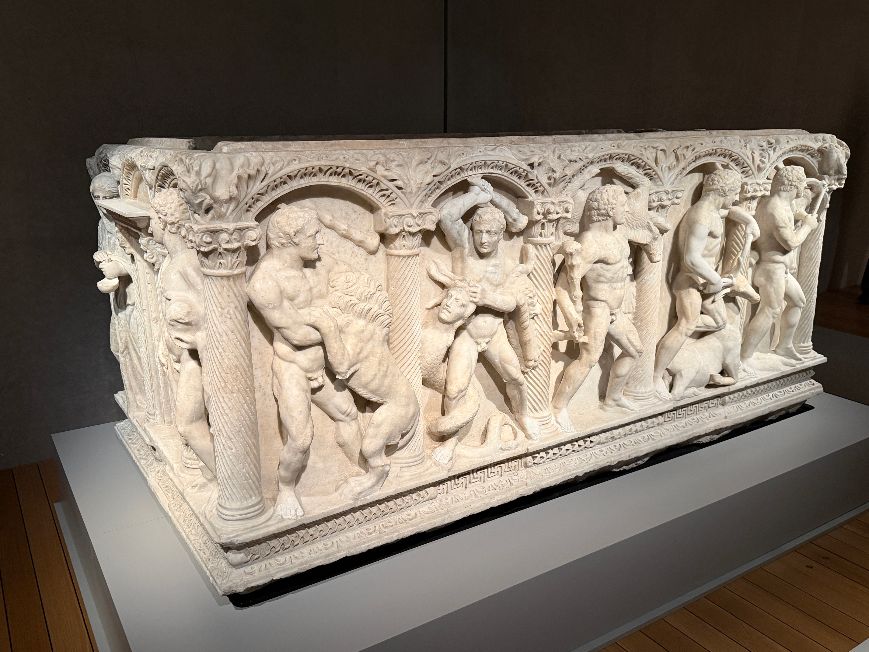
There are two sarcophagi depicting the Labours of Hercules. These are among my favorite things here, but the sarcophagi should have been placed in the round, so that one could walk around them. The backside of both is essentially hidden, with no photograph on display to show its full appearance. However, overall, they are really beautiful. Even though one was made in Asia Minor (shown below), the other in Italy, they both follow the same artistic depiction of the 12 Labours, indicating there was an established concept of how they should be portrayed.
The day before the public opening at the Kimbell, a symposium was held there to celebrate the collection. This quote from Carlotta Botta, Director of the Torlonia Foundation, really sets a high bar for how we can best appreciate what is on view:
“The recent series of exhibitions staged by the Foundation represents for us the contemporary expression of a long-standing tradition of Roman artistic patronage. In this tradition, it shapes not only what we see but also who we’ve become. This is why we feel this exhibition reflects in essence the deep connexion between individual identity and cultural heritage. So we believe that Classical culture, though rooted in antiquity, is defined by this remarkable capacity for reinvention. And it can serve in this modern time as a beacon of light because these sculptures are ideas expressed in marbles, and they remind us of ideas like dignity, beauty and resilience – reminding us not only of where we come from but what we must hold onto.”
Botta also contributed a 4-page look at the Torlonia family tree in the 160-page catalogue, beginning with the grandfather of Alessandro (1800–1886), who initiated the collection. For those who really want to study the restoration history, a combination of both the catalogue and the descriptive signs at the exhibit are essential. At the exhibit, we see a colour-coded visual representation of three possibilities, as I mentioned earlier; but in the catalogue we get a technical description of the conservation efforts. Such detail as “In the 18th century two fingers of the left hand became detached and were repaired.” The catalogue also meticulously gives the provenance, selected references, and dimensions of each object.
The alignment of everything was very crisp. And I think understanding how they restore things and seeing how they restore things, was just very done beautifully. It felt like I was experiencing what the artists kind of wanted. And I think that’s the most powerful element: being authentic to its story.
The Exhibit Catalogue is “Myth & Marble: Ancient Roman Sculpture from the Torlonia Collection”. It is available in the giftshop for $40. Distributed by Yale Univ. Press.
Each object is beautifully photographed. The images are largely B&W, simply because almost every marble is white. But for the bronze, and the statues made of gray marble, such as a statue of Isis (which was unfortunately restored as a statue of Ceres) the colour rendition is perfect.
Two chapters give an excellent background and setting for the exhibit. Book editors Lisa Cakmak & Katharine Raff teamed up for “Roman Art & The Torlonia Collection.” They survey various categories: portraits; funerary sculptures; deities and myths. Silvia Beltrametti writes on “Talking Statues: Antiquity & Cosmopolitanism.” As a conclusion to this review, I quote her very insightful commentary here:
“The antiquities presented here enable contemporary viewers to engage with an array of global debates, among them discussions of liberty, democracy, and emancipation. Examining the meaning of these notions lies at the heart of humankind’s universal experience. The real value of this kind of reflection lies in the very concept of change and reevaluation – and in the respect, the visual vocabulary of ancient Rome can provide useful interpretative lessons that span time and geography.”
The exhibit runs through Jan 25, 2026:
Lead photo: Statue known as the Amelung Athlete. Likely early 2nd century, but only the torso and left arm are original. All photos by C Cunningham