
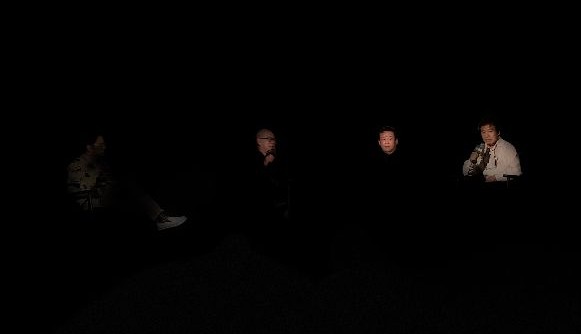
The lights were low inside the AFS Cinema. The theater was empty, its rows of seats waiting for the audience that would soon arrive. Onstage, under the glow of a single spotlight, sat Tsai Ming-liang, one of world cinema’s most revered auteurs, alongside his longtime actor and muse, Lee Kang-sheng. I stood on the steps of the stage, recorder in hand, preparing to speak with a filmmaker whose work has defined what many call slow cinema.
For Tsai and Lee, this was their first visit to Texas. Their presence marked the centerpiece of Time Passes: Thirty-Five Years with Tsai Ming-liang, a four-day retrospective presented by the Austin Film Society (AFS) in partnership with the Austin Asian American Film Festival (AAAFF). The series ran August 21–24, showcasing Tsai’s most acclaimed works, from Vive l’Amour—winner of the Venice Film Festival’s Golden Lion—to the hauntingly beautiful Goodbye, Dragon Inn, as well as shorts and newer projects including Blue Sun Palace.
Before that evening’s screening of Goodbye, Dragon Inn, Tsai and Lee met with me for a brief but telling conversation.
“Sensitive People Find My Films”
Elise Krentzel (EK): How do you imagine American audiences are going to interpret Goodbye, Dragon Inn?
Tsai Ming-liang (TM): Around the world, there are always people who can accept my movies. It is the same in the United States. Some audiences like my films, some do not.
EK: So who are those people? What are their characteristics?
TM: They are sensitive people. They care about details. They love good films. They are critical, but in a way that is close to me.
EK: Close to you? But I don’t know you yet. What is you?
TM: (laughs softly) Commercial cinema doesn’t give people freedom. Most audiences are trained to want action, movement, and speed. But I want freedom in cinema. Freedom is creation.
EK: So your films resist that commercial pressure?
TM: Yes. Watching my movies is not easy. It requires freedom in the audience too.
EK: Then would you say your films are like raw nature? Not manicured gardens with perfect lines, but untamed landscapes.
TM: Yes. I don’t like heavy drama. My drama is in small details, in sensitive moments.
EK: So the drama is in the details like long angles, pauses, the silences. Are you aiming for enlightenment by minimizing conflict? Or is this just self-expression?
TM: It is self-expression. But if audiences feel that, they are also touched by it.
EK: So it becomes like a walking meditation. Not Tai Chi, or dancing, or skipping?
TM: (chuckling) Yes. A walking meditation. Not exercise. No Tai Chi. But walking, breathing. Life itself.
At this point, Lee Kang-sheng, who has appeared in every Tsai film since 1992’s Rebels of the Neon God, quietly leaned in.
Lee Kang-sheng (LKS): Working with him for more than 30 years, it is always about finding freedom on screen. There is no acting in the usual sense. Just being.
The theater echoed with their words, the kind of dialogue that felt as unhurried as Tsai’s films. In that muted space, before the audience poured in, I felt the meditative quality he described: cinema as breathing, as stillness, as being.
That evening’s screening of Goodbye, Dragon Inn — set in a nearly abandoned Taipei movie palace—was the perfect introduction for Austin audiences. Afterward, Tsai and Lee returned to the stage, this time in front of a full house, for a Q&A session that blended insight, humor, and the same poetic sparseness that marks his films.
Over his 35-year career, Tsai has won some of cinema’s most prestigious awards:
- The Golden Lion at the Venice Film Festival for Vive l’Amour (1994).
- The Silver Bear for Outstanding Artistic Achievement at the Berlin International Film Festival for The River (1997).
- The Grand Jury Prize at the Venice Film Festival for The Wayward Cloud (2005).
- The Asian Filmmaker of the Year Award at the Busan International Film Festival (2003).
Cannes, Berlin, and Venice—three festivals often called the crown jewels of world cinema—celebrated his films. And yet, his work remains deliberately on the margins, resisting the commercial polish of mainstream Asian cinema.
Without giving away the plot of Goodbye, Dragon Inn let’s say it is a tribute to the director’s essential meaning of film, which is his art, life, and how the physical cinema plays an enormous role in the filmgoer’s psyche.
The partnership between the Austin Film Society and the Austin Asian American Film Festival reflects Austin’s growing place on the international film map. Founded by Richard Linklater, AFS Cinema has become the city’s beating heart for art house and independent films, screening everything from local debuts to global retrospectives.
The AAAFF, now in its 16th year, has carved out a vital space for Asian and Asian American voices in Austin’s cultural landscape. By hosting Tsai Ming-liang, they brought one of the most important living Asian filmmakers to Texas audiences for the very first time.
The series not only included Vive l’Amour and Goodbye, Dragon Inn, but also programs of shorts, documentaries, and Tsai’s dance-inflected works, creating a full portrait of his artistry.
Interviewing Tsai Ming-liang in that empty theater felt uncannily like being inside one of his films: the silence was not absence but presence, every pause weighted with meaning. He spoke of freedom, of details, of cinema as meditation—and then his words fell into the quiet space between us.
By the time the SRO audience filed in for the evening’s screening, the atmosphere had changed. The stillness of our conversation gave way to the hum of anticipation, and the smell of popcorn. But on screen, as Goodbye, Dragon Inn unfolded, that stillness returned, and the audience experienced what Tsai described so simply:
Walking. Breathing. Life itself.