
Peter Marshall won the 2018 Wolfson history prize for Heretics and Believers: A History of the English Reformation. He is also Professor of History at the University of Warwick. Thus, the reader instinctively has high hopes for his newest book, Storm’s Edge, which is all about the Orkney Islands just off the northern mainland of Scotland.
I won’t keep the reader of this review on tenterhooks any longer. The Times of London newspaper selected it as one of the best books of 2024, and got it exactly right. This is the doorstop book (550 pages) that you didn’t know you really needed: until now.
For those who can’t quite place Orkney on a map, it is a series of 90 islands about 180 miles off the north coast of Scotland (the Shetland Islands are further north). Not much by modern standards, but for much of its history Orkney was too far even for royalty to make the effort.
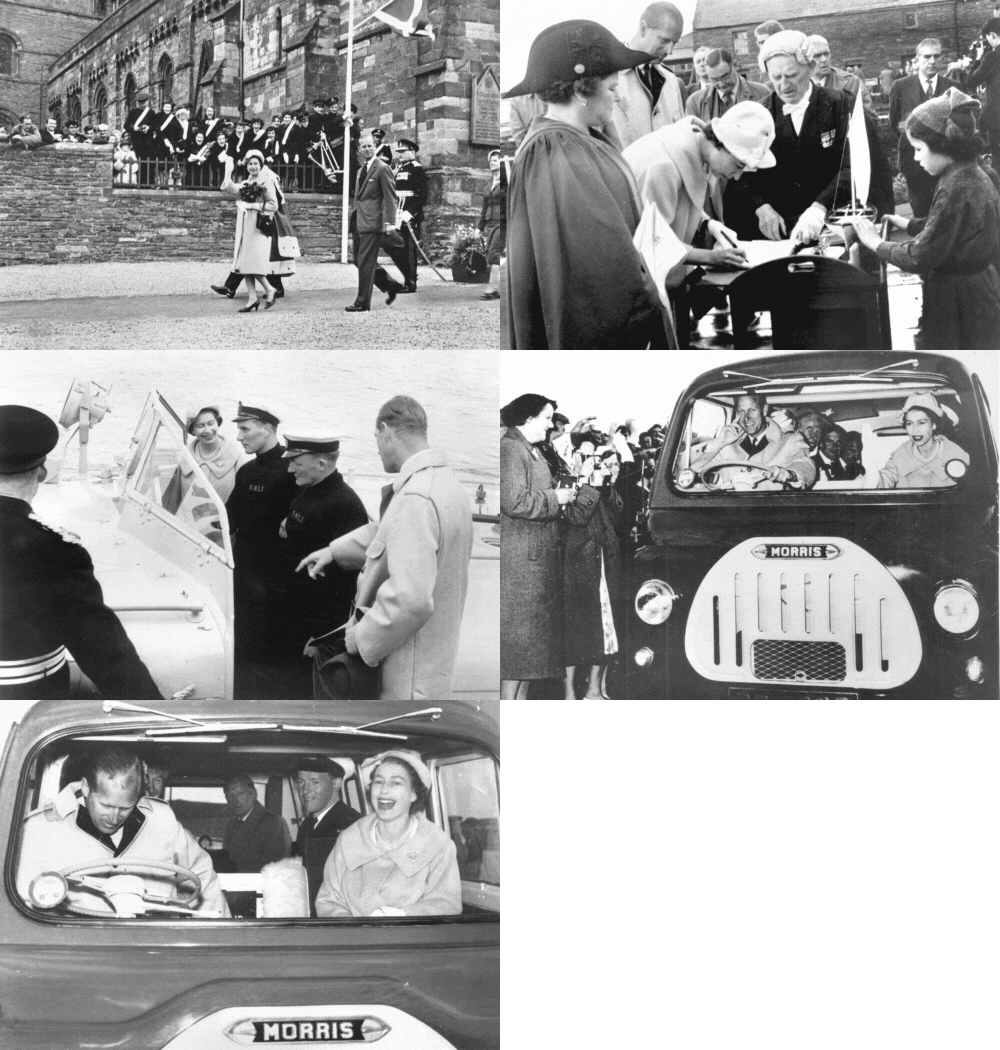
The last King of Scotland to visit Orkney was James V in 1540. The next member of the royal family to visit was in 1782 when Prince William (later King William IV) was there briefly. That’s 242 years between royal visits! It was a big deal when Queen Elizabeth II visited in 1960 (series of photos below), and she was there again in 2002 to mark the 850th anniversary of St. Magnus Cathedral. Her namesake, Queen Elizabeth I, obviously had some affection for Orkney. She declared herself at her coronation in 1559 “most worthy Empress from the Orkney Isles to the Mountains Pyrenée.”
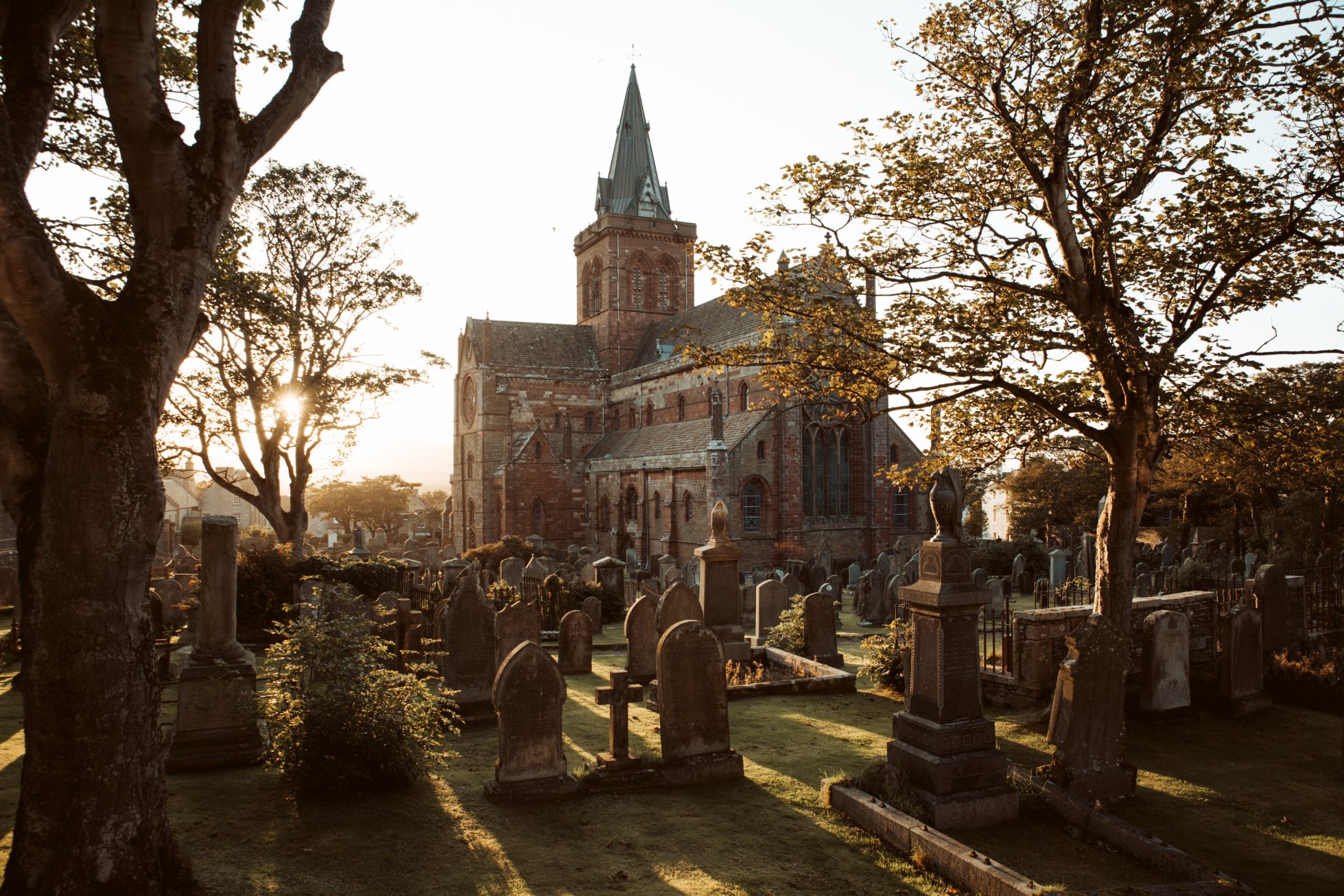
St. Magnus (lead photo) is the focal point for much of the history told by Marshall, and as it remains the oldest and most prominent building in the capital city Kirkwall, it is the central location for any tourist visit to Orkney. That concept of centrality is a key to appreciating this book.
“The principal aim of this book,” writes the author, “is to make the peripheral central, to reverse the direction of the telescope and reorient the map.” When the main inhabited islands of Orkney become home, Edinburgh (310 miles south) becomes a rarely-visited capital city. And once Scotland and England started sharing the same king (James VI, starting in 1603), the new capital, London, was an impossibly distant 725 miles. For centuries, most inhabitants of Orkney never left the islands.
That is not to say that history passed them by. Marshall shows how the islands became a pawn to be bartered over by the Danish and Scottish kings. Having been settled by many people from Scandinavia, its political status evolved over the centuries.
The 1600s was a very difficult time to live in Orkney. A famine from 1631-33 was so severe people had to eat horse meat. Then it got worse. In 1634 a petition to the privy council from the bishops of Orkney and Caithness reported “such tempestuous and bitter weather” that the harvest was destroyed. People were reduced to eating seaweed, and dogs, and some, the petition stated, “have desperately run in the sea and drowned themselves.” Marshall puts the death toll at 3,000 to 4,000. In its appeal for help, the Orcadians wrote they “are great supporters of the kingdom in many things,” their homeland lying “in sight of all strangers trading and frequenting hither from all the northern parts of Europe.” In the words of Marshall, it “was a show window of the kingdom.”
Less than 20 years later the entire kingdom was convulsed by Civil War. King Charles I was martyred in 1649, and the villainous Cromwell sent an army to Scotland. An army was raised in Orkney to support the monarchy, and sailed to the mainland of Scotland. While the nearest village they marched to is Culrain, the nearest farm was called Carbisdale.
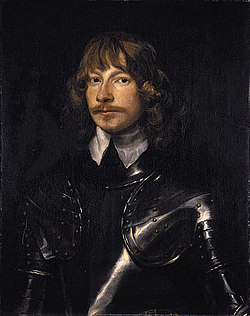
A greater number of Orkney men died at the little-known Battle of Carbisdale on April 27 1650 than in the whole of the First World War: more than 400 killed, another 450 captured. The Royalist forces, supporting the exiled King Charles II, were led by the Marquess of Montrose (pictured). “There were over a thousand Orcadians in the little army,” writes Marshall, but “few had any fighting experience. With them marched a small corps of Danish and German mercenaries, 500 or so.” Opposing this force was Archibald Strachan, “a veteran of Cromwell’s New Model Army. He had only half of Montrose’s men…but he had the advantage in cavalry, by a factor of five to one.” The battle was brief: The Danish musketeers only fired one volley. As Strachan charged with his full force, “the Royalist cavalrymen charged into their own infantry.” Montrose was found and executed.
“In the last week of May 1650, one of Montrose’s fugitive ships, its crew having mutinied in Bergen (in modern-day Norway), sailed into Leith (the port of Edinburgh).” The ship carried “incriminating documents” showing that all the ministers of Orkney had pledged their support to Montrose. All 15 ministers “were deposed and excommunicated – an imposition of spiritual sanctions more swingeing than in any place of comparable size in Britain.” With no ministers, baptisms and marriages ceased for years. In 1659, the Earl of Morton bemoaned “the deplorable condition of many desolate congregations here in Orkney.” But it was not the first time things were in such a parlous state.
A century earlier, in 1567, the people of Orkney were termed “sheep wandering without a pastor.” That judgement was made by none other than the General Assembly in Edinburgh when it charged Adam Bothwell, Bishop of Orkney, with neglecting his duties. But his greatest sin was officiating at the wedding of Mary Queen of Scots to James Hepburn, who had kidnapped her just a few days earlier. “Three days before the wedding, Mary created Hepburn duke of Orkney – first holder of this ostentatious title.” A group of nobles forced Mary to abdicate the throne of Scotland; her husband fled north to Kirkwall Castle in the capital of Orkney, but he was prevented from entering. He eventually escaped across the North Sea to Bergen, but was arrested by the Danish king and sent to a castle in Copenhagen, where he languished for 11 years. Thus ended, in 1578, the Dukedom of Orkney.
After the ultimate victory of the Royalists in 1660, with the accession of King Charles II, the remains of Montrose were given one of the grandest state funerals ever held in Scotland (a fact not mentioned by Marshall).
While various skirmishes over the centuries are recorded by Marshall, Carbisdale was the biggest battle ever fought by the Orcadians. That said, the vast majority of this book is not a military history, and it is also time-limited, ending about the year 1800.
During the colourful and exciting few decades I just mentioned, there was yet another tumultuous series of events that swept Orkney, and much of Scotland. In 1588, the Spanish King sent an Armada to defeat England and dethrone Queen Elizabeth I. At least one ship of the defeated Armada was wrecked off Fair Isle (halfway between Shetland and Orkney), where 50 crewmen starved. Those who watch British TV will find this connexion fascinating. “Whether the unwilling visitors left any permanent legacy is doubtful,” writes Marshall, “the possibility permits the conceit of a Fair Isle detective named Jimmy Perez in the popular series of Shetland crime novels” that were made into the TV show that began in 2013.
It is from this period that a chronicler gave us a first-hand account of life in Orkney. He noted a phenomenon frequently encountered there: “the willingness,” writes Marshall, “of islanders to embrace exotic stories about themselves and their origins, stories that rooted them in place, while asserting connection with worlds beyond their shores.”
Concurrently with the Armada fracas was a second tumult in Orkney, of much longer-lasting dimensions: witchcraft. Patrick Stewart, an earl, was in a feud with his brother John. “In June 1596, John was accused of plotting Earl Patrick’s murder.” His servant, Thomas Paplay “allegedly had orders to poison Patrick. Most shockingly, the indictment accused John of seeking his brother’s destruction by ‘consulting’ with a ‘known notorious witch.’”
Marhsall writes that “allegations against John were extracted with unspeakable tortures. Paplay was flogged with ropes that ‘left neither flesh nor hide.’ He endured 11 days in a metal frame clamped over the leg and heated with fire.” Paplay gave up the name of a married woman who was a servant of a local laird who also was in Earl Patrick’s bad book. She too was subjected to the leg torture “and her elderly husband, son and seven-year-old daughter were all tortured in front of her.” To end their torture, she confessed to witchcraft and was burned in public in Kirkwall on Dec. 16, 1594. Paplay was hanged. This is but one of many instances of witchcraft Marshall devotes a whole chapter to. Might be best to wait until Halloween before you read this astonishing book!
There are 2 typos: “to sent” should be “to be sent” on pg 63; “done did” should be “done” on pg 82.
Images: St. Magnus Cathedral in Kirkwall is from www.orkney.com/news/photos-of-orkney
To learn about Orkney as it is today, visit the official website: www.orkney.gov.uk
Storm’s Edge: Life, Death and Magic in the Islands of Orkney, is by William Collins. It is available from Amazon for just $24.74.