
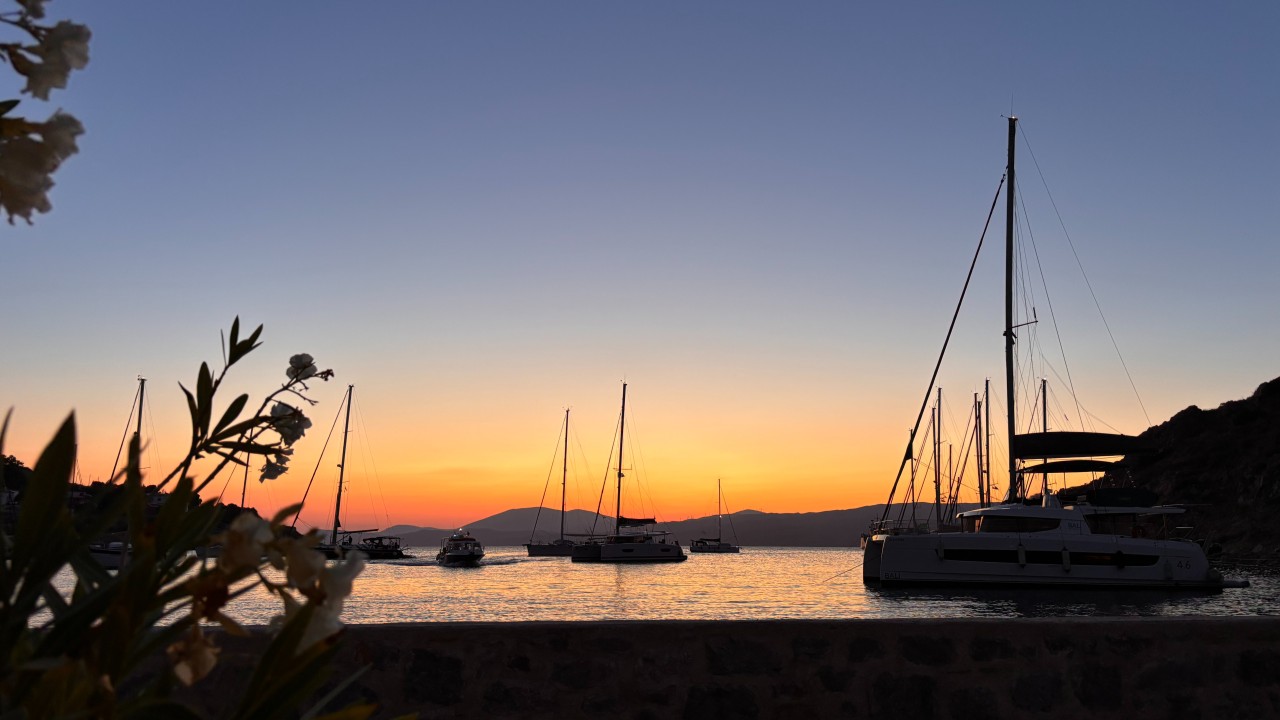
“This world is but a canvas to our imagination. I love to be alone. I never found the companion that was so companionable as solitude… I am alarmed when it happens that I have walked a mile into the woods bodily, without getting there in spirit.”—Henry David Thoreau, Walden
Hydra is one of the few places in the world where silence still reigns and I find that magical. Just like during the Covid years—while many were flipping out—I loved the stillness and lack of vehicles, noise, and people. I walked the streets and breathed in the unpolluted air, listened to the birds, admired nature, and enjoyed my own company without distraction.
On Hydra, there are no cars, no horns, no roads. Just footsteps, hooves, braying, and the sound of the Aegean Sea. That is why I have returned to it over and over again for the past thirty years. I recently spent five weeks there after a seventeen-year hiatus.
This trip was unlike any of the other previous visits. I didn’t go to Hydra initially to write a book. I went to rest and had a vague notion to write poetry as an homage to the island that is a mirror of my soul. Instead, on the very first night I had a dream that jolted me upon awakening and called me to write something entirely different. I keep a dream journal and recorded it as quickly as I could. I thought it was about me and my brother. Upon further reflection and analysis, it became Hydra: The Human Atlas. I felt I was ordained to write it.
Hydra puts a spell on me. It’s mystical, ethereal, and deeply healing. You can hear yourself think, breathe, and be. You are not shackled to a to-do list or isolated in your vehicle passing by people without care or concern. Here, you bump into one another—not literally (unless a tourist with an iPhone is too busy taking photos of the scenery rather than living amongst its beauty); you say “kalimera” (good morning) or “kalispera” (good afternoon) to everyone. From the street sweepers to servers, strangers to friends. There is an unspoken acknowledgment of your humanity on this island.
Stone alleyways with lazing cats and elderly citizens carrying bags of groceries walking slowly up 200 steps greet you calmly while you brush by bunches of hanging bougainvillea or lavender. The dry rocky terrain leads you on pathways that circle the island for long meditative walks while lemon trees bear their fruit at your feet. The cypress and pine offer relief from the blazing sun, and the olive trees are guardians of tradition and sustainability. The glistening sea beckons you to jump in and cool off. All at a snail’s pace compared with home (wherever that may be).
Located in the Saronic Gulf, a group of islands close to Athens (a one-and-a-half-hour boat ride from the port of Piraeus), sits a hunk of rock that has meant more to me than other places on our beautiful planet.
But why does travel open our creative mind? Because when we exit our habitual surroundings, we engage with life differently. Travel is a forced disruption. It awakens your senses. Colors are brighter. Smells linger. Accents and customs require attentiveness. You slow down. You notice.
On Hydra, the silence itself becomes a creative collaborator. Without cars or blaring screens, the mind clears. You begin to hear the world, everything in it—and yourself—differently. This absence of clutter is what every artist craves: space. But even if you don’t consider yourself an ‘artist’ you become one while there. Your soul awakens and your heart sings. Your senses are reignited by the scents of fresh oregano, thyme and fennel, all growing wildly across the landscape. You can pick clumps of mint to make tea or sage to clear energy.
Travel, when done with openness, resets your system. You shed your autopilot. You dissolve into something freer, more observant. The stories you overhear in a café, the old woman offering you a fig, the boy jumping into the sea from a rock—these impressions work their way into your psyche, and often, into your work.
For me, that meant letting go of the idea that I’d write poetry and instead listening to the call of a new book. The dream I had on my first night back was not random. It was Hydra itself speaking to me, guiding me to document its spirit and mine.
Now, I’m building Hydra: The Human Atlas, a book of stories, impressions, and interviews with the people who live, work, and dream there. Locals and expats. Artists and architects. Fishermen and philosophers. It’s a love letter to the island and a mirror for our own humanity.
Hydra reminds us we are not machines and must protect our innate humanity, in the face of all that is coming and all that exists right now. We must preserve our selves while adapting to rapid changes. Here’s the hook. Adaptation does not mean giving up your human spirit, mind, and creativity. It means using it for good.
Here’s what one of the opening lines from the introduction says:
“Hydra is an island of paradox: silence and storm, beauty and burden, past and future suspended in a fragile present. To write about it is to attempt to preserve what may soon be lost.”
And later:
“This book is a chorus of voices. Hydriots, expats, wanderers, and workers—all co-create a mosaic of stories that reveal the deeper, often invisible soul of the island.”
If Hydra speaks to you in these words, perhaps you’ll consider being part of its unfolding.
I’ve launched a GoFundMe campaign to help me return to the island and complete the manuscript. If you’re moved, please read more https://www.gofundme.com/f/help-bring-hydras-soul-to-the-page and consider sharing.
Sometimes, the best gifts we can give the world are the stories that help us remember what matters.
Reprinted with permission from Elise Krentzel.