
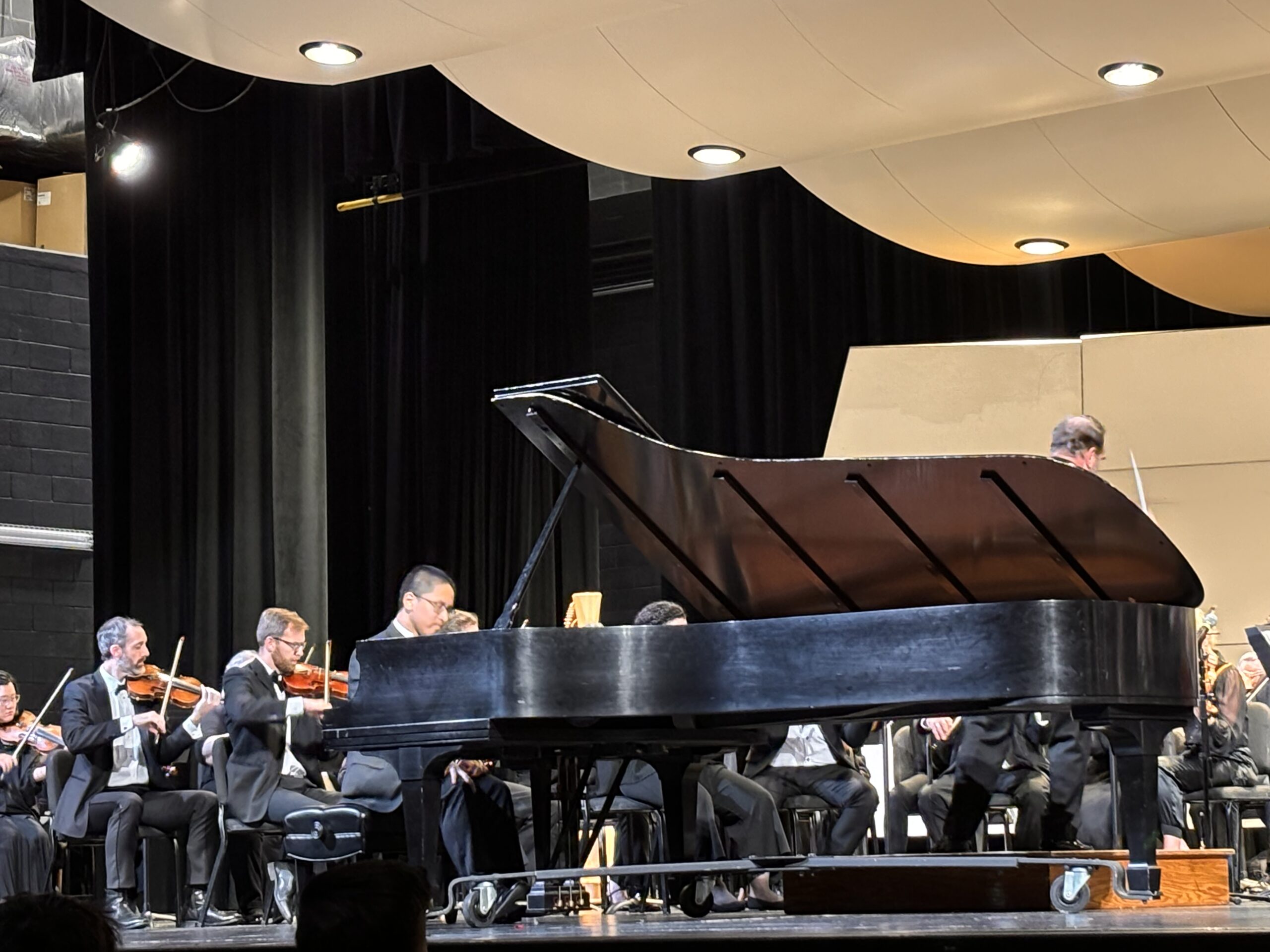
The Central Texas Philharmonic outdid themselves yet again. Stefan Sanders, Music Director for his 6th season, is a tremendous gift to this region in the state. He formerly assisted as conductor of the New York Philharmonic and has guest conducted the world over from Poland to Mexico. His exuberance and thoughtful (read easy to understand) explanations to an audience who might have a) never been to a symphony, b) did not know the story behind each performance, or c) had perhaps seen a performance long ago and forgot the theme and storyline, is accessible to all without being condescending.
The set began with Quinn Mason’s Portrait of Scheherazade, an orchestral piece written in 2022 evoking the narrator of the story collection One Thousand and One Nights. It shared the same musical features heard in Rimsky-Korsakov’s Scheherazade, op 35 suite including melodies built on ornamented arabesques, colorful harmonies and rich orchestration of highs and lows, depth and lightness. Mason’s orchestral music has been performed by notes orchestras throughout the world.
Saint-Saens Piano Concerto No. 5 in F Major Op. 103 “The Egyptian” followed. Best known for his work Carnival of the Animals, Saint-Saens was one of France’s greatest composers and pianists. Liszt, Berlioz, and Verdi touted his work.
The show’s pre-intermission highlight was the wunderkind Antonio Ajero, the Texas State International Piano Festival winner. At 20 years old, Antonio’s deft and emotional movements – from stepping into a catastrophe to a rebirth of creation of flowering budding notes and violin chords to back up the blossoming of his youthful sound. His prancing, dancing fingerwork gave the audience a little kick in their step.
The piece de résistance was the final part of the show: Nicolai Rimsky-Korsakov’s Scheherazade op. 35, an Oriental tribute written in the flowery expressionism of Russian composers, unlike their German or French counterparts. This last part of the show was set in four musical parts, which were undulated like the sea of Sinbad’s ship.
First came the Sea and Sinbad’s Ship, introducing the sultan’s theme set over a a sea of nautical rhythms. The second part the Story of the Kalendar Prince, where Scheherazade relates tales to her husband. She was slated, like all other women, to be murdered on the night after their wedding, but Scheherazade was too clever and told 1001 tales to her husband, one per night, which entranced him and led to her living. The third part, The Young Prince and the Young Princess, and the fourth ends with The Festival at Baghdad – The Sea – The Shipwreck – Conclusion. The union of Scheherazade and the sultan endures, and the tumultuous sea subsides.
Imagine a love story of the prince or the ship crashing against the rocks with loud tuba and trombone sounds. All could be heard in one’s mind’s eye (or the ear, in this case). The rich, cacophonous execution of conductor Sanders made this a memorable experience.