
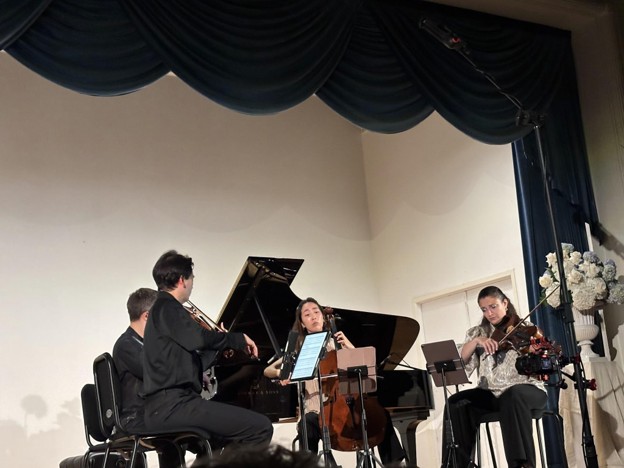
ATX Music opened its 2026–27 season on September 12 at the Mansion with an impressive ensemble of musicians: violinists Stefan Jackiw and Geoffrey Herd, pianist Anna Petrova, violist Milena Pajaro-van de Stadt, and cellist Christine Lee. The lineup brought together performers with substantial international credentials and, in several cases, significant commitments to musical education and artistic leadership.
Jackiw is one of America’s leading violinists, with a career spanning major international stages. Herd is artistic director and CEO of the Geneva Music Festival and is deeply involved in developing musical talent. Pajaro-van de Stadt has appeared as a soloist with the New York String Orchestra and is a founding member of the Dover Quartet. Lee combines her performing career with education and hosts the YouTube series Christine’s Notes. Petrova, an associate professor of piano at the University of Texas at Austin’s Butler School of Music, has received top honors at international competitions, including the Queen Elisabeth Competition.
The program moved across nearly two centuries of musical sensibility, from the spare repetitions of Philip Glass to the lush melancholy of Rachmaninoff, two composers who happen to be among my favorites and most frequently listened to.
Opening with Glass was a particularly clever choice. His String Quartet No. 3, “Mishima,” drawn from his score for the 1985 film Mishima: A Life in Four Chapters, immediately established a rhythmically insistent atmosphere. The piece accompanies the story of Yukio Mishima, the celebrated Japanese writer who died by ritual suicide in 1970. What can initially sound like monotonous repetition reveals itself through performance as something more fluid: small branches moving in the wind, tones appearing to sway and shift even as the underlying patterns remain remarkably controlled. More than once, I noticed members of the audience tapping along.
It is easy to forget how radical Glass once seemed. He was one of the major figures associated with musical minimalism, a composer whose repetitive structures and stripped-down language challenged conventional ideas about what contemporary classical music could be. Half a century later, that once-disruptive vocabulary has become part of the classical canon.
The contrast with Rachmaninoff could hardly have been greater.
The Trio élégiaque No. 1 in G minor brought an entirely different emotional temperature. The rhythmic interplay of violin and cello gave the piece the relentless intensity of a funeral procession, while the piano deepened its sense of weight and mourning. Glass makes repetition feel almost architectural; Rachmaninoff turns repetition into emotion.
Clara Schumann offered yet another change of atmosphere with her Three Romances for Violin and Piano, Op. 22. These are dreamily romantic pieces, beautifully played, although I confess that the soundscape is not entirely my cup of tea. There is something of walking hand-in-hand beside a lake with a day umbrella in these compositions. Still, the performances made a persuasive case for their delicacy and refinement.
Amy Beach’s Piano Quintet in F-sharp minor closed the program before intermission. The opening movement struck me as somewhat too sombre and dramatic, with the emotional excess of a 1930s film in which someone has just fallen down a staircase and we are given the full ripple effect of the thump. The second movement, the Adagio espressivo, was more appealing: gentler, warmer, almost like an affectionate touch on the cheek before the final movement returned to a more agitated emotional register.
The programming itself was one of the evening’s strengths. Moving between Glass, Schumann, Rachmaninoff, and Beach created enough contrast to keep the ear engaged, while the quality of the musicians made even the works I personally found less congenial rewarding to hear live.
There was, unfortunately, one practical problem that became impossible to ignore: the seating.
The floor at the Mansion is flat rather than raked, and that is not ideal for a chamber music performance. After some musical chairs of my own, I still could not see all of the musicians because the person seated in front of me was tall enough to block part of the stage. I eventually found myself turning my head upward to catch what I could. In the process, I noticed paint peeling from the upper-left corner of the ceiling. Once you have started looking at the ceiling because you cannot see the musicians, the architecture has rather inadvertently become part of the performance.
The evening also featured Refraction: Between Sound and Light, a site-specific installation by visual artist Beili Liu. The piece consisted of hanging lines of shiny reflective squares. For me, the effect was less evocative than decorative—rather like something that might have been pressed into service as Christmas decoration in a department store. Others may find a different poetry in the interaction between the reflective surfaces and the music.
That is the nature of an evening devoted to contemporary art and classical music: some choices resonate immediately, others less so. What matters is that the program gives you something to hear, something to look at, and occasionally something to argue with on the drive home.
ATX Music’s season opened with musicians of considerable talent, ambitious programming, and enough contrast to make the evening intellectually and musically engaging. For this listener, Glass and Rachmaninoff were the highlights, and the decision to place such radically different musical languages alongside one another was inspired.