
The opera Thaïs (pronounced TAY-ez in English), by Massenet, is a highly romanticized version of Anatole France’s 1890 satirical novel that highlights the anti-clerical nature of monks. In this case, one particular Jim Jones-type fellow that Massenet’s librettist Louis Gallet named Athanaël.
Despite trying to elevate France’s tale into one of spiritual awakening, I found Athanaël to be the most repulsive, disgusting and hideous creation of any opera. At least he was only responsible for one death; Jones managed 900. But their maniacal mind-control freakishness cannot be distinguished from one another.
It is thus not too surprising that of the three French Grand operas Massenet is most noted for – Manon (1884), Werther (1892) and Thaïs (1894) – the one being staged now by Austin Opera is the least performed. Directed by Crystal Manich and conducted by Timothy Myers, this is the same co-production that was staged last year at the Spoleto Festival in Charleston, South Carolina. The only other production of Thaïs in 2025 in the U.S. was by Utah Opera.
A finer metric is to look at the foremost opera house in the country: The Met in New York City. After its 1978 run, Thaïs was absent from the Met schedule for 30 years! Since the 2008 run, it was last seen in 2017. Thaïs has been performed 80 times at the Met since 1900; La Boheme has seen more than 1,300 performances since 1900. I am very much in favour of seeing rarely-staged operas, so kudos to Austin Opera for this.
There is one aspect of Thaïs that makes its performance so challenging. Every opera I have seen until now has featured set designs. Some grand, some not so grand, but at least they all had sets. Because of the dramatic scene changes in Thaïs, which require very large sums of money, some opera companies have ditched the sets entirely for Thaïs. This was the case here in Austin. The General Director of Austin Opera, Annie Burridge, stated in her opening remarks that Dallas Opera has a $20 million budget, while here we have just $4 million. Thus, the orchestra (Timothy Myers conducting), which is usually hidden in the pit, occupies most of the stage, with all the action being performed on a fairly narrow strip in front of it. I know some patrons felt robbed, but such is life. Perhaps with a change in the Texas government next year, those sitting in the Capitol building right here in Austin will be suitably generous with the arts budget and raise Austin to its rightful place as the centre of culture in the state.
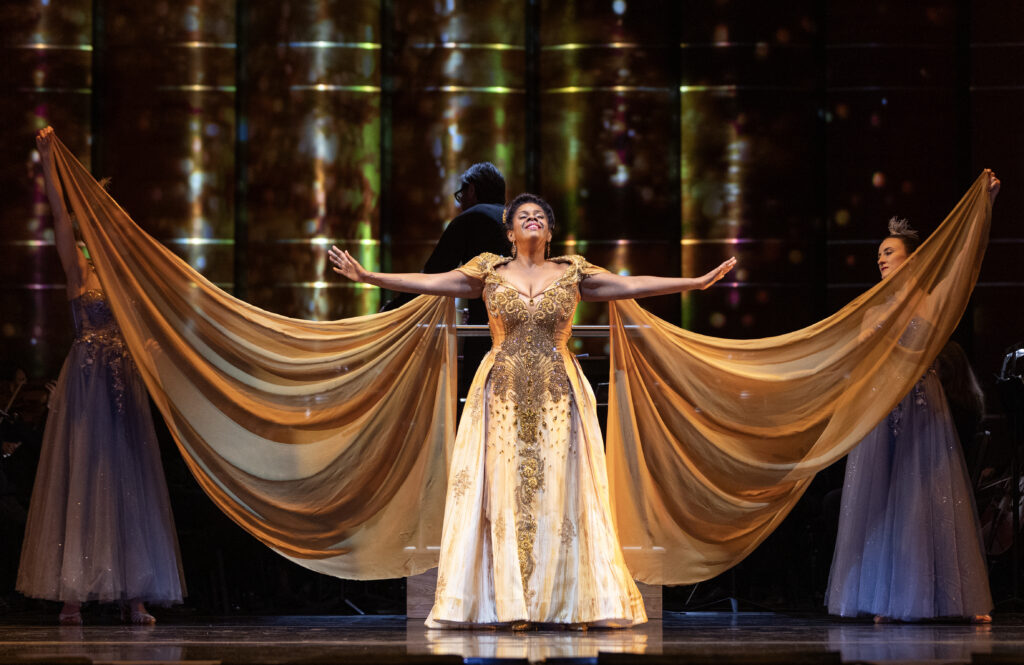
Another unusual aspect of Thaïs is its inclusion of a ballet, an aspect of French Grand opera that most people have not seen as Italian and German opera is so predominant. This appears in Act 2. In a pre-talk, Scholar-in-Residence Dr. Charles Carson said this “goes all the way back to King Louis XIV, who was a dancer. He said anything that happens in my Court needs a dance part so I can get into it! It became a social thing for the benefit of the aristocratic ‘party people’ who would show up late: the ballet essentially stopped the action so that the late-comers could enter and get seated before the opera proper resumed.
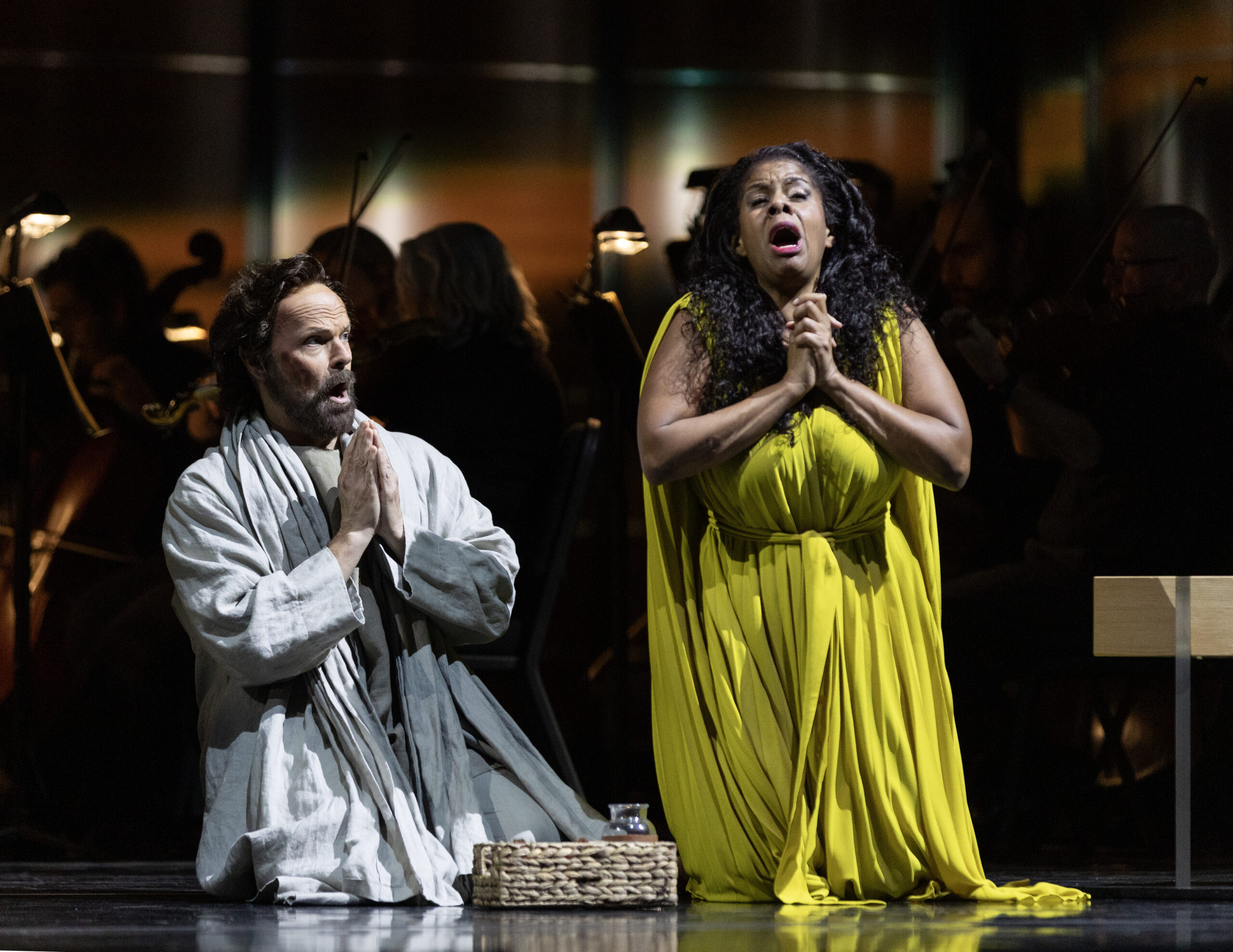
I spoke to one patron who was seeing opera for the first time. He said it was overall satisfying, although the pacing was quite slow. This was, he suggested, because of the thin plot. It does indeed extend itself too far, but the finale is one of operas’ grandest moments. Spine-tingling in its nature whether you are religious or not! Troy Cook as the scoundrel monk (who finally admits there is no Heaven), and Nicole Heaston as Thaïs (who actually sees Heaven) together send off sparks throughout this performance (lead photo). A joy to the eyes (with beautiful costumes) and ears.
Austin Opera Thais Photos by Erich Schlegel
Lead photo: Troy Cook as Athanaël and Nicole Heaston as Thaïs
second photo: Nicole Heaston as Thaïs
Visit Austinopera.org for tickets to future performances.