
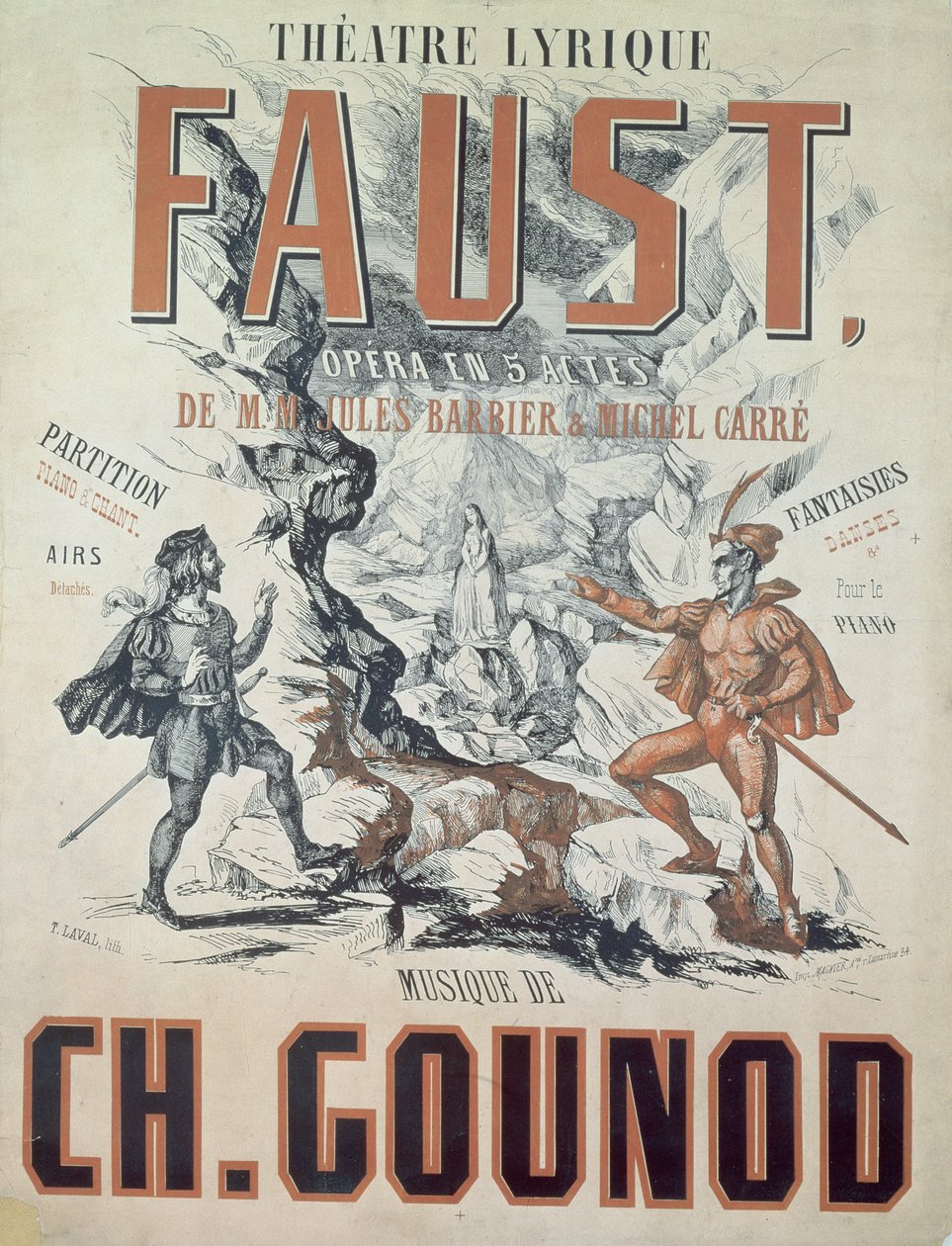
What better opera to see around Halloween than Faust? Based on a 16th-century German story of a fellow named Faust who sold his soul to the devil, this opera is based on the music by the French composer Charles Gounod.
That one premiered in 1859, and was quite traditional. An 1875 production was advertised by the poster shown here. This updated version (first staged in 2004), by the Scottish director David McVicar, shifts the action to the 1870s in Paris. He has reimagined Faust as a composer in the pattern of Gounod himself.
To quote the HGO notes, in “The climactic trio at the end of Act V, listen for Marguerite’s three repetitions of the glorious melody “Anges purs, anges radieux” (Pure angels, heavenly angels), each time sung a step higher—as if Marguerite is ascending toward heaven.” I found it to be one of the ultimate moments in the operatic canon, absolutely spine-tingling and quite uplifting, if I may venture a pun.
The primary singers performing these roles in this production are:
- Marguerite: Pretty Yende (soprano)
- Faust: Matthew Polenzani (tenor)
- Mephistopheles: John Relyea (bass-baritone)
I mention this at the outset as it is these three characters/performers who are central to the opera. Each singer is superbly able, but the combination of all three in that Act V finale is worth the price of admission.
My subtitle – eternal remorse – comes directly from the libretto by Jules Barbier and Michel Carre, first performed in 1859. That is really the keynote emotion of the opera, as the devil character, played by Relyea, induces all sorts of mayhem thanks to his pact with Faust. The document, sealed with Faust’s blood, appears in Act I. It is the first of several dominoes to fall. To the delight of Mephistopheles, in Act II, Faust (newly restored to youth by his new master) meets Marguerite and yearns for her. Their tragic embrace drives the drama in Acts III and IV.
The action of Act V is set on Walpurgis Night, an April celebration on the Catholic calendar to commemorate the 8th-century abbess St. Walpurga. Thus, the intervention of angels at the climax of the opera has its origin in this annual event.
The story of Faust has been reimagined many times through the centuries. For our time, the pact with Mephistopheles can be seen through the lens of humanity’s uncritical devotion to artificial intelligence, automation, and data harvesting. Scholars note that building complex technological systems without moral limits mirrors the hubris of Faust. The phrase “Faustian bargain” has entered the lexicon to label a host of human sins, from politics to the environment. It would be sobering to see the opera Faust brought forward once again, from the 1870s to the 2020s.
John Churchwell, head of the music staff at the HGO, made some relevant remarks at the pre-talk. What would happen if you could literally sell your soul?
“It’s simultaneously an exhilarating and terrifying conceit. On the one hand, you have a demonic concierge with unlimited power at his fingertips: the world is your playground and whatever pleasures or riches you desire are instantly yours. On the other hand, you have to keep up your end of the bargain. You’ve signed a contract in blood: your soul ultimately belongs to Satan. The question we’re left with: Is a brief lifetime of living like a god a fair trade for an eternity of suffering in hell? And whose lives might you destroy in the process? Many of us might recognise ourselves in the character of Faust.”
HGO has performed versions of Faust no less than 8 times, beginning with the 1961-62 season, so it can be considered an old war horse. Even so, since this is the first performance in a decade, it will reach many new audience members. Director of this revival is Peter Relton. Scenic design by Charles Edwards is dramatic without overwhelming the narrative.
Faust is being performed Nov. 7, 13 and 15, 2026. Masquerade attire is encouraged at the Nov. 13 show.
Performance time, including intermission, is just over 3 hours.
Venue: Wortham Theatre Centre, Houston
Tickets: www.houstongrandopera.org
For more musings about the meaning of the Faust legend, read the online 2022 article in The Opera Queen, by Catherine Kustanczy.