
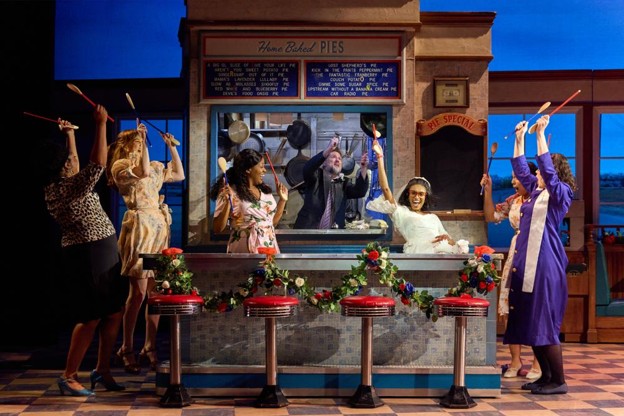
Broadway in Austin produced another blockbuster show, which enthralled the audience, producing fits of yelling, clapping and whoo-hooing while the performers weren’t even halfway through their songs.
Waitress, celebrating its 10th year, graced the Austin stage for two nights at Bass Concert Hall.
Written by Jessie Nelson and based upon the motion picture (which I had never seen) by the late Adrienne Shelly, the all-female production team did a bang-up job. The highest accolades go to Sara Bareilles for the music and lyrics. Perhaps together with Sara and the Waitress (live) band, Nadia DiGiallonardo for the original music supervision and arrangements, and Abbey O’Brien for tour direction and choreography, we need more than kudos and applause. The musical elements were beyond anything I have recently heard. Every actor was more than a competent vocalist. The sound was crystal clear and moved me to laughter, tears, sadness, and joy throughout the evening. Let’s give it up for the musicians, starting with conductor/pianist Jáyla McLennan, associate conductor, and keyboardist Aj Yi, Mitch Lee on drums, Joshua Bartkowski on bass, Annabelle Fuerst on cello and guitar, and Jason Gray on guitar.
Samantha Lane Scruggs played the main character, Jenna Hunterson, a waitress and expert pie-maker who dreams of a way out of her small rural Southern town, not least because of her abusive marriage to a louche, drunk, arm-swinging idiot with a massive ego and pea-sized brain. Jason Whitton plays Cal, the husband. The waitresses at Joe’s Diner include Becky, played by Hannah-Kathryn Wall (tremendous vocals), a take-no-prisoners realist and down-home pragmatist, and Dawn, played by Becky Alex, a stereotypical shy, nerdy perfectionist with low self-esteem. These three are a triumvirate of support to one another.
Jenna is determined to escape her brute husband and sees an opportunity in a pie contest in another town, where the prize is $20,000. Her pie-making talent could offer her a way out and a chance to build an independent life. At the same time, she begins a madly passionate affair with an out-of-town gynecologist, Dr. Pomatter, played by Connor Lewis. Then she gets pregnant.
She seems independent and strong-willed until that moment. That’s what I take umbrage with. In a spate of plays and adaptations of the past twenty years, even the female writers have gone right-wing, and what I mean by that is that they give women no choices in their reproduction. Why didn’t Jenna or the doctor use a form of protection? Him, a condom, and her, an IUD, the pill or diaphragm? Why is getting pregnant the wonderful, happy choice for a young woman in her twenties when she has the entire world ahead of her? It is so engrained in the long history of suppression of women that this ruffled me.
There were other elements that jarred me. They ate TV dinners in the 1990s? Who ate that? When I was growing up in the 1960s, when my parents had my grandparents babysit, that was a quick way to serve dinner, but it was a treat, like Halloween candy. Not a staple! The way Jenna succumbed to her boyfriend’s abuse was typical also of the 1950s, when women didn’t raise their voices, but again, this was a modern play, and the premise was that she was going to escape.
The gynecologist was a quack all along. When he first met Jenna, he didn’t even take her blood when she visited him during her pregnancy, nor offer a sonogram. When she visited him a second time, saying she was bleeding, he shooed it off and said it was normal. It is absolutely NOT normal to bleed during a pregnancy.
She doesn’t enter the contest because her husband stole the money she was saving for it. He finds it in the couch in their apartment (why on earth wouldn’t she open her own bank account in the 21st century?).
Turns out the gynecologist doctor is married. This doesn’t phase Jenna, and the moment the baby is born, she totally forgets about her passionate love affair with the doctor and everything that preceded this. Her husband, meanwhile, rants and rages in the hospital while the boyfriend gynecologist is there, but he storms out. That would never, ever happen given the scenario, environment, and geography of the place.
Jenna decides to give birth since that is the happiest ending and that is when the story falls apart. The conclusion feels vacuous, a short way to end the play. The passionate affair, the married doctor, and the emotional complications that preceded the birth seem to evaporate the moment the baby arrives.
After the birth, Joe gives the diner to her to inherit. Again, Jenna relied on men for her existence, like in Gone with the Wind, she relied on the kindness of men and that made me angry. Nothing at all to do with independence. Finally, Jenna doesn’t even name the new diner after herself; she names it after her daughter.
For tickets to future Texas Performing Arts shows
Visit the official Texas Performing Arts ticket office for upcoming Broadway in Austin productions, concerts and other performances at Bass Concert Hall and McCullough Theatre.
Tickets and upcoming events: https://texasperformingarts.org/