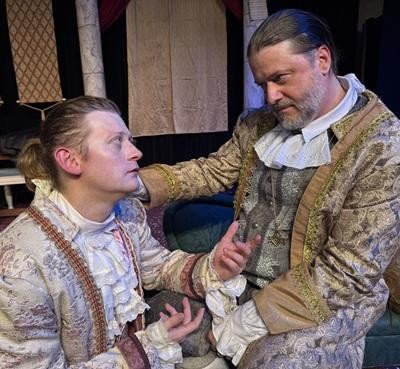
City Theatre’s Amadeus gave my eyes and ears two very different evenings. Beautiful period costumes, complemented by wigs and makeup, established the elegance of eighteenth-century Vienna, while the mixture of accents and contemporary conversational delivery repeatedly brought me back to present-day Austin.
Visually, the production offered considerable pleasure. Costume coordinator Kristin Knipp, supported by Tracy Hurd, deserves recognition alongside Bert Flanagan, who created the women’s dresses, and Virginia Davis, who designed the costumes for Mozart, Salieri, and Emperor Joseph II. Together, their contributions supplied the production with a persuasive period appearance and some of its most memorable artistry.
Directed by Bridget Farias Gates, Peter Shaffer’s play examines the corrosive envy of court composer Antonio Salieri toward Wolfgang Amadeus Mozart. Brad Forsyth plays Mozart opposite Kevin Gates’s Salieri, a man whose ability to recognize extraordinary talent becomes its own exquisite torment. Beneath the courtly manners lives an artist forced to comprehend the brilliance he longs to possess.
Inventive interpretations appeal to me, and theatrical convention offers ample room for experimentation. Once a production commits so thoroughly to a period through its clothing, however, I expect the speech and physical details to support that world. Here, the care devoted to the costumes heightened my awareness of choices that pulled in another direction.
Emperor Joseph II began with an accent suggesting a European inflection, while other characters spoke in recognizably American English. To my ear, the mixture made the court sound assembled from different theatrical worlds. A shared British or Anglicized delivery would have suited my sense of the production’s formal appearance; consistency across the ensemble would have strengthened the illusion.
Phrases such as “I mean” and “like,” delivered with the familiar cadence of contemporary conversational fillers, became particularly distracting. Context and rhythm determine how such words land, and the delivery I heard suggested casual present-day conversation amid the courtly finery. Each occurrence loosened my connection to the setting the costume team had worked so carefully to establish.
Constanze Mozart’s nose ring sharpened that impression. Against the surrounding period dress, the adornment registered as a conspicuously modern detail and drew my attention directly to the performer’s appearance. Within such a specific visual setting, even a small accessory carries considerable weight.
Elsewhere, the staging offered an engaging approach: keeping the ensemble together in a shared space, with voices and whispers giving life to the surrounding gossip. Background murmurs turned the court into a social organism, constantly listening, assessing, and circulating information. Through that arrangement, private jealousy acquired a public atmosphere, as though every ambition had an audience and every indiscretion its messengers.
Salieri’s hypocrisy provides especially fertile dramatic ground. His professed devotion and cultivated respectability coexist with his willingness to manipulate Mozart’s wife, using professional influence as leverage for sexual favors. Mozart’s vulgarity offends his sensibilities, while his own behavior exposes the appetite for power beneath his moral posture.
Shaffer places a delicious cruelty at the center of this relationship: Salieri possesses the discernment to understand exactly how gifted his rival is. Recognition feeds resentment, and admiration becomes entangled with the desire to control another artist’s future. Court gossip, professional ambition, and personal grievance all belong to that tightening web.
Ultimately, my reservations centered on the relationship between the production’s parts. Elaborate costumes invited me into a richly imagined period, and the whispered ensemble staging gave effective expression to its social machinery. Greater unity in vocal delivery and personal styling would have helped sustain the theatrical world those elements so vividly promised.
Special recognition also goes to Andy Berkovsky, City Theatre’s artistic director, for his continuing commitment to Austin theater and the artists who bring it to life. Sustaining a local company requires persistence, resourcefulness, and an enduring belief in the value of gathering people around a live performance. His work deserves a warm acknowledgment as City Theatre celebrates its twentieth anniversary season.
Amadeus continues through October 18, 2026, with performances Thursday through Saturday at 8 p.m. and Sunday at 3 p.m. Performances take place at Genesis Creative Collective, 1507 Wilshire Blvd., Austin, TX 78722. Tickets are available through City Theatre’s ticket site; additional information is available at citytheatreaustin.org, by email at info@citytheatreaustin.org, or by calling 512-470-1100.