
What happens when a handful of people place the future of humanity behind sealed doors and take on the responsibility of deciding its fate?
That unsettling premise lies at the heart of L.B. Deyo’s original play, Oversight, presented by The Zahir. As Artistic Director, Deyo has written a script that is philosophical, political, deeply human and unnervingly timely. Oversight asks a question that has become impossible to ignore: How dangerous is artificial intelligence?
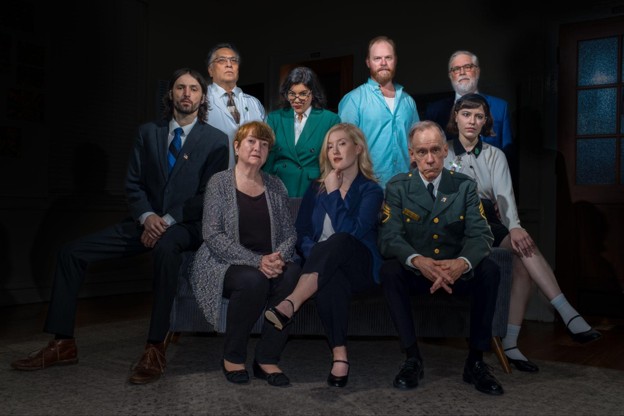
Set entirely inside a secure government committee room in Washington, D.C., the play unfolds as seven officials and a lone stenographer convene under extraordinary circumstances. Their mission is deceptively simple: determine whether the United States should commit trillions of dollars toward expanding an American AI initiative to maintain technological superiority over China.
From that premise emerges a tense, fast-moving debate about power, ethics, national security, and the accelerating pace of technological change, which the inventors cannot predict. Rather than offering simple answers, Deyo invites the audience to think about the repercussions of what is happening that feels remarkably familiar in today’s political climate.
The committee members represent sharply opposing worldviews. Some are pragmatic, others ideological, and still others appear driven by personal ambition or institutional loyalty. Their disagreements mirror many of the divisions that dominate contemporary American politics, creating moments that are both provoking yet disturbing, and darkly humorous.
Robert Pierson delivers one of the evening’s strongest performances as Senator Greune, whose skepticism about the enormous financial and ethical costs of the proposal provides a compelling counterweight to the urgency expressed by others around the table. The character evokes the populist skepticism associated with figures such as Bernie Sanders in questioning whether the staggering financial and ethical costs of the proposal truly serve the public interest.
Dana Mara brings authority and composure to Committee Chair Erin Johnston, attempting to maintain order as increasingly difficult. Egos get ruffled when questions emerge. Justin Smith’s Vice President gradually reveals layers beneath an initially sardonic exterior. His folksy Southern cadence, tendency to sidestep direct questions, and self-assured commentary often recall the rhetorical style of Vice President J.D. Vance, adding moments of dry humor while underscoring the political theater unfolding inside the committee room. David Kroll’s General Stossen embodies the military’s strategic concerns with conviction, while Laura D’Eramo adds a stereotype of a TV broadcaster’s presence as the often-interrupting Secretary of State.
As the scientific voices behind the project, Rommel Sulit and Jessica Cohen portray the tension between innovation and responsibility. Sulit’s portrayal of Kareem Najah, the Chief Scientist at Open Brain, was intriguing in its restraint. His downward gaze and halting delivery created the impression of a scientist struggling to communicate the magnitude of his vision. His pauses and uncertainty made the character feel less like the confident architect of a technological revolution and more like someone searching for the right words to convince a skeptical room. Whether intentional or not, that vulnerability added another layer to the question at the center of the play: should humanity trust those who claim to be building its future?
What makes Oversight compelling is not simply its exploration of artificial intelligence. At its core, the play examines the people entrusted with decisions that could alter civilization itself. Their fears, biases, ambitions, backgrounds, convictions, and uncertainties become just as important as the technology under discussion.
Without revealing its final moments, Oversight builds steadily toward an ending that leaves audiences wrestling with hard questions long after the lights come up. Rather than offering certainty, Deyo leaves viewers to confront their own assumptions about progress, governance, and the price society may pay in the race for technological dominance.
In an era when artificial intelligence dominates headlines, boardrooms, and governments alike, Oversight feels like tomorrows’ front page. It is an ambitious and provocative and well written work that lingers long after the curtain falls.
Performance Information
Oversight runs through August 22, 2026.
Hyde Park Theatre
511 W. 43rd Street
Austin, TX 78751
For showtimes and tickets, visit:
Hyde Park Theatre: https://www.hydeparktheatre.org
The Zahir: https://the-zahir.org
Tickets: https://tickets.atxtheatre.org