
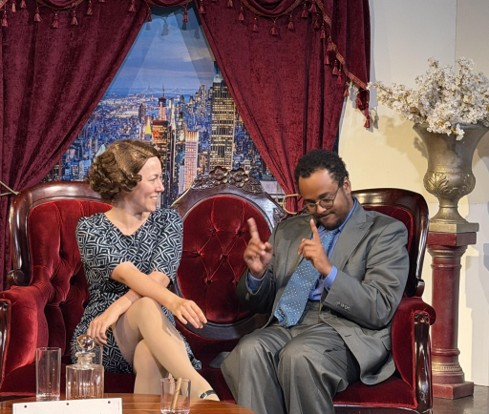
I almost missed Midnight, which would have been a shame. It was the last performance of the season, and I was thrilled to have seen it. Coming from the Bronx, I was laughing from the moment I walked into the theater. The absurdly overdone New York accents of the bellhops, Paolo and Ralph, who escorted me to my seat, immediately put me in the right mood for what was to come.
David Epstein’s Midnight, directed by Rene Fulton, is set in a Ritz-Carlton suite in New York in the 1950s, where a fading film director, an aspiring playwright, a determined assistant, a butler-actor, hotel staff and a couple of mobsters collide over a manuscript, a movie deal and a $1,700 debt that has to be settled by midnight. It is classic farce, but what made this production work was Fulton’s understanding of the world in which the absurdity takes place. Rene Fulton got the gist of what New Yorkers are all about, the 1950s, and making the absurd applaudable, particularly in the second act, when the level of insanity was cranked up.
The humor is often verbal, and there were lines that had me in stitches. One was a comic distortion of Shakespeare’s famous line from Twelfth Night, “If music be the food of love, play on,” transformed here into, “If music be the song of love, throw it on the ground.” Another: “Sooner or later every good play becomes a mediocre movie.” Both capture the play’s particular sense of humor, smart enough to recognize the cultural reference, irreverent enough to throw it on the ground.
Mark Gerchak as Theo Stinz, the bellhop and rogue Scotsman, won my heart. There is something wonderfully infectious about an actor who understands exactly how far to push a character without losing the character underneath the joke. Gerchak found that balance.
Jordan T. Maxwell plays the Bronx pizza guy who owes the mob $1,700. We never quite discover why. Is it a gambling debt? Maxwell’s character is wonderfully insecure and completely illiterate in the ways of Hollywood. Having written a play, he has sent his precious manuscript by post to Universal Studios, apparently believing that this is how one gets a script into the hands of Hollywood producers. His innocence makes him both funny and oddly endearing, particularly because he is surrounded by people who understand the machinery of show business far better than he does.
Taylor Flanagan’s Evie Maryweather is one of them. She is the PA, publicist, deal maker and eventual associate producer who appears to be holding the entire enterprise together while the men around her pursue their various fantasies of success. Evie falls in love with the Bronx pizza guy, and this is where I found myself unconvinced. I understood his appeal as a character, but I never quite understood why Evie fell for him. A strong woman perhaps scorned, definitely under appreciated by her boss, in her professional world. Perhaps she saw an innocence and authenticity in him that the others lacked; maybe that was the point. But the emotional leap never fully landed for me.
Matrex Kilgore’s James Halloway is another story altogether. Halloway is egotistical, hysterical in the sense of being emotionally uncontrollable rather than funny, and spectacularly unsuccessful. We have zero compassion for him, as we shouldn’t. That is clearly what Epstein intended, and Kilgore commits fully to the character’s self-importance and desperation. Halloway wants to be somebody in an industry that appears to have moved on without him, and his inability to recognize his own predicament is what makes him so deliciously exasperating.
But the scene that really got me was the slow-motion fight. It took the audience completely off guard. The choreography, the timing and the sheer absurdity of watching a fight unfold in slow motion created one of those rare theatrical moments when an entire room seems to discover the joke simultaneously. It was a barrel of laughs, and for me it was the best scene in the play.
That is ultimately what Midnight does well. It doesn’t ask us to take these characters seriously, but it does take their ridiculous dreams seriously. Everyone wants something: recognition, a career, a break, a deal, a way out. They are all chasing some version of the life they imagine they deserve, and the collisions between those desires are what drive the comedy.
There is also something fitting about Summer Break Theatre choosing this play for its return after a brief hiatus. Founded by educators and theatre artists Jon DeMitchell and Maggie Meador, the company exists to celebrate and support educators through the performing arts. The company’s own story, returning to the stage and continuing to create, echoes the stubborn optimism at the heart of Midnight: the belief that you keep making the thing, even when the odds are against you.
Credit where credit is due: the production team behind the madness deserves its own applause. Maggie Meador, Producer; Rene Fulton, Director; Mel Hinojosa, Technical Director; Carolina Davila Villarreal, Stage Manager; Gavin Kenter, Lighting Designer; and Caleb Bell, Sound Designer. Farce is deceptively difficult to pull off. Behind every perfectly timed entrance, slammed door, lighting cue and slow-motion punch is an army of people making sure the chaos looks effortless.
I left the theater laughing, which is no small achievement. More importantly, I left thinking about how much live theater depends on timing, chemistry and the willingness of an entire ensemble to commit to the ridiculous. Midnight had all three. I’m very glad I caught the final performance of the season.
For future productions, keep an eye on Summer Break Theatre: www.summerbreaktheatre.com.