
The author of this exemplary book dealing with sympathy in Romantic-era literature is Stacey McDowell, associate professor of English and Comparative Literary Studies (Univ. of Warwick).
I found the word ‘paradox’ to be particularly pertinent. McDowell uses the word twice early on in the book. Consider ‘shared reading’ where two people either read from the same book at the same time, or one listens while the other reads it aloud. The following paragraph encapsulates the animating principle of the book:
“Yet the attempt to share something so putatively private [as reading] often makes shared reading seem more like an experience of shared solitude. This notion of ‘shared solitude’ captures something of the paradoxical combination of privacy and sharing involved. That seeming paradox is what also accounts for shared reading’s appeal: lured by the idea of reading’s inwardness attempts to share it are lured too by the promise of insight into something cherished for its inviolability.”
In the second instance, McDowell relies entirely on the work of the scholar Adela Pinch, who identified “a paradox in late eighteenth and early nineteenth-century studies of emotion, which on the one hand insist that what makes feelings authentic is that they originate in private, inner experience and on the other appreciate that people often come to know their own feelings second-hand by encountering them in books.” Why this insight was not extended to a full chapter on Mary Shelley’s works is yet another paradox.
For, despite the author’s grasp of the academic literature, I was surprised and disappointed that she did not mention the 2016 doctoral thesis of Shoshannah Bryn Jones Square (currently an assistant professor of literature at Mount Allison University, New Brunswick, Canada). The title of her thesis is: “A Complicated Compassion: The Paradox of Sympathy in Mary Shelley’s Fiction.”
Remarkably, Shelley is only mentioned once (in a footnote) in McDowell’s book. As sympathy is the very essence of the book under review, and since Shelley was one of the pre-eminent Romantic-era authors, I can only say that eliding Shelley’s philosophy of sympathy is a serious matter. While the conclusions McDowell reaches remain valid within the remit of what she has studied, they could have been so much more broadly applied by taking all of this into consideration.
This is not the place to summarise a 250-page doctoral thesis, but I will note that in Square’s research, she examines the complex and contradictory motivations behind sympathy in Shelley’s works, showing that it can “arise from benevolence, self-interest, or a combination of the two, an entangling of intentions that serves to complicate this moral sentiment.” Nonetheless, Shelley “celebrates sympathy as a social virtue, as the locus of our moral selves. Shelley’s understanding of sympathy was partially shaped by the Moral Sense philosophy of Shaftesbury, Francis Hutcheson (1694-1746), David Hume (1711-1776), and Adam Smith (1723-1790), whose ideas resonated with many of the imaginative writers of the Romantic era.” (quoting from the thesis) All four of these men are treated by McDowell, making the absence of Shelley all the more keenly felt. As Square writes, “Shelley shows how the natural limits of sympathy might be mitigated through reading.”
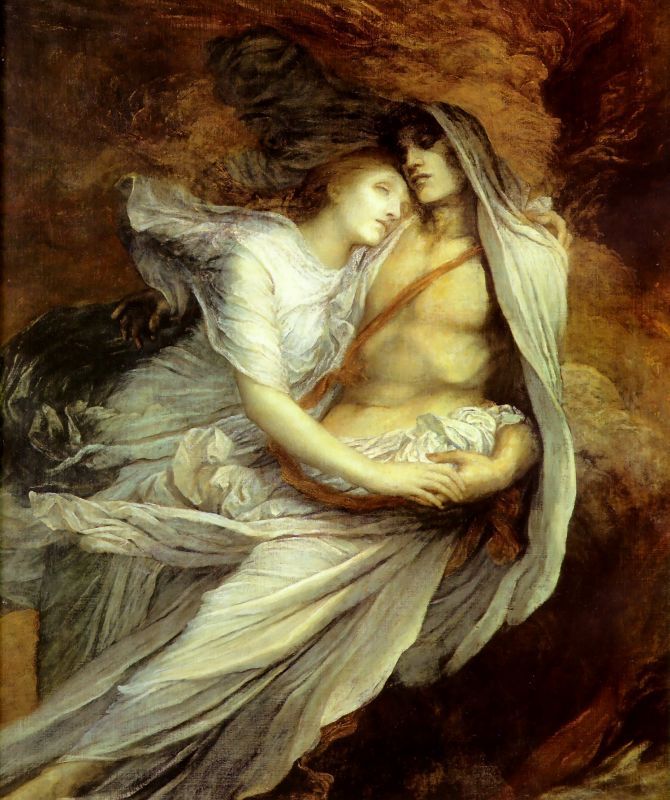
As McDowell states in her Introduction, Smith’s 1759 book Theory of Moral Sentiments lists as a possible source of mutual sympathy “the act of reading to a companion.” For Smith, reading together is a test of sympathy. The spark for much of the literature McDowell studies is depicted on the book’s front cover: from Dante’s Inferno, we encounter Paolo and Francesca. In the painting by Ingres on the cover, we see the handsome Paolo giving Francesca a kiss on the cheek. But in the Inferno, he kissed her on the lips. Not so awful, except for the fact she was married to Paolo’s ugly brother. That was enough for Dante to find them in the second circle of Hell: the horrific image I use with this review shows the lovebirds entwined, in eternal damnation.
What brought them to this fate? Reading a book together.
Not just any book, but the tales of the court of King Arthur, where his wife Guinevere was kissed by Sir Lancelot. This is the fatal kiss they were compelled to re-enact. Centuries after Dante wrote about the star-crossed lovers, Leigh Hunt took the 66 lines Dante wrote about them and expanded it into a 1700-line poem. While writing it, Hunt asked for some advice (which he mostly ignored) from none other than Lord Byron, the quintessential Romantic-era writer. After Hunt’s work Story of Rimini was published in 1806, Byron had a go at the Paolo-Francesca tale as well: he even visited Rimini, where they purportedly lived and died. His take on the romance found its way into several works ranging from the famous book Don Juan to The Prophecy of Dante (1821). A fine study of the works of Byron and Hunt forms the core of McDowell’s book.
One might say Byron was obsessed with the story, which invaded his own private life. In 1813, when trying to extricate himself from his relations with Caroline Lamb, Byron expressed a desire “to be spared from meeting her until we may be chained together in Dante’s Inferno.” But Byron did not blame Paolo and Francesca for what happened. He blamed Plato! Byron believed it was “not all those poetic fantasies of romance that lead readers astray, but rather a deceiving fantasy of immunity within the ideal of platonic or spiritual love,” quoting McDowell.
She also quite properly pushes back against other scholarly opinion. In the case of John O. Hayden, who remarked that Francesca “responds like a shop-girl,” to Paolo’s advances, McDowell says he “mistakes prosaicness for lack of subtlety.” She also calls out Richard Darnton (emeritus professor at Princeton) for a misleading translation relating to Rousseau’s novel Julie (1761). A bestseller of its day, people sent fan letters to Rousseau: “they were moved to sympathy by the feelings the novel portrayed” and were led to “reflect upon and give vent to their own.”
Darnton points out that a line from Julie is used in 1799 by Adam Bergk in his work The Art of Reading Books. Bergk went on to write that reading should help develop the “maturity of mind and heart,” whereas Darnton’s translation states rather that reading “should help us find an outlet for the expression of our heart and mind.” While Darnton “wants to see Bergk as paving the way to Romanticism,” McDowell is having none of it. Maturity and expression are not the same thing! Darnton, she writes, mistakenly “takes the subjectivity and expressivity associated with Romantic writing and finds an equivalent in the act of reading.” It is in such correctives that a proper understanding of the past is established, a sterling achievement of McDowell in this book.
I could easily write another thousand words in this review, but I will briefly conclude with Goethe’s 1774 book The Sorrows of Young Werther, certainly one of the most famous (or infamous) of the century. In that tragedy, which spawned numerous real suicides in Europe, we find Charlotte and Werther reading together (sound familiar?). Just one kiss and Charlotte’s reaction causes Werther to kill himself.
“Goethe,” writes McDowell, “signals the lovers’ emotional symmetry through symmetrical structures of language in what amount to a grammar of intimacy.” Thus, the title of this review.
In conclusion, I will revisit the concept of paradox, which makes an appearance in the final pages. McDowell writes

“By showing just how little gets shared in any episode of shared reading, Romantic writers seem keen to preserve its unknowable element of reading, the sense of what remains inscrutable and ineffable and therefore tricky to share. In these cases, the paradox of shared reading seems to be that the only way to share the experience is by not trying to share it or talk about it at all.”
Despite the concerns I expressed about not including Mary Shelley, this is a most insightful book whose conclusions are so important they must be brought into the general consensus of any literary study of the period. This is the 158th book in Studies in Romanticism, by Cambridge University Press. The extraordinary project began in 1993, averaging 5 new titles annually.
There is a typo on pg. 187, in footnote 121: New Yok should be New York
Reading Sympathy in Romantic Literature is by Cambridge Univ. Press. It lists for $130.
Lead Image: Paolo et Francesca, by the Symbolist painter George Frederic Watts, 1872-75
Second image: road sign for Paradox, New York. Photo by C. Cunningham
Extended Reading: For those who are a bit rusty on their Dante, this is what transpired when Dante met Paolo and Francesca in Hell
“And I began: “Thine agonies, Francesca,
Sad and compassionate to weeping make me.
But tell me, at the time of those sweet sighs,
By what and in what manner Love conceded,
That you should know your dubious desires?”
And Francesca responds:
And she to me: “There is no greater sorrow
Than to be mindful of the happy time
In misery, and that thy Teacher knows.
But, if to recognise the earliest root
Of love in us thou hast so great desire,
I will do even as he who weeps and speaks.
One day we reading were for our delight
Of Launcelot, how Love did him enthral.
Alone we were and without any fear.
Full many a time our eyes together drew
That reading, and drove the colour from our faces;
But one point only was it that o’ercame us.
When as we read of the much-longed-for smile
Being by such a noble lover kissed,
This one, who ne’er from me shall be divided,
Kissed me upon the mouth all palpitating.