
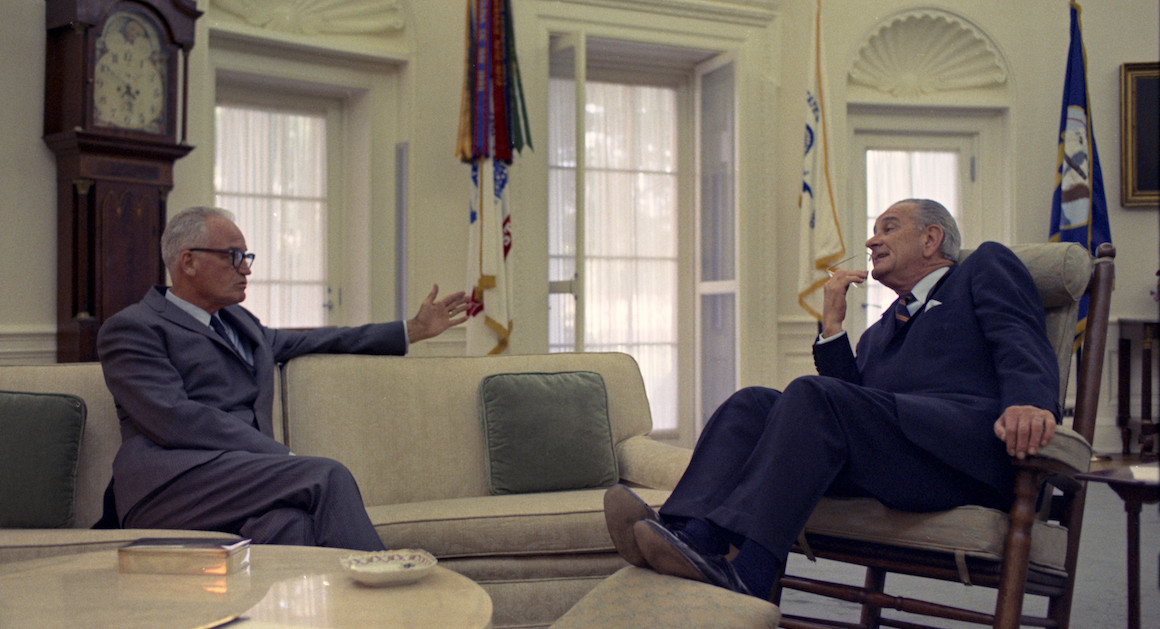
Photo: Goldwater and LBJ in the White House, 1968
Former VP Mike Pence made it clear how he regards the legacy of President Lyndon Johnson. Speaking at the LBJ Presidential Library in Austin yesterday, he boldly stated “I happen to believe that the Civil Rights Act of 1964 is the greatest legislative accomplishment of the 20th century.” This was greeted by thunderous applause, particularly as everyone in the audience is aware of the recent decisions by the Supreme Court and the Administration to nullify that Act.
Pence was a Democrat before Reagan came into office.
“Let me say, the heroes of my youth, they are two men that continue to be deeply inspiring to me this day are President John F. Kennedy and Reverend Dr. Martin Luther King. Their eloquence, their idealism.
“President Kennedy’s inaugural address about making God’s work on this earth our own continues to be a great source of inspiration.
“I know President Johnson serving alongside as his Vice President, and then taking the reins in tragedy, was an extraordinary moment in the life of a nation. But it was those leaders that inspired me first, and still inspired me to this day.
“I love how Dr. King viewed the Declaration of Independence: as a promissory note. It was unfulfilled, but he always had a hopeful and an optimistic view.”
BARRY GOLDWATER and CONSERVATISM
“President Calvin Coolidge said, ‘leaders come and go, issues change, the principles are final.’ If all men are created equal, that’s final. If government derives its legitimacy from the consent of the government, that’s final.
“It seems that we’re living in a time where we focus more on what divides us as a country instead of the things that we’ve all long believed. And I think that was Barry Goldwater’s assertion.”
Pence has just written a book, What Conservatives Believe, which relies heavily on Goldwater’s views. Much as he admires Goldwater, Pence distances himself from the 1964 presidential candidate for the Republican party.
“There are issues about which, candidly, Senator Goldwater got wrong: he opposed the Voting Rights Act.”
What I try to do, Pence explained, “is take those same conservative principles and apply them to the challenges of today.
“I actually met Goldwater once, when I was five. His train made a whistle stop in that ’64 presidential race. It came through little old Columbus and Vienna. I don’t even know why they stopped, the town was so small.
“But my mother – she was a big fan of him – put me and my three brothers in these little train hats that the campaign passed out. She put us on a flatbed truck with hay bales, and got a picture in paper! So, I can say I campaigned for Goldwater!”
Pence’s commitment to conservatism makes it all the more anomalous that he partnered with DT. “As I write in the book, in all fairness to the President, he’s never said he was a conservative. In fact, he’s said on a number of occasions, a couple of which I quote, he said I’m not a conservative.”
JOKESTER
Pence tried to put the audience at ease in his opening remarks.
“I’m not used to crowds this large anymore. A little out of practice. Not long ago I got invited to speak at a small town in eastern Indiana, and I was running late, kind of as usual.
“I was hustling up to the head of the auditorium, and the guy that invited me was standing in the doorway looking sheepish. I looked down and I saw there were three people on the front row for my speech.
“I said, “Did you see there were just three people here for my talk?” He said, “Yes, sir. I’ve seen that.” And I said, “Well, didn’t you tell them I was the speaker?”
“And he said, ‘”No, sir, I’m going to find out who did!’” This was received with great laughter by an audience consisting almost entirely of Friends of the LBJ Library. I expect few members of the opposing party were present, but they applauded him repeatedly when he defended the sanctity of the Constitution.
PRES. REAGAN
Pence was in conversation with Mark Updegrove, CEO of the LBJ Library. “You actually got to know another founding father of modern conservatism, Ronald Reagan, who you alluded to in your speech,” prompted Updegrove.
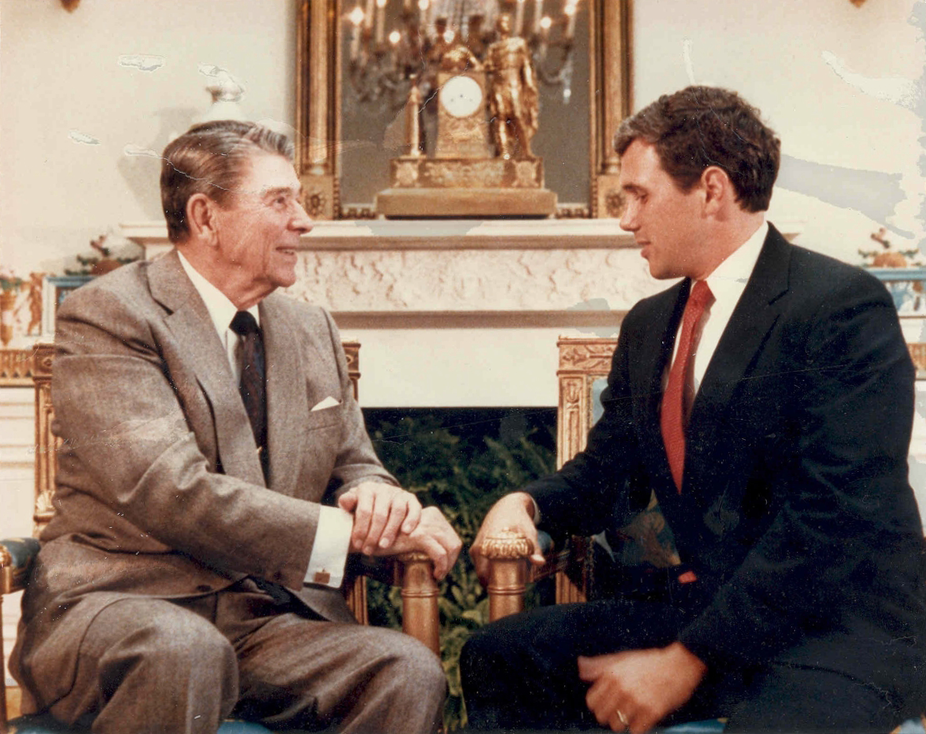
“Yes, I have said Reagan grew up in the Midwest. Can we be really clear on that? He grew up not really very far from me, you know, in a small town.
“And I literally was drawn to his idealism, his eloquence, but when I met him in 1988, I was a first time candidate for Congress. I’m the black-haired guy sitting in the blue room next to the president.” (see photo)
Pence was with his young bride in the White House, and was given by his campaign staff some nonsense to read to the President. “And I just, I looked at her and I said, you know, I think I’m going to tell my grandkids about this moment. I don’t want to read this to the president.
“Karen patted me on the arm and said, just tell them what you want to tell them.
“And I sat down nervously, sat ramrod straight, and I just said to President Reagan, ‘Mr. President, I want to thank you for what you’ve done to inspire my generation to live in this country again.’”
“Because all the heartbreak of the Vietnam War, all the scandal of Watergate, all the malaise of the 1970s, it felt in that moment in 1988 that he provided a kind of principle-based leadership.
“Part of the title of the book comes from his farewell address. President Reagan actually said that he didn’t consider the principles that he governed on as being new ideas. He said, ‘I consider more of a rediscover.’”
“I think what Ronald Reagan stood for is really what, in the name of what both parties stood for, for generations throughout our history, which was to provide for common defense to promote freedom and free markets and free enterprise. And I sense he stood for those things and that’s what drew me to the party.
“One of the reasons that I wrote the book was I feel that the Republican Party was minted on those principles whether you agree or disagree with them.
“But I really do believe we’re living in a time when many, many Americans right of center are confused about what it means to be a conservative. We weren’t confused back in the ’80s, or I would argue during Bush years, or during my time in the Congress, through the time I was Vice president.”
THE INSURRECTION
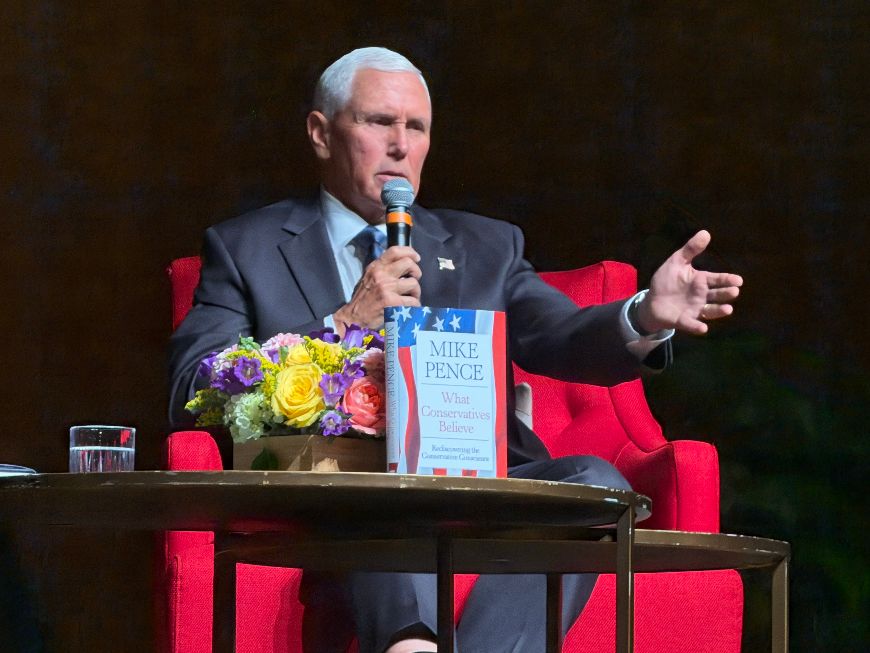
“I think January 6th was a tragic day in the life of our nation. But thanks to the courage and law enforcement, the riot was quelled. The only heroes I saw that day were wearing uniforms,” an assertion that got loud applause. His appearance at the LBJ Library is pictured here. In the photo, you can see his book on a table in front of the Vice-president
“I believe it will be remembered as a day of tragedy, but I hope history also records it as a triumph of freedom. Because on the very same day, every member of the House and Senate, Republican and Democrat, returned to their chambers and completed their order for the peaceful transfer of power under the Constitution of the United States of America.
“I mean, our system was challenged. But our institutions, our form of government, our institution held. I never felt a greater sense of resolve on any day of my life than that day. I knew I was where I was supposed to be doing what I was supposed to be doing.
“The thing I’ve learned traveling around the country over the last five years is that the Constitution is the common ground in which we stand.
“I write a whole chapter in the book about, for me, as a conservative, this is about what I believe a conservative is doing, that keeping faith in the Constitution is the beginning.
“The President and I are very different people. But what made that day tough was that, he wasn’t just my president, he was my friend. And leading up to that day, I made it clear to him what I understood my obligation under the Constitution. We ended up in cross purposes.
“We actually parted amicably, because I can honestly tell you the president was actually very contrite in the remaining weeks of the administration. privately exceedingly so with me.
“In fact, I remember one late night, related to one of our meetings where we were going through the details of the transition, it was just the two of us in that little dining room just off the Oval Office. And the president was very down.
“And I just looked at him as we were wrapping up the meeting and I just said, ‘I want you to know I will pray for you.’ And he looked at me and said, ‘Don’t bother.’
“I got up and was walking out the door and I stopped and turned around and I said, ‘You know, I get the impression there’s two things we’ve never really been able to agree on.’
“And he looked up and said, ‘What’s that?’ And I said, ‘I don’t think we’re going to agree on my duties on January 6th.’ And I said, ‘I’m never going to stop praying for you.’
“And he said, ‘That’s right, Mike. Don’t ever stop.’”
“You know, in the months that followed, we talked a few times, but when he returned to the rhetoric that he was using before January 6th, I just thought it was best apart ways.”
On the subject of the $1776 million fund to reward those who tried to overturn the Constitution (the most despicable presidential proposal ever in American history), Pence waffled, drawing a distinction between those who committed violence and those who didn’t.
“I think the President was wrong to pardon anyone who assaulted a police officer or vandalized a cop. And I said over the last couple of weeks, anyone who assaulted a police officer or vandalized a cop should not get one dime of taxpayer money.”
CHINA and UKRAINE
“How we deal with China is one of the great challenges of our time. It’s a challenge that will require both parties working together to meet the moment. Our administration, I think, changed the national consensus on China.
“I remember my first days as a vice president, you do courtesy meetings with senators on Capitol Hill. And I went to Senator Chuck Schumer’s office; I’d known Chuck for a long time. And he said to me, “I’m going to fight you every day, except China.” He goes, “You can be as tough as you want on China on 100 percent.”
“And literally, in the course of our administration, we essentially sent a message to China that years of trade abuses, intellectual property theft, military provocations, human rights abuses against Muslim Uyghurs and other minorities, including Christian pastors: we just said that’s over.
“We imposed $250 billion in tariffs on China. And China came to the table and negotiated a phase one trade deal in the early days of 2020.
“I don’t believe that it is inevitable that we will end up with either a political or an economic or otherwise confrontational challenge with China. But I think it depends on us. I met President Xi: I stood toe to toe. He’s made his intentions about the Asia Pacific clear, beginning with Taiwan.
“But I believe if we remain strong, if we remain committed to our free allies in the Asia Pacific, if we hold China accountable to open their markets and end the trade abuses in other countries, then we have a pathway forward.
“The truth is, as I write in the book weakness arouses evil. And if we show weakness, this is where I think Ukraine also matters. We called on our European allies to live up to their commitments, $120 billion more in investments in our common defense. I think the aid that Europe is now providing to Ukraine is greatly facilitated by the defense bill that we called on our European allies to make. So that was significant.
“I’m going to tell you what, if America and the West falters in Ukraine, it will only embolden China and other authoritarian regimes to attempt to redraw international lines by force. That’s another reason we’ve got to stand with the people of Ukraine.”
Photo in Austin by C. Cunningham at the LBJ Library, June 10, 2026.
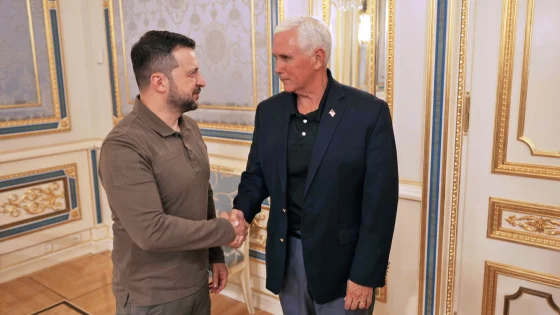
Final Photo: 2023 meeting with Pres. Zelensky of Ukraine
Lead Photo: Senator Barry Goldwater and President Lyndon Johnson in the Oval Office, May 21, 1968.