
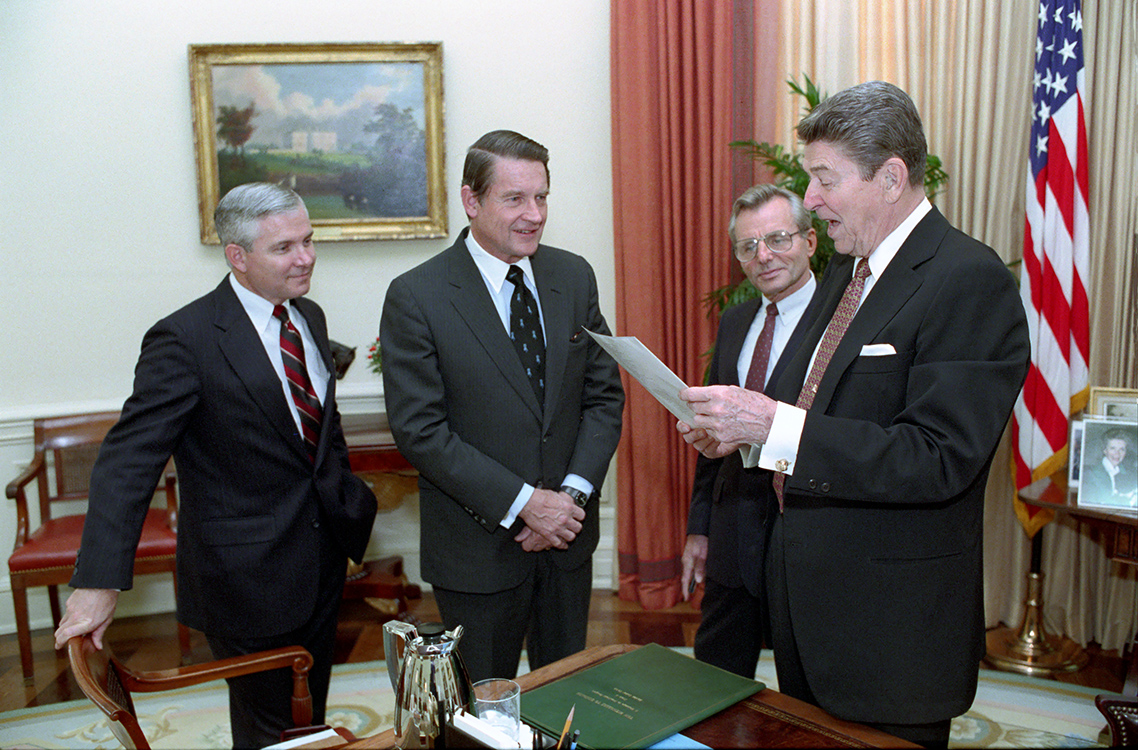
In a recent appearance at the University of Texas in Austin, former Secretary of Defense Robert Gates shared his fond memories of both British PM Margaret Thatcher, and his boss Pres. Reagan.
“It was my good fortune to have a number of dealings with Margaret Thatcher over the years. I was the only person working in the White House when she became Prime Minister, who was still working in the White House when she left office, 11 years later. She changed Britain and she saved Britain. When Tony Blair was elected somebody said, who won the election? The answer was Margaret Thatcher, because Blair adopted many of the policies that she had.
“I will share a Margaret Thatcher anecdote. Gorbachev was withdrawing forces from Eastern Europe and we were being slow under the first President Bush to respond. We had to seize the initiative and begin to draw down some forces in Europe. And so we (Defense Department, and the White House and the State Dept.) put together a plan of what we would draw down. The deputy secretary of state at the time, Larry Eagleburger, and the President, wanted to give the leaders in Europe a heads up about what he was planning and get their reaction.
“So he wanted to send Larry Eagleburger and I to meet with Thatcher, Helmut Kohl in Germany, Francois Mitterand in France, and Andreotti in Italy. And we figured we’d do Thatcher first, because we figured when you get through her, the others would be a piece of cake.
“She would not have it, and she didn’t like it. But she said, ‘the President wants to do this, fine.’ So, then we did a second round talks three months later: he sent Eagelburger and I back. And she greets us very icily and we’re meeting up in her parlor.
“She said, ‘won’t you take your accustomed seat?’ And that was the signal that she was not in a good frame of mind. And we did it and she finally agreed.
“But we’re walking out and she has her arm on each of our shoulders as we’re walking out of Number 10 Downing. And she’s smiling and very nice and she says, ‘You two are welcome in my house any time.’ Her hands drop, and then her face froze, and she said, ‘Never again on this topic.’
“And then the next day she calls Bush. She said, ‘Well, I met with Tweedledum and Tweedledee.’ I always played Tweedledee!” This was met with uproarious laughter by the audience at UT.
Gates then went on to relate a conversation in the White House. “I worked for two presidents who had no discernible sense of humour: one was Richard Nixon and the other was Jimmy Carter. But Reagan had a sense of humour. And the truth is, for me, a sense of humor reflects a person who’s at ease with himself, and has self-awareness and so on.
“I was briefing Reagan before his first meeting with Gorbachev in 1985. And we’re sitting in the oval office and George Schultz is there and all those poo bahs, and I’m sitting at the end of the couch and Reagan is sitting in the wing back chair and I’m briefing him, and I hear this terrible screeching noise and he reaches up and he adjusts his hearing aid in his left ear. He kind of winces, so it had to be painful.
“Another couple of minutes went by and all of a sudden I heard these terrible screams, and he kind of screwed up his face, and he pulled his hearing aid out of his ear, and he pounded it in his hand, and as he was putting it back in his ear, he leaned over and whispered to me, ‘It’s my KGB handler trying to reach me!’”
What can one say after anecdotes like this? Gates clearly had the entire audience in the palm of his hand as he deftly answered a series of questions about current foreign policy. Now 82, Gates has lost none of the edge that kept him in the highest councils of power for decades.
“I think that we are living in perhaps one of the most, if not the most dangerous period in our modern American history. For the first time, we face the nuclear-armed adversaries in both Asia and in Europe, both of which have aggressive and ravenous aspirations. In China, for the first time, really in 200 years, we’re facing an adversary that has more industrial and manufacturing capability than United States or the first time we are facing a country that is as technologically advanced as we are in many respects ahead of us in some areas and living in our fields and others.
“And it is a country that has extraordinary shipbuilding capability. We have one tenth of one percent of world’s ship building capability in the United States. The Chinese have 50%. Between 2017 and 2024, they built more than 300 warships. We built 17. And in the midst of all of these things, we have a government that is paralyzed and has been paralyzed for a number of years. So that’s why I believe it’s such a perilous time.”
On Russia, Gates said “I think that Putin believes that it’s his personal destiny to recreate the Russian Empire and without Ukraine, there can be no Russian Empire. And so, his aspiration is to recreate that empire that includes Ukraine.
“And there’s a parallel piece of it that doesn’t get talked about much, but that he talks about a lot. And that is his feeling that he needs to protect the 25 million Russians who he refers to as orphaned by the collapse of the Soviet Union. These are the Russians that were left behind in Ukraine and Kazakhstan; 25% of the population of Latvia is ethnic Russian, and he feels a responsibility for protecting them. And so, several countries are looking at Russia and Putin and his aspirations because of that ambition. And the truth is, he’s he is determined to achieve these objectives.
“He has not changed his objectives in Ukraine at all since the beginning of the war. So how does this end? I think that the odds of an agreed ceasefire or peace, if you will, are very low. I think what is more likely to happen is if he is successful in seizing all of the Donbas, that what you would see essentially would be a winding down of the conflict, sort of what we saw after the seizure of Crimea between 2014 and 2022.”
“The major thing I think about, to understand about who Putin is, is that he’s a bully. And the only way to deal with him is to make clear you’re not afraid of him.”
The relationship between Russia and China is a major dynamic at play. “I think the war in Ukraine has demonstrated the degree to which the nature of the relationship has flipped from the 1950s, where the Soviet Union was the big brother and the Chinese were the small little brother. And now it’s the Chinese in charge, their economy, their military power, and their role in the world.
“The outcome of the Cold War was really determined by non-military instruments of power: economic, technological, strategic communications, development assistance, ideology, and so on.
“In all of those areas, except for economic, the Chinese I think are outpacing us. They’re technologically quite advanced, probably ahead of us in some areas, even with us in some areas, behind us in some others, but nipping at our heels.”
Getting their message out is a key factor in China’s long-term plans. “In 2011, China invested $7 billion to create a global strategic communications capability. Now, there isn’t a single country on the planet where there you can’t get Chinese radio, television, social media, print media, internet, and so on.”
The Unites States has ceded this whole strategic communications arena. “In 1998, the Congress dismantled the United States Information Agency. And then the more recent actions taken this year, shutting down the Voice of America. The Chinese have a voice all over the world right now, and we don’t.”
The pullback of the United States does not stop there. “In terms of economic relationships, China is now the biggest trading partner in more than 120 countries around the world. They’re the biggest partner in every country in South America. And we cut our development assistance.”
On the Department of Defense, which he ran under both the Bush and Obama administrations from 2006-2011, Gates is of two minds.
“I have sort of what might appear to be contradictory views on the defense budget. I think there is significant room for reform in the defense budget, and I’m not talking about procurement. I’m talking about the budget itself.”
Actually cutting something from the Defense budget is a task comparable to the Labours of Hercules. “Most of my predecessors as secretary were lucky cut one or two major legacy programs. When Dick Cheney was secretary under the first president Bush, he cut two programs. One was the A-12 joint fighter: the litigation for that ended when I was secretary 20 years later! And the other program he quote unquote ‘cut’, was the Osprey, which is still flying.”
“In 2009, with the cooperation and frankly the collaborative effort with the military and the civilian sides, we cut 36 major legacy programs. And if they had been built in completion, they would have cost the tax payer $330 billion. So, there’s a lot of room for going in and getting rid of legacy programs that aren’t working, aren’t relevant anymore.”
“But that said, I also think we need to be spending more on defense; that the current level of investment, given the programs that are underway in China in particular, but also even in Russia, make that necessary.
“But here’s the rub. The Department of Defense has not had an enacted budget at the beginning of the fiscal year in 15 years. Every year, for the last 15 years, the Defense Department has operated on a continuing resolution. Here’s the deal on a continuing resolution: you can’t start anything new. So, this chaos in Congress is not only not new, it has an enduring impact over time.” On this and other topics, Gates delivered a master class in defense and foreign policy to all those fortunate enough to attend.
On Gates’s last day in office, in 2011, President Obama awarded Gates the Presidential Medal of Freedom, America’s highest civilian honor. Well deserved.
Photo: President Reagan meeting with William Webster (center), Robert Gates (far left) and Frank Carlucci in the oval office. 11/04/1987.
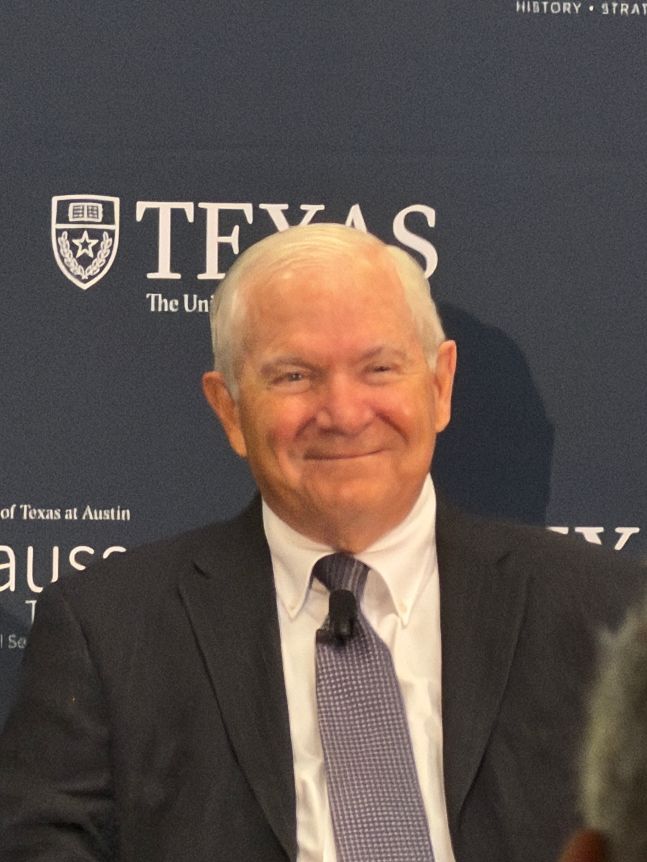
Second photo: Gates at the Univ of Texas. Credit: C. Cunningham