
Over the centuries, the texts that have been rescued by time from ancient Greece and Rome have been studied in many ways. As human ingenuity is never lacking, Natalie Swain has taken ‘comics theory’ to better understand a suite of love poetry by Ovid.
Written around 20 BCE (that is 2046 years ago, give or take), Swain (assistant professor Classics at Acadian University in Canada) immediately defends her use of comic theory to study Ovid.
“There may be some immediate objections to my research methodology based on the ostensible disparity between the highly visual medium of comics and the entirely textual genre of Latin elegy.” Swain takes the offensive, bringing to bear on her potential opponents the biggest gun the arsenal: the words of Aristotle:
For just as some people replicate many things by copying color and shape, and others through music, so too all the arts create mimesis through rhythm, language, and harmony, both separately and together.
Other scholars have noted that the Amores of Ovid employ a “narrative of segments that build to a metaphor of closure. This, she tells us, is how comics operate. “In comics individual panels recreate single moments of various duration in narrative time that build towards narrative completion and closure.” While a handful of scholars have realized the Amores exhibit a “segmentary nature of elegiac narrativity, none succeeded in suggesting a methodology for further unpacking this narrative-through-segments approach.”
Swain should be highly congratulated for realising that the way forward is to use the theory of how comics are drawn, and the ability of the human mind to ‘fill in the blanks’ of action between the narrative/images.
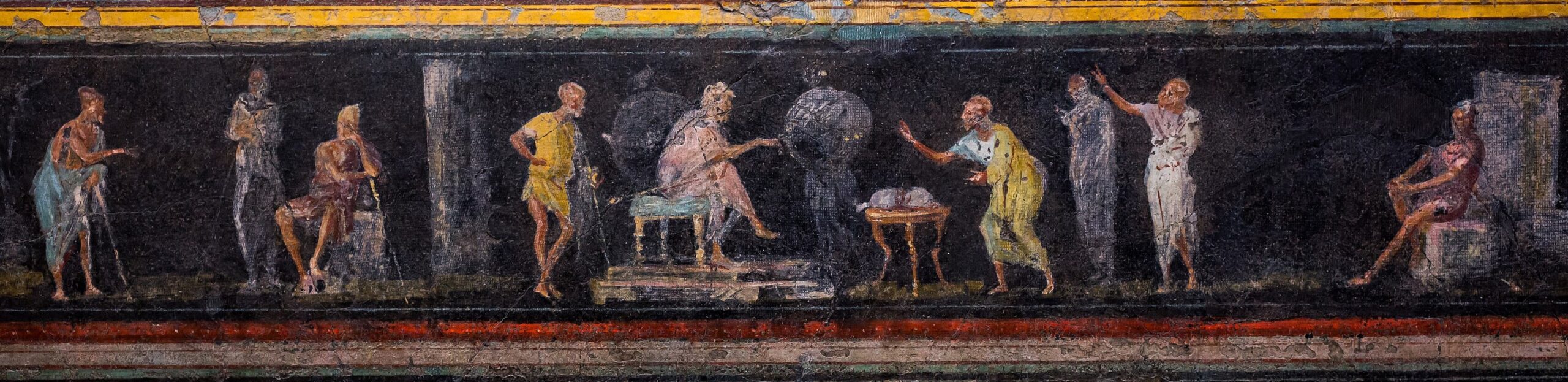
Another scholar, she relates, “has demonstrated that there is a clear alignment between Latin elegy and the wall paintings of the Villa della Farnesina in Rome.” Dated to the very time Ovid was writing his love elegies, these scenes in the villa represent love scenes. Swain rightly latches onto this, writing that the paintings help “to reveal the deeply visual foundations of Latin elegy.”
For those are fans of graphic novels, Swain is not looking at those even though the term has sometimes displaced the term comics. “Part of what I will be arguing here concerns the inherent differences between the long-form novel [i.e. graphics novels] and comics.”
Going beyond the love elegies, she looks also at Ovid’s Metamorphoses. In book Five, “a contest is described between the Muses and Pierides, in which both groups recount a mythological narrative. These nested stories reflect the two-page spreads within comics: individual narrative units that may ostensibly come to an end, but those ends are always false, making way for the continuation of the broader narrative of the Metamorphoses to proceed.”
This is just a taste of the potential power of comics theory to reshape our understanding of ancient texts. For the future of this study, Swain admits “I did not address the complex way in which time works in comics.” She suggests applying that more advanced concept to Ovid’s Heroides, a collection of 21 fictional letters, written in Latin elegiac couplets, where mythological heroines write to their absent or unfaithful lovers, expressing their love, betrayal, and despair. One hopes to see more of such analysis by Swain, who has done a sterling job here.
Image: a scene from the Villa della Farnesina in Rome, painted 2046 years ago. Courtesy of Wikimedia Commons.
Narrative in Ovid’s Amores: Comics Theory, Elegy, and Segmentary Narrative. The book is by Bloomsbury. It lists for $103.50.