
Eugene Onegin explores the fragility of the human heart and how unspoken words can shape destinies. That description of the famous ballet, set to the music of Tchaikovsky, is by the Joffrey Ballet. It succinctly captures the mood and spirit and the ballet created in 1965 by John Cranko.
Thus, it is fitting that for the 60th anniversary of that notable event, Houston Ballet is currently staging a revival of Cranko’s brilliant work. But there is another anniversary we are celebrating this year that lets us think about a curious historical thread: it is the 250th anniversary of the birth of Jane Austen. She was born in Steventon Rectory, and even though it was torn down in the 1820s, we know from a memory of her niece that an oval looking-glass hung between the windows in the sitting-room. It was also in the 1820s that Alexander Pushkin began writing the novel-in-verse Eugene Onegin. It contains an allusion to Austen’s great novel Pride and Prejudice, but here I want to quote what Pushkin wrote about Tatiana, the lead female character.
“Tatiana, in a low-cut, slight, revealing mantle holds a mirror towards the glowing moon which shimmers alone in its dull glass.”
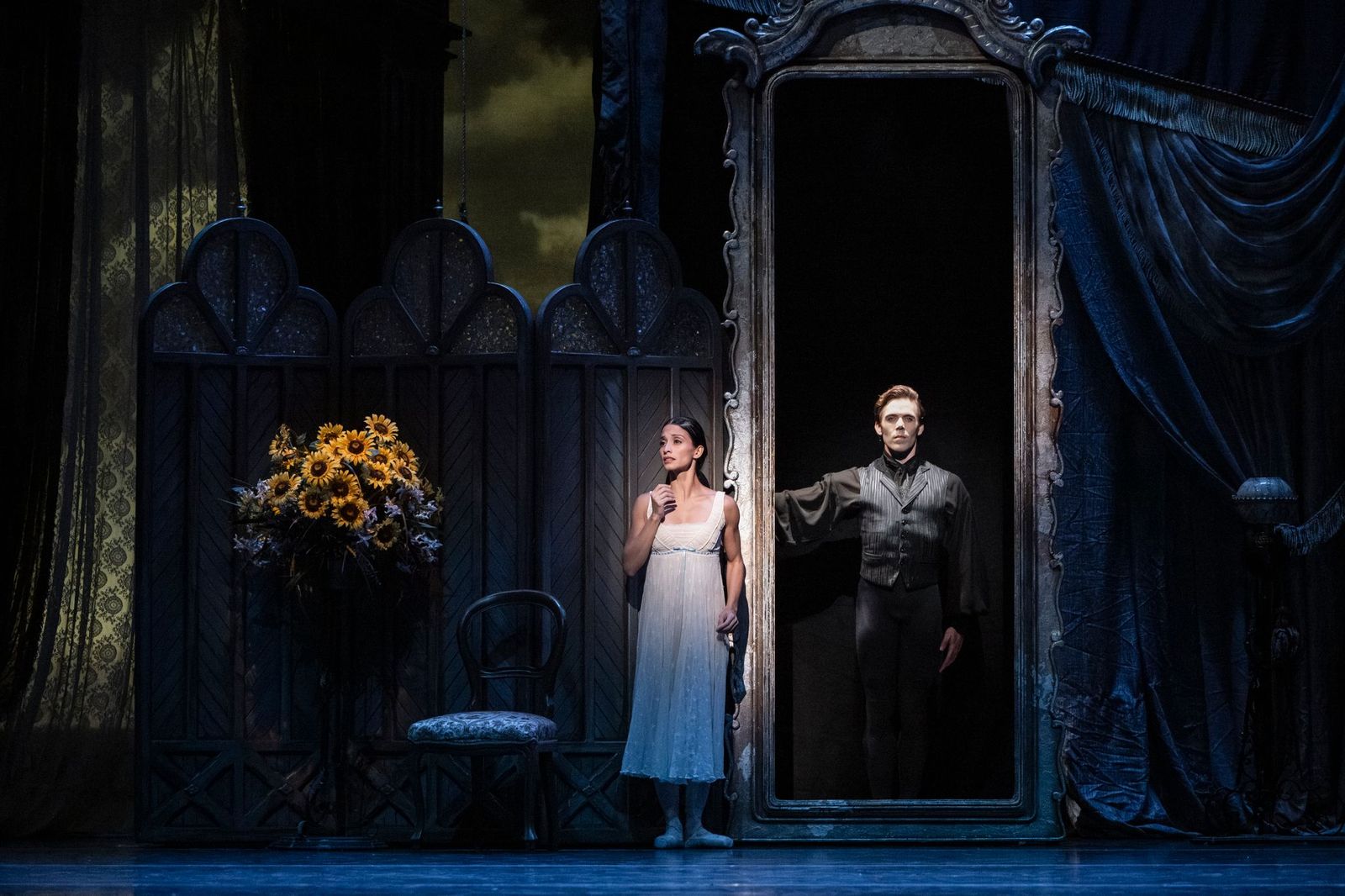
High Romanticism indeed, a hallmark of the 1820s. It is captured in Cranko’s visual narrative: as the programme notes helpfully state, a distillation of both Pushkin’s original poem and its adaptation as an opera by Tchaikovsky. What the lead female ballerina in this ballet sees through a large looking-glass in her bedroom is the highlight of Act 1. She has met a handsome fellow named Eugene Onegin, and looks longingly into mirror. The intensity is so great it shatters the space between reality and fantasy: he steps through the mirror (see lead photo).
The resulting ultra-romantic dream sequence is the most famous pas de deux in 20th century ballet. It features a sequence of difficult holds, some of avian proportions, as Tatiana seems to take flight. The final lift was truly statuesque, reminiscent of the topping if a capitol building. I saw Jessica Collado as Tatiana, and Gian Carlo Perez as Onegin (the cast changes on the following day). Both were imbued with the ethos of Cranko’s intent; quite breathtaking! For those who have not seen the ballet, think of the I’m Flying scene on the bow of the Titanic, with Jack and Rose. The High Romantic impact is quite similar.
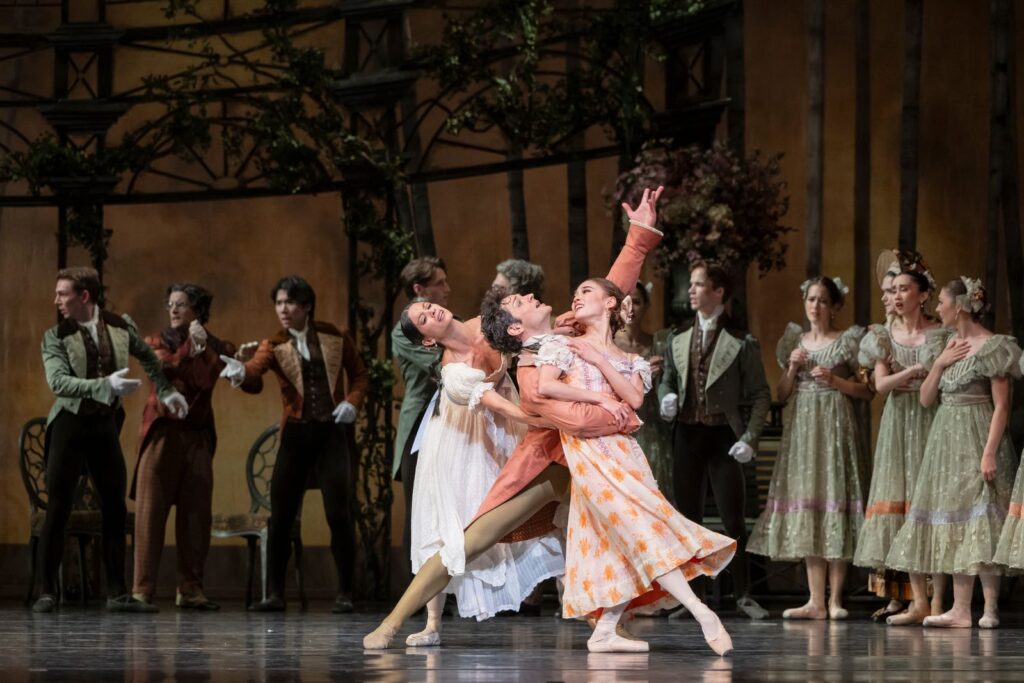
Act 2 brings to mind another film: a 1964 Vincent Price classic, The Masque of the Red Death. In the film, people gather in a castle to avoid the plague. In the ballet, there is dance of death, where Onegin, like a plague carrier, infects those around him. Tatiana is given the opportunity to diagnose the disease when Onegin tears up her letter. Fortunately for her, it was not a fatal attraction: she merely suffered a broken heart. We focus here on another duo whose lives cross that of Tatiana and Onegin. Tatiana’s sister, Olga, is married to Lensky. Onegin decides to flirt outrageously with Olga, which shatters (like a mirror hit by a stone) his High Romantic ideals. Olga becomes the unwitting carrier of Onegin’s plague to her husband. The two men fight a duel, in which Lensky dies, and Olga’s heart is shattered too. On the night of my visit, I saw Eric Best and Lensky and Tyler Donatelli as Olga. Both delivered superior performances, both as ballet dancers and as actors in this extraordinary exploration in the fragility of the human heart.
Backed by the superb Houston Ballet Orchestra, conducted by Simon Thew, this is an unmissable stop for anyone who will be in Houston this coming weekend. It is on for three performances at the Wortham Centre: Sept 12, 13 and 14.
https://www.houstonballet.org/seasontickets/2025-2026-season/onegin
lead photo by Alana Campbell. Karina González as Tatiana and Connor Walsh as Onegin
second photo: Houston Ballet Principal Karina González as Tatiana, Soloist Sayako Toku as Olga and Principal Angelo Greco as Lensky