
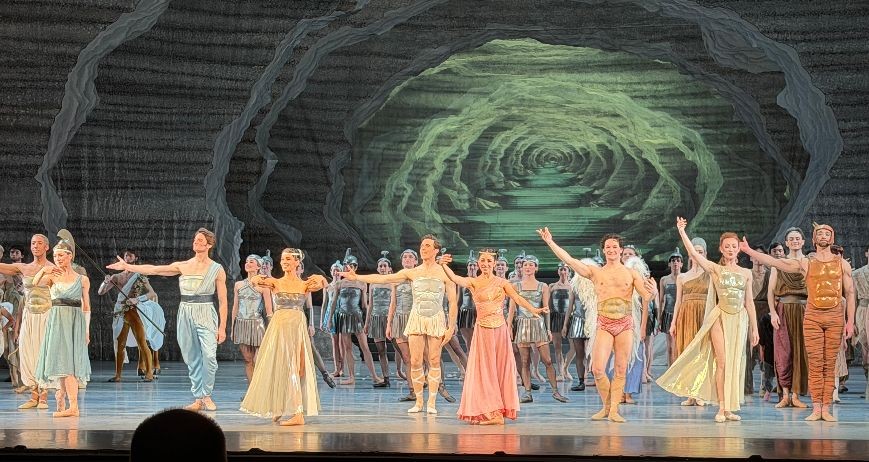
As the Houston Ballet gears up for its new season, starting in September (see below), it just gave us the Gods themselves in a superior production of the 19th-century ballet Sylvia.
Sylvia saw its premiere in Paris in 1876. According to Dr. Julianne Pöche, “the music by Léo Delibes is modelled on Wagner’s music dramas in many respects. This may initially come as a surprise in the context of the ballet genre, but on closer inspection it seems logical. The reception of Wagner made it possible to combine two things: ballet as a genuinely French genre with a musical language that was at the height of its time – that of Wagner. This kind of modern dance theatre was an ideal programme item for the newly opened Paris Opera House.”
In essence, there are three leading ladies here. Sylvia is a semi-god, Artemis is a real god (daughter of Zeus, no less), and Psyche is a mere mortal. Each has their own love interest: Sylvia falls in love with The Shepherd (who remains both nameless and artless), Artemis falls for the hunter Orion, and then there is Psyche. Well, she doesn’t really fall in love. It was the god of love himself, Eros, who falls in love with her! A bit unlikely, you might think, but this is Greek mythology!
The ballet opens on Mt. Olympus itself, complete with Zeus and a roster of gods and goddesses on hand (as one who has studied ancient Greece extensively, I felt right at home).
The first act essentially sets up a tableaux for the display of all three leading ladies. In the first is dark tragedy, as Artemis is tricked into killing Orion by her brother Apollo. In the second, Psyche screws up her relationship with Eros and seeks help from Aphrodite, the mother of Eros. And in the third, Artemis arrives with her army. One of them, Sylvia, spies a shepherd. Their love match is torn apart when Sylvia gets abducted a river god.
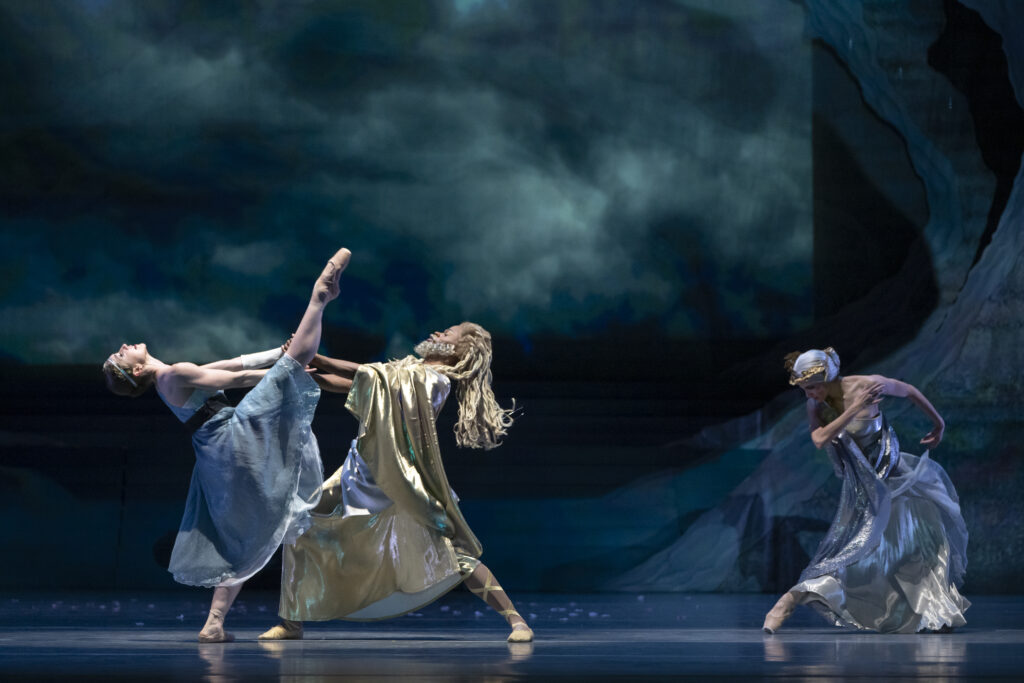
Now that the tableaux is set, Acts 2 and 3 untangle the seemingly impossible hurdles, which requires a trip to the Underworld and the presence of Pandora’s box, no less! The choreography (originally by Louis Merante in 1876) was brilliantly reimagined for the Houston Ballet in 2019. This is its second outing, very fortunate for those of us who missed it seven years ago.
Sylvia was also staged in Sydney in 2019 by Artistic Director Stanton Welch. An Australian reviewer at the time wrote “I came away feeling frustrated. While Welch is a choreographer whose work I admire, dance doesn’t lend itself to the kind of complexities of storyline that Sylvia contains.”
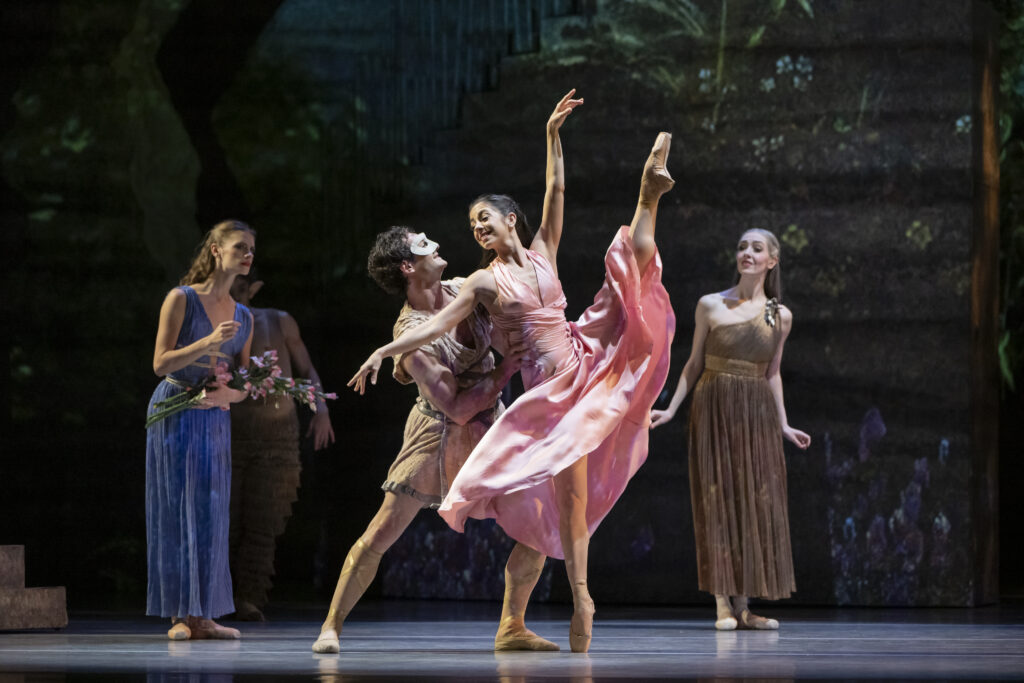
Indeed, the plot is quite convoluted: while the programme notes are extensive, I heard husbands reading it to wives at each intermission so they could both try to grasp the meaning of what they had just seen. For those of us who have studied Greek mythology, it was not quite such a leap (if I may use a term from ballet) to figure it out, but of course Sylvia was not written for historians.
I personally found it to be one of the most exhilarating ballets I have ever seen, quite superb; and while I’m sure everyone appreciated the technical brilliance of the dancers, and the very fine sets, I suspect many were non-plussed by the plot.
On the subject of leaping, I must single out Angelo Greco as Eros, whose multiple leaps in the air caused the audience to burst out in spontaneous applause. (For some performances, Eros is played by Eric Best).
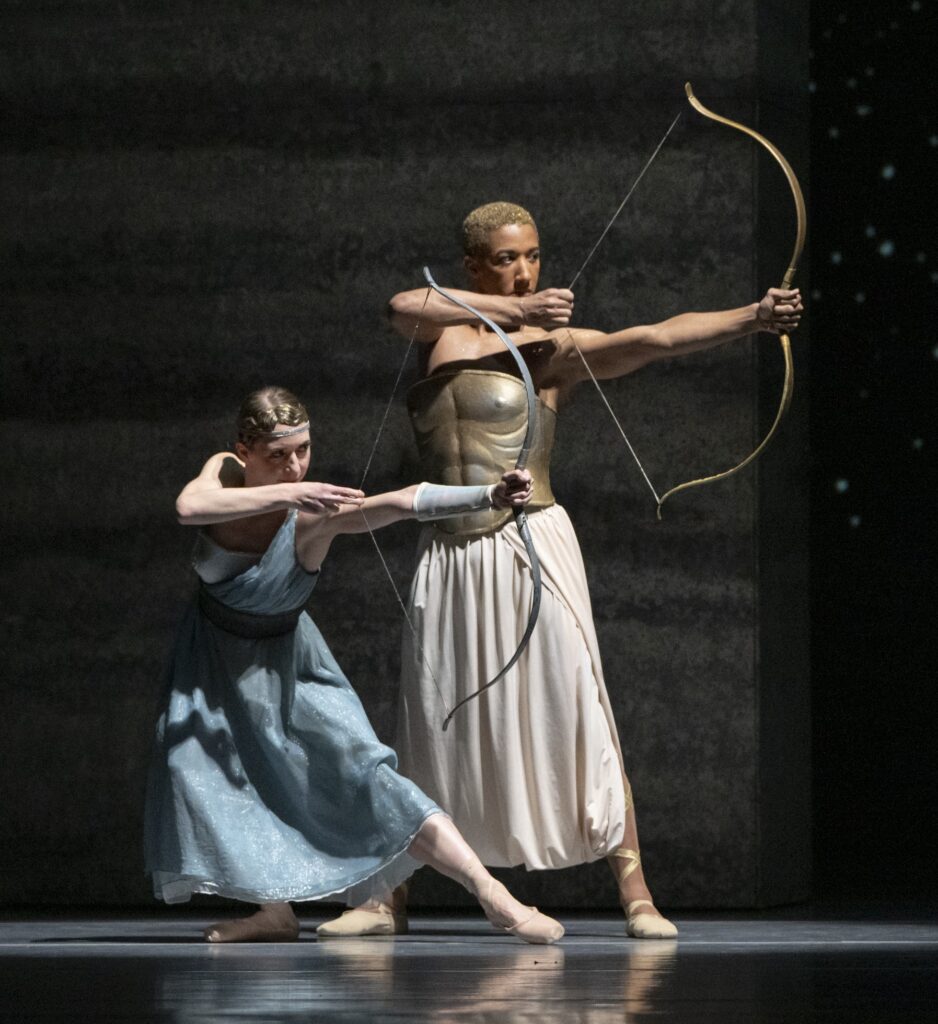
This ballet is noted for its portrayal of archery, virtually unique in the canon of ballet. In Swan Lake, The Queen Mother gives Siegfried a crossbow, but it only serves as a plot device representing a challenge to old constraints. Here, we see a whole troupe of archers at the command of Artemis, Greek goddess of the hunt. (pictured above are Artemis and Apollo)
Lead photo by C. Cunningham: The principal cast of Sylvia, left to right. Artemis (helmeted) and Orion; The Shepherd and Sylvia; Eros (shirtless) and Psyche. Apollo is at far left, the river god Alpheus at far right.
Second photo:
Houston Ballet Principal Jessica Collado as Artemis, First Soloist Naazir Muhammad as Zeus and Demi Soloist Estheysis Menendez as Leto in Stanton Welch’s Sylvia.
Photo by Alana Campbell (2026). Courtesy of Houston Ballet
Third photo: Houston Ballet
Principals Karina González as Sylvia and Connor Walsh as The Shepherd in Stanton Welch’s Sylvia. Photo by Alana Campbell (2026). Courtesy of Houston Ballet.
Archery photo: Houston Ballet Principals Jessica Collado as Artemis and Harper Watters as Apollo in Stanton Welch’s Sylvia. Photo by Alana Campbell (2026). Courtesy of Houston Ballet
Sylvia is performed thru March 8, 2026. Next up from Mar 12-22 is Broken Wings, a narrative ballet inspired by Frida Kahlo’s life and art set to the music of Mozart.
THE NEW SEASON:
Our 2026-2027 Season is an invitation to believe — in the power of storytelling, the beauty of movement, and the shared magic of live performance. This season brings cherished classics and bold new visions to the stage, from the timeless romance of Swan Lake and the sweeping drama of Manon to Stanton Welch’s imaginative world premiere Where’s Alice? and the long-awaited return of his fan-favorite Pecos Bill. We also proudly welcome Lar Lubovitch to Houston Ballet’s repertory with his signature work, Meadow alongside the Houston premiere of George Balanchine’s Symphonie Concertante.
You belong here, whether ballet is a lifelong tradition or a discovery waiting to be made. Witness the long-awaited revival of one of Welch’s most prolific works, Madame Butterfly and the electrifying energy of his staging of The Rite of Spring. Join us for the debut of a world premiere from Soloist Jacquelyn Long and the return of Tony award winning choreographer, Justin Peck’s riveting work Reflections. The season is brimming with works that evoke moments that move, inspire, and stay with you long after the curtain falls.
Houston Ballet’s 2026-2027 Season
Pecos Bill |September 11-20, 2026
Manon |September 24 – October 4, 2026
Where’s Alice? |February 25 – March 7, 2027
Madame Butterfly |March 11-21, 2027
The Rite of Spring |May 27-June 6, 2027
Swan Lake |June 10-27, 2027
Visit the website for tickets: www.houstonballet.org