
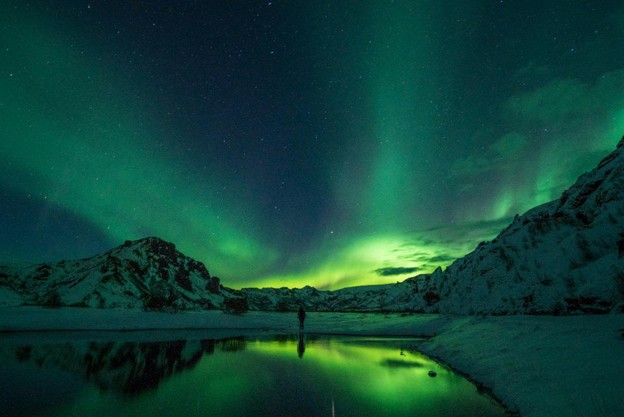
There is something humbling about looking up at the stars.
For a few minutes, the arguments, borders, algorithms, ideologies and divisions that occupy so much of our daily lives become insignificant. Above us is something that belongs to no nation, political party, religion and certainly any corporation.
The sky belongs to everyone.
That may be one reason total solar eclipses have become something more than astronomical events. Around the world, they are increasingly occasions for people to gather, travel across continents for experiences with people from unfamiliar cultures and stand together beneath something far larger than themselves.
For Austin-based IMXP, that idea is at the heart of what it does.
The company produces global gatherings built around total solar eclipses, but its philosophy goes well beyond putting people in a field and handing them eclipse glasses. Deliberately and thoughtfully rooted in the communities where the events take place, IMXP works with local partners and incorporates the culture, traditions and people of the place itself.
IMXP In Iceland, the eclipse gathering that took place on August 11–15, in an extraordinary setting: the event site at Helisandur is near the glacier associated with Jules Verne’s Journey to the Center of the Earth, a film I watched with fascination growing up.
But the landscape is only part of the experience.
The event includes a main music stage, a children’s “Star Seeds” area, an Aurora stage devoted to workshops, talks and comedy, and a sacred fire area overseen by Indigenous elders. Local folklore has also found its way into the programming, including the creation of elf homes for younger participants.
It is an unusual mixture of astronomy and folklore, technology and ancient traditions, music and meditation, children and scientists, artists and astronauts.
And perhaps that mixture is precisely the point.
A gathering under one sky
CXO Mary Liz Bender, who works with IMXP, and is an experiential artist whose work fuses art, technology and wonder describes an organization that sees celestial events as an opportunity to create experiences that can change the way people see themselves and the world around them.
The idea originated with Founder and CEO Mitch Morales after his experience at the Oregon Eclipse, which may have been his first total solar eclipse. Whatever the exact chronology, the experience clearly left an impression: what struck him was not simply the spectacle of the moon passing in front of the sun, but what happened to the people gathered to witness it.
A total solar eclipse creates a temporary community.
People who may have absolutely nothing else in common find themselves standing shoulder to shoulder, waiting for the same extraordinary moment. When totality arrives, everyone looks up.
That shared experience can be surprisingly powerful.
IMXP has built its future around that possibility, with a planned trilogy of eclipse events beginning in Iceland, followed by Egypt in 2027 and Australasia in 2028.
The ambition is global, but the philosophy is local.
The experiment inside the event
One of the most intriguing examples is something IMXP calls “The Portal.”
For the Iceland event, 50 innovators and artists have been brought together to learn from local elders and then create experiences and installations for the festival grounds.
The idea is less traditional festival programming than cultural exchange—a kind of experimental laboratory in which people arrive not simply to consume an experience but to participate in creating one.
Astronauts Ron Garan and Dr. Sian Proctor are among those involved.
There is even a connection to what might be called an “analog astronaut” experience: stepping outside familiar surroundings, entering an environment that challenges perception, and seeing the world from a different vantage point.
That concept resonates beyond the festival.
Because perhaps what we need right now is not another place to escape from the world, but places where we can encounter it—and one another—differently.
Technology meets the ancient sky
For all its emphasis on community and local culture, IMXP is also deeply engaged with technology.
The organization operates with a globally distributed team and has developed technology for data collection, event automation and community engagement. Ticket holders can participate in WhatsApp communities and help shape aspects of the experience before they even arrive.
Other projects push the technological boundaries even further.
The Dorothy Project, a Canadian community-driven initiative sponsored by Space for Humanity, plans to send 360-degree cameras into the stratosphere to capture the eclipse from above.
It is a fascinating juxtaposition: ancient humans looking toward the heavens and modern humans developing increasingly sophisticated ways to look back at ourselves from them.
Yet the destination remains the same.
Look up.
Why the sky matters now
Perhaps the most compelling aspect of these gatherings is not what happens during the few minutes of totality. It is what happens between people before and after it.
We live in a moment of extraordinary connection and extraordinary disconnection.
We can communicate instantly with someone on the other side of the planet, yet increasingly inhabit separate informational, political and cultural realities. We are surrounded by technology designed to capture our attention, reinforce our preferences and keep us looking at screens.
An eclipse asks us to do something radically different.It asks us to stop and to look away from the screen and instead to look up.And when we do, we see the same thing that everyone else sees. That simple act carries a surprisingly profound message: whatever separates us on the ground, we share a planet moving through the same universe.
The people gathering for these events come from different countries and backgrounds. They speak different languages. They have different beliefs and different histories.
But for those few minutes, none of that matters very much. There is only the sun, the moon and the people standing beside you.
That may explain why eclipse gatherings are becoming increasingly compelling.They are temporary experiments in community engagement for something larger than the daily grind. In a world that often seems to be pulling itself apart, the idea of intentionally creating communities around wonder feels almost radical.
Wonder is democratic. You don’t need a particular education to experience it. You don’t need to agree with the person standing next to you. You don’t need to belong to the same tribe.
IMXP is based in downtown Austin, but its vision is planetary.
Its events move from country to country, bringing together musicians, scientists, artists, children, elders, entrepreneurs and curious travelers. Each gathering becomes something slightly different because the people and place are different.
A total solar eclipse lasts only minutes. But the memory of standing among thousands of strangers, all looking upward at the same impossible darkness, can last a lifetime. In the end, perhaps the most important thing an eclipse reveals is not something about the sun or the moon.
It is something about us.
Next event planned is COHERENCE:
A four-day convergence on the threshold of Spring, COHERENCE will take place March 19 – 22, 2027 in the Texas Hill Country, timed to the Spring Equinox.
https://coherencegathering.com