
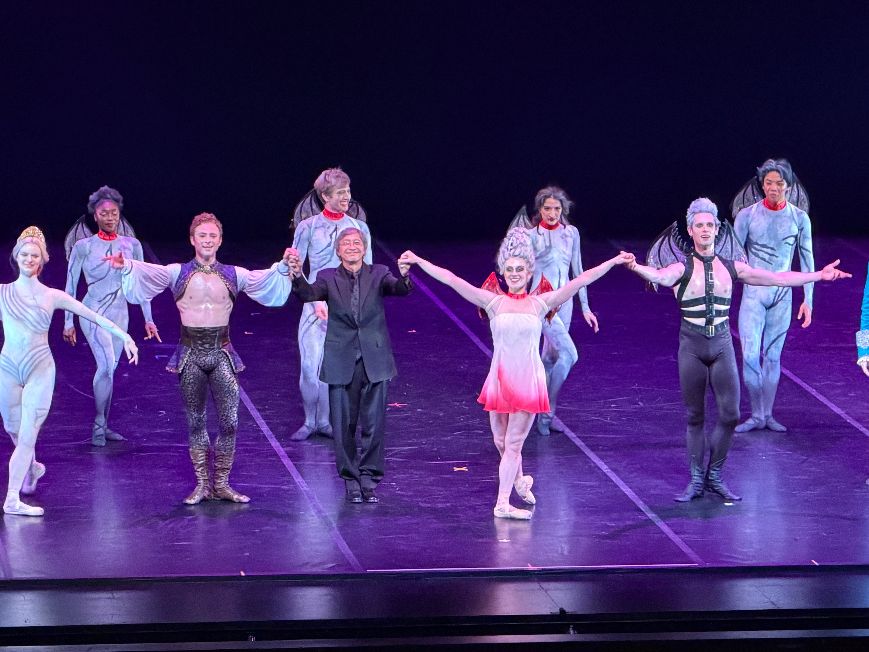
Courtesy of Ballet Austin, lucky members of the public were able to meet the Queen of France at the Long Center recently. She was in attendance for a performance of a world premiere ballet in her honour.
The concept and choreography of Marie Antoinette: Vampire Queen of Versailles, is by Stephen Mills. “I came upon this idea a couple of years ago when I was visiting the Palace of Versailles. If you’ve ever had the opportunity to go there, you know that there are ghosts and there are vampires and probably some werewolves in the garden. There are all sorts of creatures stumbling around that castle with all its history!
“I have always been fascinated with French culture – some element of my family is French – and so I’ve always been interested in the language the history.”
To adopt a new tack on the story of Marie Antoinette, which has been done literally hundreds of times, Mills took a different approach. “I decided to drop the historical aspect of it, not tell the story of this bratty young woman who took the fall for all the evils of the men around her, and instead tell something that might be a little more interesting today. And that’s how we introduced the idea of the vampire into the story.
“Throughout history, women in the period don’t get to play vampires. So, I thought that might be interesting for the dancers.”
Music creator Graham Reynolds:
He reflected on the ballet Poe (about Edgard Allan Poe) that he did with Mills in 2024, and how that and other earlier joint efforts differed from Marie. “The biggest difference is that we’ve done a lot of recorded scores. We’ve done several where I was performing leading an ensemble and then with Poe it was the first time we worked with Austin Symphony, and so it was an all-acoustic piece. This one was a hybrid, so it took previous work, pre-Poe and Poe, and mashed it up.
“So, we have an orchestra for Marie about the size that you could have had at Versailles, but then drum machines and synthesizers and sound design in a very 21st-century palette mashed up.” A select group of the Austin Symphony Orchestra was led by maestro Peter Bay at the Marie Antoinette ballet.
Mills revealed his musical inspiration for the score. “The influences I want you to think about are Prince, Tricky, who was a British singer, and Massive Attack. That was a really important influence in the 90s. It was that kind of vibe that I wanted to go for because Marie Antoinette was the most au courant person of her time: everybody followed the way she dressed, what she ate, the things she was interested in. The books she would read, everybody would read those books. Everyone followed her very, very closely. So, I wanted it to be a sound that would have been contemporary.”
Costume design was a critical factor in the ballet, as Margaret Mitchell explains.
“Before the music was settled, and way before the scenery was settled, I began working to make costumes. And I knew, having worked with Graham and Stephen before, that we were going to have modern music.
“I was influenced by Dolce & Gabbana, and Vivienne Westwood. She did a riff on the 18th century so there was a lot of carry-over there and I thought about it in a continuum in a way, especially with Marie.
“She starts out in the big dress that’s impossibly huge. As she progresses through the ballet, she becomes more modern and freer as she becomes the vampire. As a vampire she is in a modern dress because vampires never die. Louis is in period clothes the entire ballet: he’s a big contrast to the vampire.”
In their discussion at the Long Center, Mills gave his own take on the background of Marie Antoinette, and her fate. “Marie came from Vienna at 14 years old to marry King Louis XVI: she was a very young girl and not prepared for what was about to happen there. And because she was an outsider, being Austrian and not French, everybody in the court was very dubious about her. And so, there was a lot of gossip about her, a lot of stories being told about her.
“People were trying to undermine her the entire time, and then they didn’t have children for seven years. The talk was that she was not being a very good wife, not being a good queen. So, she had a very difficult life. Even though she was the queen of France, she was still a woman in the 18th century.
“She was not in control of her own identity, her own body, her own being. It was important for me in this story not to have some man get right in and save her. It was important for her to take control of her own destiny and that’s why when she had to choose one or the other: life and love with Axel or death and immortality with De Maret? That was really what that was about for me.”
“She made a choice and she was the one that turned herself into a vampire. It’s a scary thing, but also making it a little empowering. I don’t know what it is to be a vampire,” an admission that was greeted by much laughter.
Mills mentions here a handsome man at court, Axel, who is much more exciting for her than the king, her husband. But she is also pursued by De Maret, a man dressed in black, who we come to realise is a vampire.
While the second of the two acts concludes with Marie giving herself up to De Maret, the action is primarily focused on Axel and De Maret. Their pas de deux is actually the most lengthy homoerotic passage I have ever seen in a ballet. For much of act two, Marie is nowhere to be seen. It’s just the two male dancers: the vampire in a tempting black outfit, while Axel wears a costume fully exposing his ripped torso. (In the performance I saw, De Maret was danced by Morgan Stillman, with Colin Heino as Axle; Marie was danced by Grace Morton.)
Astonishing in its intensity, this performance must rank alongside Christopher Rudd’s 2020 ballet Touché, famous for featuring the first male pas de deux in American Ballet Theatre’s history. But in this case, it’s not about love between two men, but the passion each one has for Marie, and their battle to win her over.
Mills has created what will surely become part of the treasured cannon of American ballet. The costumes, the music, the concept and the dancing. An impasto of brilliance, with the world-premiere right here in Austin!
Mills’ 25th year at the helm of Ballet Austin will be celebrated at the Paramount Theatre in downtown Austin on April 23. Get a ticket!
Next up is The Magic Flute, May 8-10, at the Long Center.
For future performances: www.balletaustin.org
Lead photo: Grace Morton with Peter Bay at centre. Colin Heino is at left, with Morgan Stillman at right.
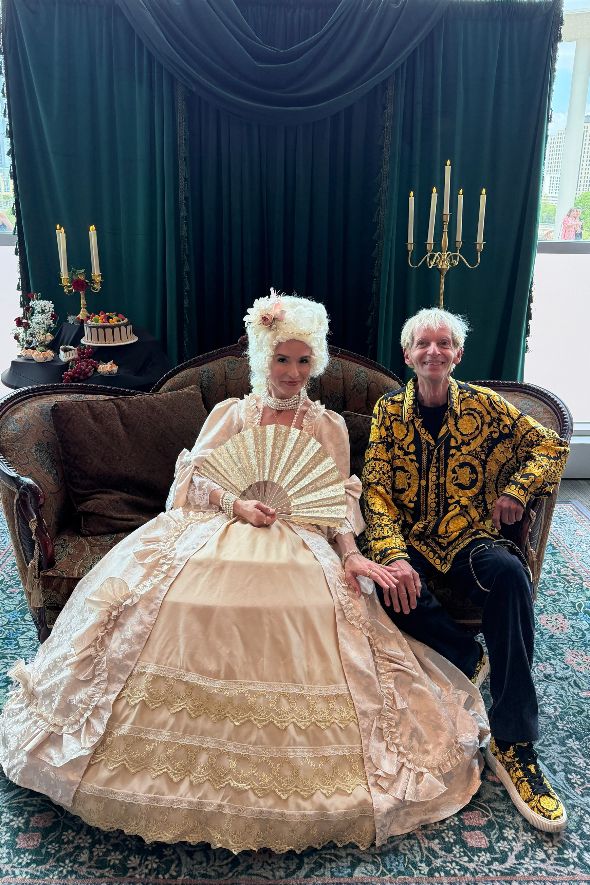
Second photo: Dr Cunningham with the Queen