
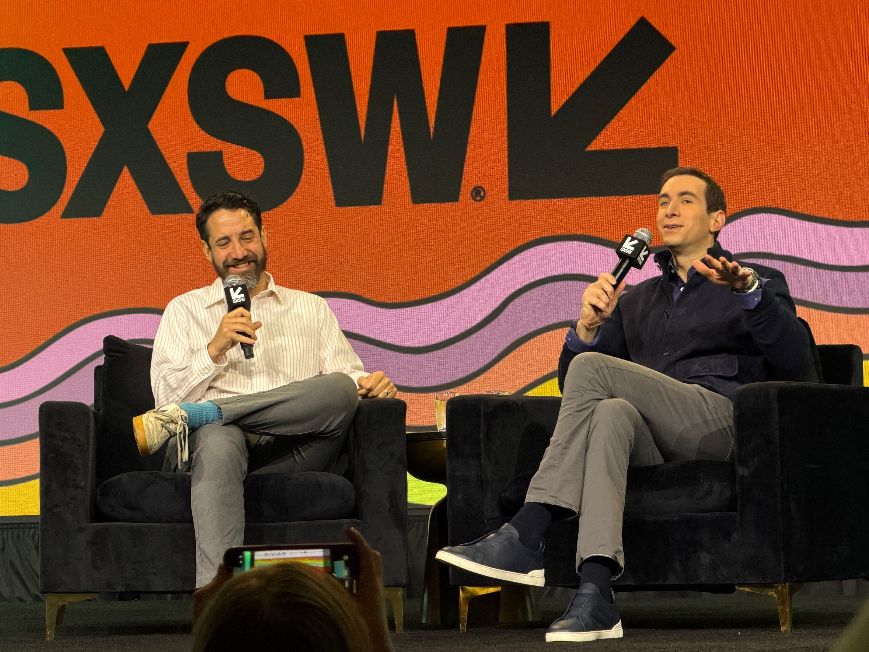
Andrew Sorkin became famous for his book 1929: Inside the Greatest Crash in Wall Street History. He visited SXSW in Austin this week to explore the similarities and differences between then and now.
“About a decade ago I started reading the matter and I became enthralled by the period, but more importantly, the characters, which was the one piece of the story that I didn’t think had been really told.
“I loved books like Barbarians at the Gate (1998) and Bob Woodward books that put you in the room where you can feel the people and understand their incentives and their motives and who’s trying to screw over who and what’s really happening. And that was the book that I said I’d write.
“And then, invariably, as I was writing the book – and maybe this is the scarier part about it – I’d be there on television or writing articles in the paper about where we were in our economy and I’d go, ‘that seems very familiar to me. That certainly sounds and feels like now.’”
Interviewer Joe Weisenthal (left in photo) asked a provocative question. “Like no one knows exactly what it is, but whether it’s AI or whether it’s geopolitics or whatever, do you think that there is just this pervasive sense of like, something bad is gonna happen in the not-too-distant future?”
“Pretty much,” Sorkin replied ruefully. “But I don’t know if that’s because just as a society we are sort of hand-ringers, and we’re always sort of looking for something to worry about, or if there’s something demonstrably different this time.
“I do think that this moment – both in terms of the technology and I’m referring to AI and the geopolitical moment that we’re in politically and everything else – lends itself more towards that and it’s true in the 1920s where we were going through an extraordinary revolution technologically. Whether it was automobiles or radio, people were excited like crazy but they were not ringing their hands. There were a couple of Cassandra’s but not many compared to now and maybe it’s because now feels even more complicated.”
Sorkin identified a key difference between the stock market in 1929 and now. “The problem back then, which is a little bit different than now, is that people were able to buy stock on margin at levels that were extraordinary. So, you could go into a brokerage house. and literally put down a dollar and the broker would lend you $10.
“And that really was more of a problem than just about anything because people were basically betting far beyond their own means and not even understanding what that meant. So that when the market dropped in October, November, 1929 by 50%, you couldn’t hang on. The broker called you and said, ‘we’re taking your house.’
“Interestingly, by the end of 1929 – and this was something that I had no conception of – the stock market was only down by 17%. But you would have had to hold on to even get there, and most people couldn’t.”
Sorkin, a very youthful-looking 49, talked about Winston Churchill, who was in New York City in 1929. “This is before he’s the Prime Minister: he is basically out of money and shows up in New York to give a lecture series. He travels around the country and he meets all these wealthy financiers who are sort of enamored with this British politician, thinking he might go somewhere! He gets totally taken by the bug of trading and literally makes millions of dollars, and then loses millions of dollars during the fall of 1929. Churchill happens to be at the New York Stock Exchange on October 24th, Black Thursday, 1929, because he’s that crazed about what’s happening in the stock market! So many people used to just literally try to go down there to check out what was happening.
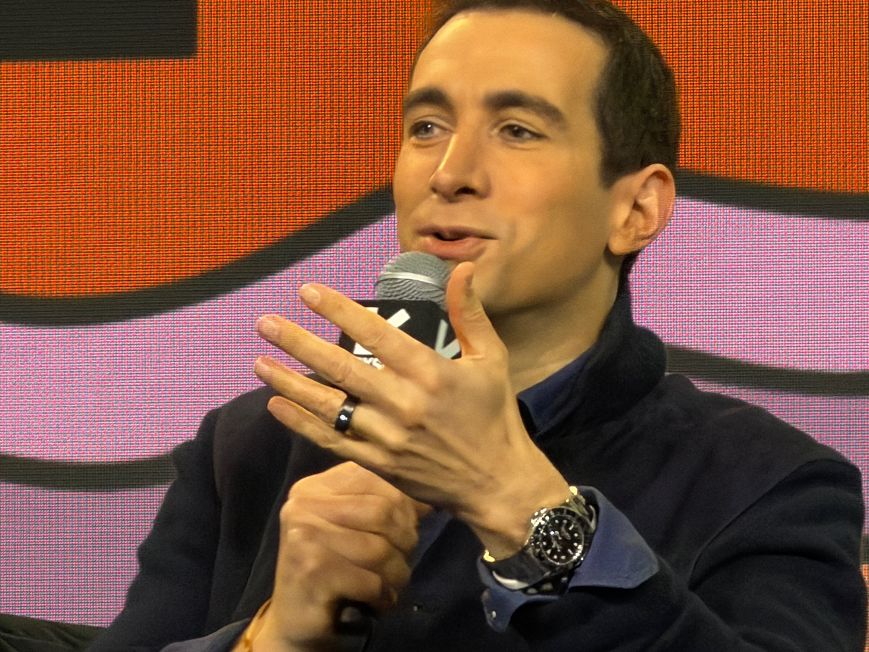
“The traders on the floor were famous. There was a guy, Mike Meehan, who actually traded RCA. He was the specialist on the floor. People would go just to take a picture with him or to see him like he was a celebrity.
“There was a woman named Evangeline Adams who served as my favorite character in the book. Adams was an astrologer: she had an office at Carnegie Hall. Every banker, including J.P. Morgan, used to go visit with her to find out whether they should be buying or selling stocks!
“She had a newsletter with 100,000 subscribers. People would pay her $50 an hour just to get her views on what was going to happen and that sort of gives you a sense of just how crazy things had got at that point.”
But not everyone was crazy. “Back in 1928 Charles Merrill, co-founder of Merrill Lynch, actually came out publicly and told people to get out of the market. People hated him because the market then went up 90%. And so that’s sort of the problem with deciding when to ring the bell.
“Even the Federal Reserve back then knew that things were out of control and wanted to do something about it, but they were so scared that if they raised interest rates too much to try to tamp down all this speculation, that they would tip over the economy.
“And given that the Federal Reserve was so new (it was born in 1913), if you read some of their diaries, they literally thought they would get hauled in front of Congress and Congress would end the Federal Reserve.”
Weisenthal chimed in here. “You know this conversation I have to say between me and you: it makes me feel a little bit better about being a journalist in the sense that like if we miss the Bubble – if we don’t warn about the thing – it’s okay because people would have hated us for saying it’s okay. This is the perversity of even being a professional money manager today. This is why we have a herd mentality because if you are a paid money manager, you run a hedge fund, whatever it is, the incentive is to beat the index. It’s to beat everybody else. If you get out early and say, ‘”Oh, I’m just so conservative,’ you’ll get fired for that way earlier and more quickly than you’ll get fired for following everybody else down off the cliff.”
This begs the big question that is on everyone’s mind. There could be some kind of mismatch between the hundreds of billions of dollars that are invested in AI right now and the revenue potential on the other side. “There could be this sort of moment where the math doesn’t work.
“There’s a sense that you know we are in an AI bubble and is it gonna pop and if it pops is it gonna destroy the economy on the other end? It’s like if it works, yeah, that’s also gonna destroy the economy (maybe) and so that is the double-edged sword.”
Whether this will trigger another Depression, 1930s style, remains to be seen.