
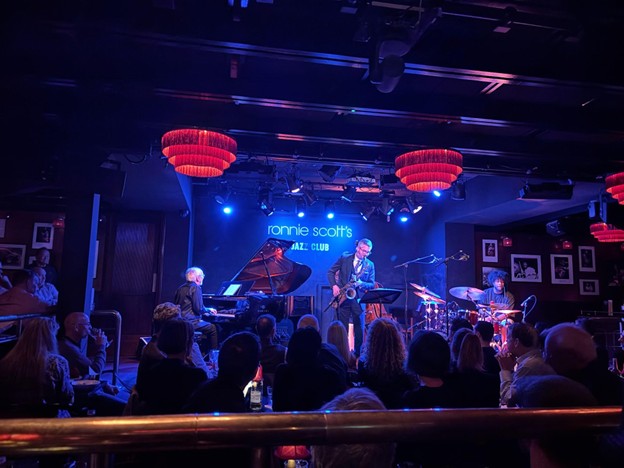
I just returned from nine glorious days in London, a city I have always meant to live in, but didn’t. For whatever reason, life took me elsewhere on the Continent and in Asia. So I revisited in October, the so-called worst month (I am a veteran of dreary, dank, rainy days, having survived Amsterdam for thirteen years) and relished the wind and chilliness.
This feature is the first in my London travel series.
Anyone in the jazz world knows of the famous club Ronnie Scott’s, which has been in business since 1959. Located in Soho at 47 Frith Street, London W1D 4HT, the East End saxophonist Ronnie Scott and his partner Pete King founded the club. It was born out of a hunger for authenticity — a refuge where musicians could play their truth without pandering to pop or commerce. It became a sanctuary for the faithful: a late-night communion of brass, bourbon, and bravado. Ronnie himself, sharp-tongued and self-effacing, emceed the nights with a mix of gallows humor and grace, as though jazz were a sacred ritual and he its reluctant priest.
Over the decades, every serious jazz pilgrim — from Miles Davis to Chet Baker, Nina Simone to Esperanza Spalding — has passed through that narrow doorway, leaving behind echoes of improvisation that still hum in the walls. The up-and-comers play there to prove they belong; the masters return to remind us what belonging sounds like. Ownership may have changed hands since Ronnie’s death in 1996, but the essence hasn’t dulled. The room still breathes rebellion and reverence in equal measure — a living relic of artistic defiance where the music never fully ends; it just slips into another set.
On October 21st, just another evening of waiting in the queue for the possibility of entering a sold-out show (two sets per evening), my friend Alex and I lucked out. There were two seats center on the balustrade, feet away from the bar, so we grabbed them — for Bob James.
For me, Ronnie Scott’s isn’t just a jazz club; it’s a portal. I wasn’t walking into a venue tonight — I was stepping into my mother’s memory, into the echo of her own becoming. I picture her at thirty-four, young and raw from heartbreak over my parents’ divorce, on her first overseas trip with my British Aunt Lillian from London, who took her over the pond to cheer her up. Maybe Mom was clutching a drink, the smoke curling up in the air while a saxophonist poured his soul into the room. And now, as I walk in half a century later, carrying the same bloodline of feeling — wiser, wilder, softer, stronger.
When the first saxophone note hit by Leo Richardson, I let it blur the line between then and now. Maybe she’s there beside me, I wondered, smiling through the trumpet’s wail, proud that her daughter found her own rhythm, her own rebellion, her own jazz.
We took our seats; the lights dimmed to a purple-bluish hue and then — whammo! — Bob James, a legend in the jazz world, hit the keys like it was 1972. He’s been playing for six decades and still goes strong, wiping out my short-lived nostalgic teary eyes into ones of joyous foot-tapping and finger-snapping. Beside him, the Dallas (and former Austin-based) drummer James Alex Adkins blew the audience away. Michael Palazzolo on bass was rocking.
They played hip-hop and cinematic jazz, and the smooth 1980s fusion sound invented decades earlier by Miles Davis in the 1960s. Later, Herbie Hancock, Chick Corea, John McLaughlin, Weather Report, and The Mahavishnu Orchestra took the experiment in their own direction through the ’70s. By the 1980s, the genre had evolved into what most people recognize as “fusion”: slicker, more electronic, and radio-friendly. Figures like Pat Metheny, Larry Coryell, Al Di Meola, and Weather Report were among the musicians and bands known then.
But the pièce de résistance of the evening was “Nautilus.” Originally a smooth-jazz tune (from his 1974 album One), it became one of the most sampled pieces of the hip-hop generation and thus sealed James’s fate as one of hip-hop’s godfathers. Run-D.M.C., Ghostface Killah, Eric B. & Rakim, A Tribe Called Quest have sampled it, as well as LL Cool J, Slick Rick, De La Soul, and dozens more.
By merging hip-hop and jazz — and bringing together old and young performers — I walked out of the club satisfied that Mom not only grooved along with me the entire show but that she would never stop, even on the other side of the veil.
When you’re next in London, don’t miss a night at Ronnie Scott’s. Find them on IG @officialronnies or ronniescotts.co.uk.