

The Underdog Within
Even as a child, I noticed the way people were treated differently — how some were dismissed as less than human because they didn’t “measure up” to arbitrary social standards. I remember watching with sharp awareness as adults spoke harshly or condescendingly to those without power. My parents, may they rest in peace, raised my brother and me with the belief that every person deserves respect, regardless of station, background, or appearance. That lesson — treat all with kindness, no matter who they are — shaped me, and I’ve passed it on to my son.
So when I encountered the work of Intel Lastierre at DORF in Austin, it resonated deeply. Here was an artist unafraid to shine light on inequality, displacement, and the complex contradictions of the immigrant experience. Intel’s exhibition, Infernal Rebirth: Into Hell, Illusions and Realities, bridges myth, surrealism, and autobiography, reflecting both personal struggle and collective history. The works pulse with a sense of defiance and compassion: art as testimony and confrontation.
About the Exhibition & Curatorial Context
This exhibition was supported and shaped by the curatorial insights of Sara Vanderbeek, whose own artistic practice explores the layering of memory, architecture, and image, and who has been instrumental in elevating new voices in contemporary art.
Equally vital is the presence of Regine Malibiran, the inaugural DORF Curatorial Fellow. In this role, Regine supports both the conceptual framework and the programmatic development of exhibitions like Infernal Rebirth. Her curatorial approach emphasizes dialogue between artists and audiences, ensuring that work as layered as Intel’s finds resonance within the Austin community.
When I sit down with Intel Lastierre — whose given name is Crystal — I can feel both humility and fire. Intel speaks with candor about migration, survival, and the weight of culture. Our conversation unfolds as both Q&A and storytelling, punctuated by moments of laughter, philosophy, and tears of raw honesty.
Q&A with Intel Lastierre
EK: First off, your name. Do you work for the CIA?
Intel: (laughs) No, no. Intel is just my nickname. My real name is Crystal. When I was very young, maybe two or three, I couldn’t pronounce my name properly. I called myself “Intel.” It stuck, and now everyone calls me that.
EK: I love that. Where do you live now?
Intel: I live in San Marcos. I migrated to Texas in 2017.
EK: What brought you here?
Intel: My husband. We knew each other since high school, but I moved here when we married.
EK: And when did your art career begin?
Intel: My path has been meandering. In the Philippines, I wasn’t a full-time artist. I was a gallerist, and I also worked in photography — even nude photography, which was difficult to show because of cultural restrictions. When I came here, I had no connections, no family, no friends. I didn’t know what to do. So I started painting. Slowly at first — maybe one piece a year. But in 2021, around the time of COVID, I decided to fully commit. Seeing the Francis Bacon exhibition in Houston was pivotal. His massive works, his amorphous forms — they inspired me. That’s when I began creating in earnest.
EK: I see Francis Bacon’s influence, but I also see touches of Dalí.
Intel: Yes, Dalí, Bacon, many of the masters. But ultimately, it becomes my style, my color palette, my way of merging influences into something personal.
EK: What strikes me is the use of nudity in your work. That must have been challenging, coming from a Catholic-dominated culture.
Intel: Very much. The Philippines is deeply Catholic. Ten years ago, if you exhibited nude photography or painting, galleries would cover it. Even now, it can be taboo. We don’t even have divorce. Religion still molds politics, education, everything.
EK: That must be suffocating.
Intel: It is. That’s why I began painting here in Texas. My work would not have had the same space back home.
The Artworks
As Intel and I walk through Infernal Rebirth, she pauses to discuss three major works in detail. These pieces crystallize her vision — a fusion of myth, critique, and personal history.
Paradise of Terrestrial Pleasures, 2023 (lead photo)
Oil on canvas, 109″ x 59″
This is Intel’s largest painting to date, inspired by Hieronymus Bosch’s Garden of Earthly Delights. A riot of color and form, the canvas seethes with consumption and chaos.
Intel: “This painting is about capitalism. How it consumes everything and everyone. I parallel capitalists with a Filipino mythical creature called the Tembaloslos. These beings have enormous mouths; when they open them, you can see their eyes and noses. I painted them without faces, just gaping maws of greed. To me, the Tembaloslos symbolize the capitalist appetite: endless, lustful, devouring. Capitalism takes the myth of the American dream and exploits immigrants in the process.”
The grotesque beauty of the canvas is undeniable. Lurid colors seduce even as monstrous forms repel. The eye is drawn into a vortex of delight and disgust.
The Paradox of Arrival, 2025
Oil on linen, 40″ x 65″
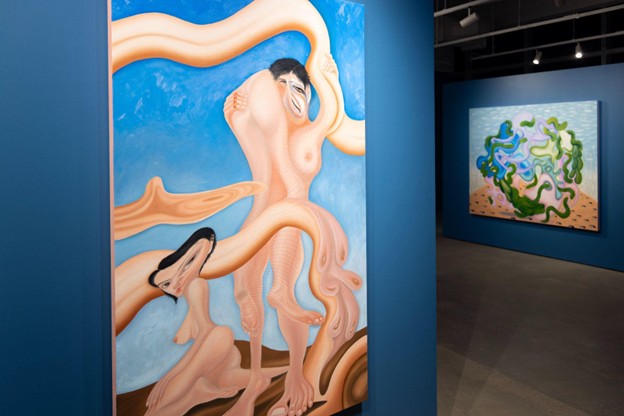
This work draws inspiration from Virgil’s Aeneid, the epic of Aeneas’ journey from Troy to Italy, where he becomes a founder of Roman civilization.
Intel: “I parallel Aeneas’s journey with that of immigrants. Like Aeneas, immigrants carry the weight of their past while seeking new foundations. But Aeneas can also be seen as a colonizer — he killed natives, justified by believing he was the chosen one. That duality fascinates me: the immigrant as both vulnerable and powerful, oppressed and complicit. For me, this painting speaks to all who arrive in a new land with dreams, only to find themselves entangled in cycles of deprivation and exploitation.”
The Sisyphean Paradox, 2023
Oil and dry transfer lettering on canvas, 75 ½” x 63″
This was the painting that captivated me most.
Intel: “This is about the relentless pursuit of the fake American dream. Immigrants and the working class are trapped in cycles of labor and survival — pushing the boulder uphill, like Sisyphus, only to have it roll back down. Albert Camus said we must imagine Sisyphus happy, embracing absurdity. But I disagree. We don’t need to embrace suffering. We need to change the system that makes us suffer.”
The surface bristles with texture. Lettering transfers create a palimpsest of language, echoing bureaucratic documents — passports, visas, contracts — that define immigrant lives. The green and black palette feels both lush and oppressive, like a forest that entangles rather than liberates.
EK: Your references are intensely intellectual: Virgil, Camus, Bosch, Filipino folklore. Where do these come from?
Intel: I read widely, and I’m always looking at history, myth, philosophy. I don’t want to make art that is just decorative. It has to carry meaning, even if that meaning is uncomfortable.
EK: You said capitalism devours immigrants. Could you expand?
Intel: Immigrants are promised opportunity. But in reality, many are trapped in exploitative labor. We sustain capitalism, but we don’t benefit equally. We clean houses, build structures, take care of children — yet remain precarious. My sculptures address this directly.
Sculptural Installations
Intel gestures to an installation of golden cases layered with household tools embedded with teeth.
Intel: “This piece pays tribute to working immigrants. The three golden layers symbolize the illusion of upward mobility. The teeth embedded in tools represent how labor is consumed. These tools are both instruments of survival and symbols of exploitation.”
Nearby, a sculpture of synthetic hair loops into a taut rope.
Intel: “Hair represents immigrant identity — our DNA, our roots. This piece is called Tagago B. It symbolizes the immigrant’s constant tug-of-war: staying or going back, legal or illegal, surviving or thriving. Our stomachs — our hunger — become the compass of our lives.”
Intel’s exhibition is not easy viewing. It demands engagement, compels recognition of injustice, and refuses to let viewers rest in comfortable narratives of the American dream. But it is also profoundly hopeful. Each canvas, each sculpture insists that suffering can be transformed into vision — that art itself is resistance.
The show also reminded me of the delusional filmmaker Leni Riesenthal, Hitler’s cinematographer, who until her dying day at 101 years old, claimed that her art had nothing to do with politics.
As I leave DORF, I think again of the lesson my parents taught me: respect every human being. Intel’s art makes that lesson visceral. It confronts the ways society fails to honor its most vulnerable, while celebrating the resilience and creativity of those same people.
Infernal Rebirth: Into Hell, Illusions and Realities is more than an exhibition. It is a call to witness, to empathize, and to imagine a world where no one is treated as less than human.
Presented at DORF, Austin
📧 dorf@dorfworld.org | 🌐 www.dorfworld.org
The show runs until January 31, 2026
DORF started this inaugural year a fellowship program called FIPP.
Find out more about how to apply here https://dorfworld.org/fipp
Photos courtesy of Eric Manche and DORF
Second Photo: The Paradox of Arrival