
I came across a compelling lecture on the subconscious on Eventbrite that intrigued me. I’m a member of the Jungian Society and have studied metaphysics and a bit of new-age quantum physics as it relates to the neurology of the mind. As the lecture was free, I thought, why not. We can always learn more, right?
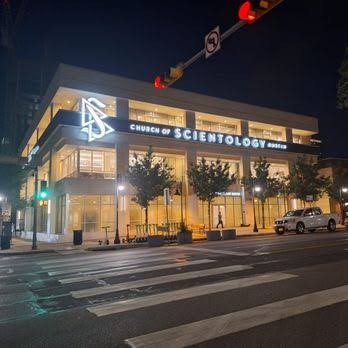
I invited a friend to join me. Since food was offered, we decided to skip dinner and eat at the lecture. We entered the parking lot next to the building we were heading to near the Strip on Guadalupe off campus; my friend made a comment. This looks like Scientology. “Oh, no, let’s leave,” I offered. I had no interest in being pitched to join a cult. In the 1970s, when I was living on West End Avenue in Manhattan, in a pre-war twenty-story brick building, someone knocked on my door one day inviting me to the seventh floor to learn more about this new philosophy called Scientology.
I went, curious as I am, through a maze of rooms, each leading to the catch where you’d sign up and give your life away to a system of beliefs that warp your mind. I shivered. Even at nineteen, I knew the difference between brainwashing and free thought. I told them no thanks and wormed my way back to the elevator to leave. All the while several lemmings followed me, chanting, “Read this book, read this book.” It was Dianetics by Ron L. Hubbard, the founder of the cult.
There is something extremely odd and telling about this stretch of Austin. In the capital of Texas, on the Strip across from the University of Texas campus, there seems to be an extraordinary concentration of churches and religious institutions alongside the bars, boutiques, shops, restaurants, and normal college-campus life. For a university neighborhood that is supposed to be a place of intellectual inquiry, competing ideas, and questioning, the physical presence of organized religion is striking.
Many of these religious leaders often prove to be frauds, and people exposed Hubbard as one much later. If you saw the British 1997 documentary Secret Lives: L. Ron Hubbard, it explicitly challenged Hubbard’s biography and the mythology surrounding him. Contemporary reporting described it as a documentary that “pulls apart the Hubbard legend.”
Accounts include testimony about Hubbard’s treatment of children in the Sea Organization, including the reported confinement of a four-and-a-half-year-old boy, Derek Greene, in a ship’s chain locker for two days. The documentary included testimony from former Scientology executive Hana Eltringham concerning the incident and characterized the treatment as child abuse.
Hubbard published Dianetics in 1950, presenting his ideas about the human mind as an alternative approach to understanding psychological distress. Scientology later developed into the larger religious and philosophical system associated with his name. Scientology presents Hubbard’s concepts about the mind as discoveries, but Hubbard’s own system provides the terminology rather than established psychology. Dianetics divides the mind into an “analytical mind” and a “reactive mind,” with the latter supposedly storing painful experiences as “engrams” that can influence a person outside conscious awareness.
A woman who was not a public speaker and didn’t have a clue about her subject except what she memorized by rote gave the talk. Hubbard took the entire premise of what the subconscious is from ancient texts like the Akashic records or Hinduism. Talking of memory, cellular memory to be specific, that leads one to remember good or bad happenings requires a root cause analysis, which many modern psychologists have discovered for over a century. I wondered where OSHA was?
The “food” presented was not dinner. They sadly displayed Sam’s Club raw veggies, some cakes, and cheese under mesh hoods. We declined.
The Project 2025-like twisted incompetent analogies illustrating the connections between the Self, Group, and Mankind. Self to these cultists equaled having children, procreation, and family. Their theory claimed that society would oust you without children, preventing you from achieving happiness and reaching your highest level of mankind. The example of pregnancy was right out of The Handmaid’s Tale. All I could think of was ‘join Scientology and maybe one of the Borg will impregnate you for the betterment of mankind’.
Scientology’s Eight Dynamics provide the framework behind this progression: Self, family and procreation, groups, mankind and, eventually, increasingly expansive levels of existence. Scientology explicitly described the first four dynamics as Self, family/creativity, group and mankind. What I was hearing in the lecture was not simply a discussion of the subconscious, but an entire system of thought in which Hubbard’s terminology and hierarchy were being presented as a way of understanding human existence. If you were a feminist, or a woman who chose not to have children, or part of the LGBTQIA + community, you would never find peace of mind!
As my friend and I got up to leave, a swarm of over ten Borgies rushed into the conference room. It was simply psychedelic. Wearing the same dark red t-shirts, this hive didn’t smile or offer any salutations. They surrounded those of us who were about to exit.
One of these creepy crawlers with bug-black eyes cornered me against the wall and was less than three inches from my nose, demanding if I read Dianetics. No, I haven’t, and I won’t. Why not? Because it’s written for cult members, and this is a cult.
He almost stepped on my toes.
Why won’t you join? Because I just said I don’t believe in this, in cults, in Ron Hubbard or in Scientology. Now move, please.
I came to hear a lecture on the subconscious. Instead, I listened to a rote presentation of Hubbard’s ideas and then being physically surrounded when I tried to leave. Apparently, curiosity has its limits, and I had reached mine.