
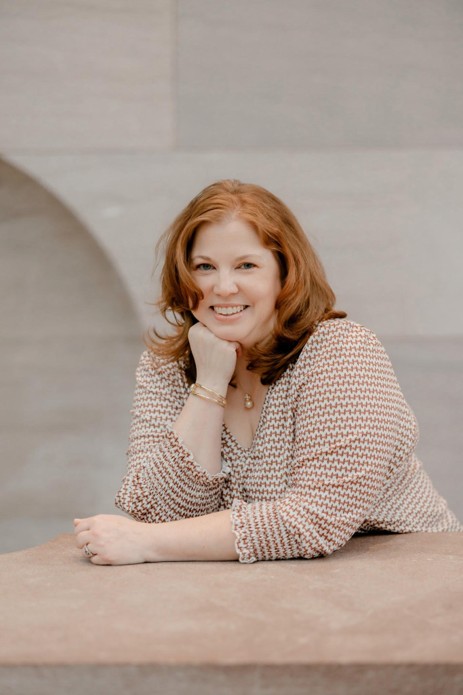
A discussion and personality profile of Karen Uslin
The improbable road to a stage that turned out to be home
Karen Uslin does not describe her career as a plan. For her it’s a habit: saying yes, following curiosity and putting herself where something interesting might happen. In her twenties, she says, she would say yes to almost anything. A film screening. A trip to an embassy. A conversation with someone she had never met. During her PhD years at The Catholic University of America, that instinct became her personal strategy. If she could meet people from different worlds, she reasoned, eventually those worlds might open doors.
They did. Today Uslin works with the Defiant Requiem Foundation, teaches and researches music and Holocaust history, does professional genealogy work and serves as vice president of the National Carpathian Russian Society. But those labels only begin to explain what makes her interesting. The deeper thread is her fascination with the way people inherit stories, lose them, recover them and sometimes discover that the story they have been chasing has been chasing them.
That realization became personal. Uslin grew up in Northeast Philadelphia and southern Bucks County, in an East European immigrant environment where Polish, Ukrainian, Russian, Hungarian and Albanian cultures were part of the landscape. She attended a Catholic girls’ school with strong Polish roots. Later, she pursued a PhD at Catholic University, where she became deeply involved in music of the Holocaust and Jewish music.
The apparent contradiction is part of what makes her story compelling. She was raised Roman Catholic, yet her academic work led her into Jewish music and the history of Catholic victims of the Holocaust. Rather than resolving those tensions into a single tidy conclusion, Uslin seems drawn to the messier truth: several things can be true at once. Catholics could be complicit with the Nazis; Catholics could also be persecuted by the Nazis. Jewish suffering can be central to the Holocaust story without erasing the suffering of other groups. History, she argues, resists easy packaging.
“There’s no such thing as a hierarchy on trauma.”
For Uslin, that is not a slogan so much as a method. She wants to make room for stories that have been overlooked without pretending that doing so diminishes stories that are already known.
Her curiosity about Catholic history also brought her to people who changed the direction of her life. One was Father James Moore, a Dominican she met while working on a paper about Verdi’s Requiem. She jokes that she was nervous even walking into the Dominican House of Studies. The friendship that followed became one of those rare relationships she describes as a kind of soulmate connection, not romantic but deeply formative.
What she learned through that relationship was to ask why. Why does the Church do what it does? Why are some people canonized? Why do certain traditions survive while others disappear? Why do some stories become part of public memory while others remain buried?
That question eventually led her back to music. Uslin has a particular affection for Hildegard of Bingen, the medieval composer, mystic, writer and Doctor of the Church. She teaches Hildegard to music-history and theater students and once contacted the convent Hildegard founded in Germany. Her enthusiasm is infectious: Hildegard, in Uslin’s telling, was brilliant, formidable and unwilling to take nonsense from powerful people.
Then came the discovery that transformed all of those interests into something startlingly personal. Uslin is adopted. She knew she had some kind of Eastern European biological background, but not precisely what it was. In 2017 she found information about her biological family. In 2023 she learned that her ancestry was connected to the Ruthenian, or Carpatho-Rusyn, people, a Slavic ethnic group whose history stretches across a region shaped by changing borders, empires and persecution.
Her reaction was almost comic in its inevitability: Hadn’t she been studying this world for more than twenty years already? The discovery did not simply give her an ancestry. It gave her a new way of reading her own life.
A Byzantine Ruthenian church happened to be about twenty minutes from her home in Silver Spring, Maryland. Father James told her to go. She did. She stayed for four hours talking to people, took home books to read and eventually began singing with the church. What had been an abstract academic interest became a lived cultural inheritance.
And then the road bent toward Carnegie Hall.
A Polish violinist, conductor and composer, Mariusz Monzak, was developing a concert of Carpatho-Rusyn music. He had assembled the funding to bring the music to Carnegie Hall, where, Uslin says, this music would be performed there for the first time. He asked her to participate. She did considerably more than sing.
At the May 27, 2026 concert, Uslin sang in the choir, performed as a soloist, wrote program notes and co-emceed the event. Onstage at Kurt Weill Recital Hall, she wore a traditional Carpatho-Rusyn beaded necklace and sang music connected to the culture she had only recently discovered was biologically hers.
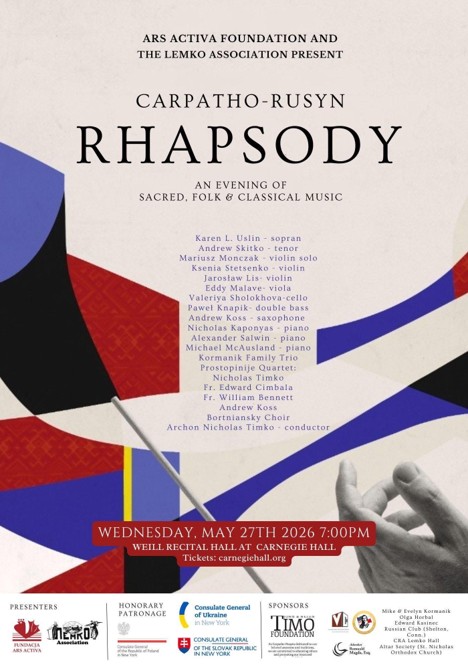
That moment contained almost everything: the Philadelphia childhood surrounded by East European immigrant culture; the Polish influence of her school; the years of musical training; the academic work; the Holocaust research; the genealogy; the discovery of her biological family; the Byzantine church; and finally a public performance of her own ancestral music. It was not simply a concert. It was a convergence.
Uslin calls it an improbable journey. For an adoptee, she says, having something tangible from one’s biological background is meaningful. Having the chance to share it with a public audience is something else entirely.
What happens next is still deliberately unwritten. Uslin is not interested in pretending she knows exactly where her career is going. She wants more opportunities to speak and perform, and is interested in cultural heritage consulting and genealogy. But the larger ambition is clearer: connect people to stories and cultures that may have been disrupted or lost in their backgrounds, so they can understand themselves better and understand the world from which they came.
That may be the most revealing thing about Uslin. For all her scholarship, she is ultimately interested in the human scale of history. Saints, survivors, nuns, immigrants, ancestors and ordinary families are not remote historical figures to her. They were people who made choices, had contradictions, fears, relationships and lived ordinary lives. If those lives can be brought close enough for someone today to recognize something of themselves in them, history stops being a museum exhibit and becomes a living inheritance.
And perhaps that is how Karen Uslin got to Carnegie Hall: not by following a straight line, but by following the threads. Music led to theology. Theology led to history. History led to genealogy. Genealogy led to identity. Identity led back to music.