
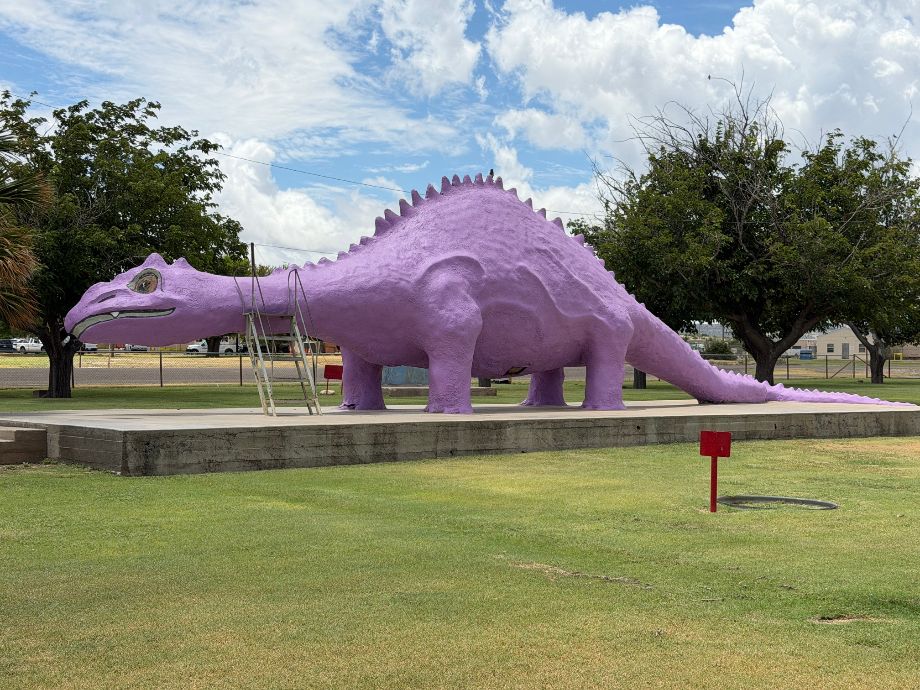
The population is only 1,000, but Iraan is a must-see destination spot for those travelling west from Austin.
Just a bit of history to start: It was exactly 100 years ago, 1926, that oil was found here. The field has produced more than one billion barrels of oil, making it one of the largest in the United States.
The land which the oil field underlies was owned by Ira and Ann Yates, ranchers in the Trans-Pecos region of West Texas. Ira Yates donated 152 acres of his land for the townsite of Iraan: it is named for them: Ira+Ann. His descendant, the current Mr. Yates, lives in Austin, but is still quite engaged with Iraan.
For tourists, the most active time to visit is early June, when the town hosts a big festival for a big guy (Alley Oop) and his even bigger pet.
Alley who?
Well, for those of you tenderfoots too young to remember, the comic strip Alley Oop was a fixture in the newspapers of America for half a century. It was created in 1932 by local newspaperman V.T. Hamlin while he lived in the town. The strip blends prehistoric slapstick comedy, science fiction, and historical adventure.
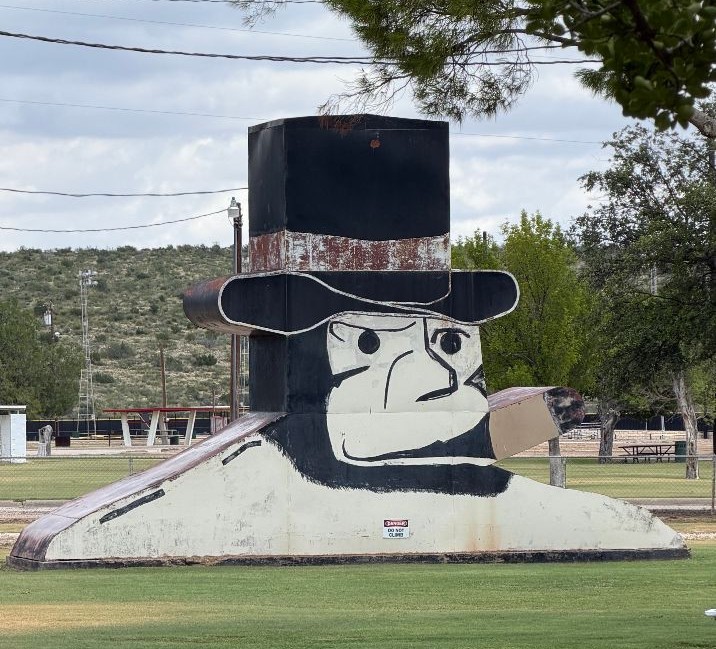
The title character is a brave, thick-skulled, stone-axe-wielding caveman who wears a fur loincloth. Alley’s loyal, sweet-tempered pet dinosaur whom he rides like a horse, is named Dinny. You can meet both of them here in person!
Dinny, 65-feet-long, is certainly the most photographed dinosaur in Texas. And unlike most dinosaurs, she is a delightful pink all the way from her face to her cute tail. There is a stepladder right beside her, so you can walk up and pet her. Don’t worry about the teeth: she is domesticated, and never bites tourists!
While an early version of a dinosaur prototype was built by locals in 1956, the official 80,000-pound permanent concrete statue and the Alley Oop Museum & Fantasy Land Park officially opened to the public in May 1965. The ribbon-cutting ceremony coincided with Alley Oop Day to honor the 65th birthday of her creator V.T. Hamlin, who was present for the event. At 16 feet tall, Dinny is carefully watched by another gigantic installation a few feet away: a 20-foot-tall metallic version of Alley Oop himself! A prehistoric cigar dangles from his mouth.
All this sits beside one of the finest small museums in the state. There are literally thousands of exhibits here, with the entry room mostly dedicated to dinosaurs (the real ones) and Native American artifacts going back 100,000 years.
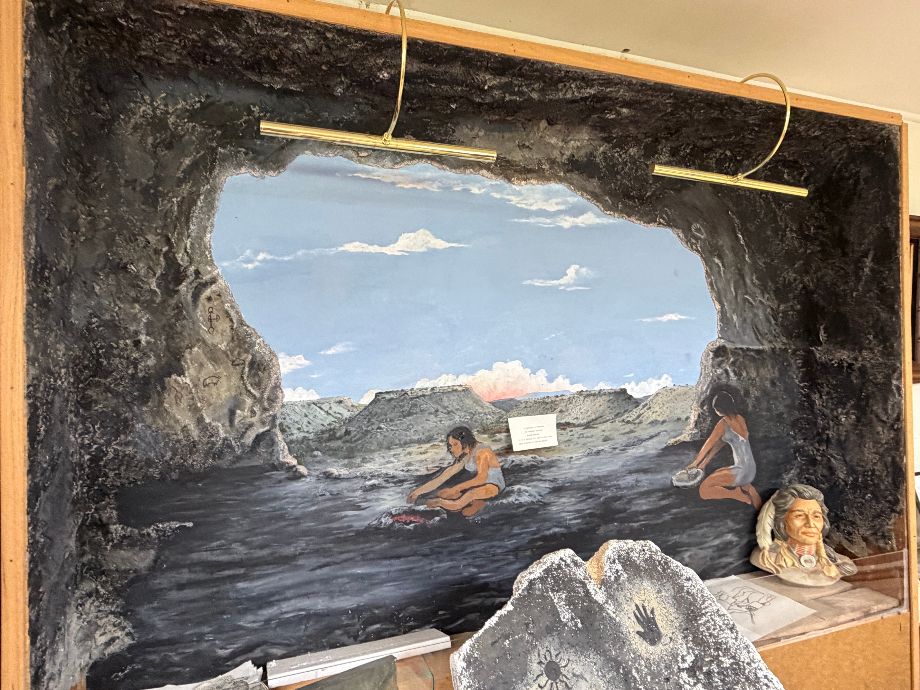
While it is no longer active, the Iraan Archeological Society has at least one founding member left: Snooks Collett. A beautiful 3-D panorama she created in on display here (see photo) and some of the artifacts she recovered are on display. Now 99, I had the good fortune to meet her on my visit to Iraan.
The model created by Therman B. Sullivan in 1964 for the full-scale Dinny is on display here, along with real fossils and carbonised wood.
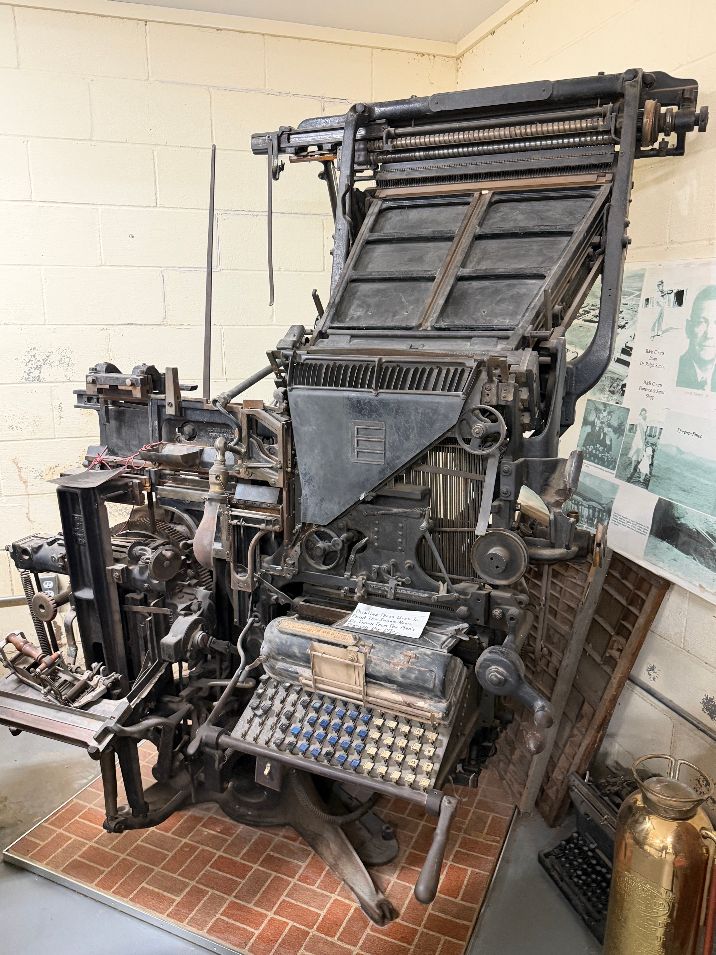
The other rooms are a treasure trove of the old days in Iraan. Including the printing press used by the Iraan newspaper from the 1940s to 1970s, and the popcorn machine from the Iraan theatre in the 1930s. A 1930s permanent wave machine, which is modelled by a female mannequin, looks like a science fiction torture device!
Going back to the 1920’s, there is a dollhouse with miniature furniture crafted by Dr. Walter Williamson, a doctor here; and a radio with horn speaker, on loan from Roger Horne. My favourite small item is a toaster that belonged to Mrs. Clark. She arrived in Iraan in 1929; her husband Delfo worked here for the Standard of Texas Oil Company.
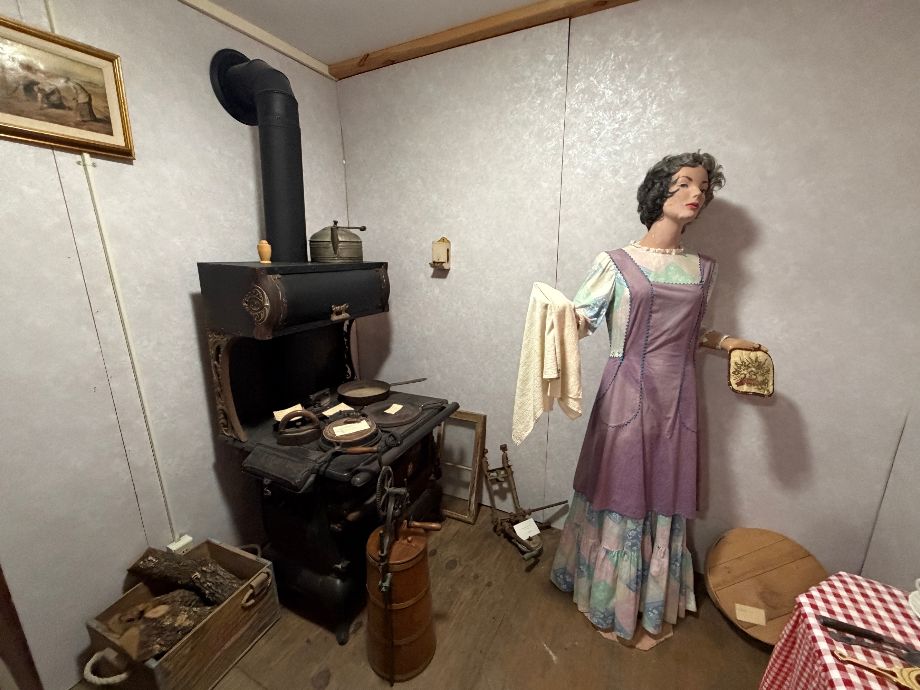
The most amazing piece I saw dates from the 1850s: a quilt, which was “hidden in the Mammoth Caves, Kentucky, during the Civil War.” It is in one of the rooms that recreate an old house. You can open the door to this stand-alone structure and walk through the kitchen (complete with the lady of the house; see below) and other rooms. Here you can see the gloves worn by I.G. Yates when he wed Annie Shockly Brooks on 26 Jan. 1883. Really fascinating.
A small classroom has been reconstructed, courtesy of Collett and Harley Brooks. It features a desk from the former high school here.
Lots more to see! This is just a teaser. There is also a fine display here about the 19th century Fort Lancaster, which is not far away. So see that too on your roadtrip from Austin (about 4.5 hours).
Website for the Park in Iraan
Open Thursday – Sunday 2 – 5 p.m, but call ahead to make sure it’s open:
https://texastimetravel.com/directory/alley-oop-park-and-fantasyland