
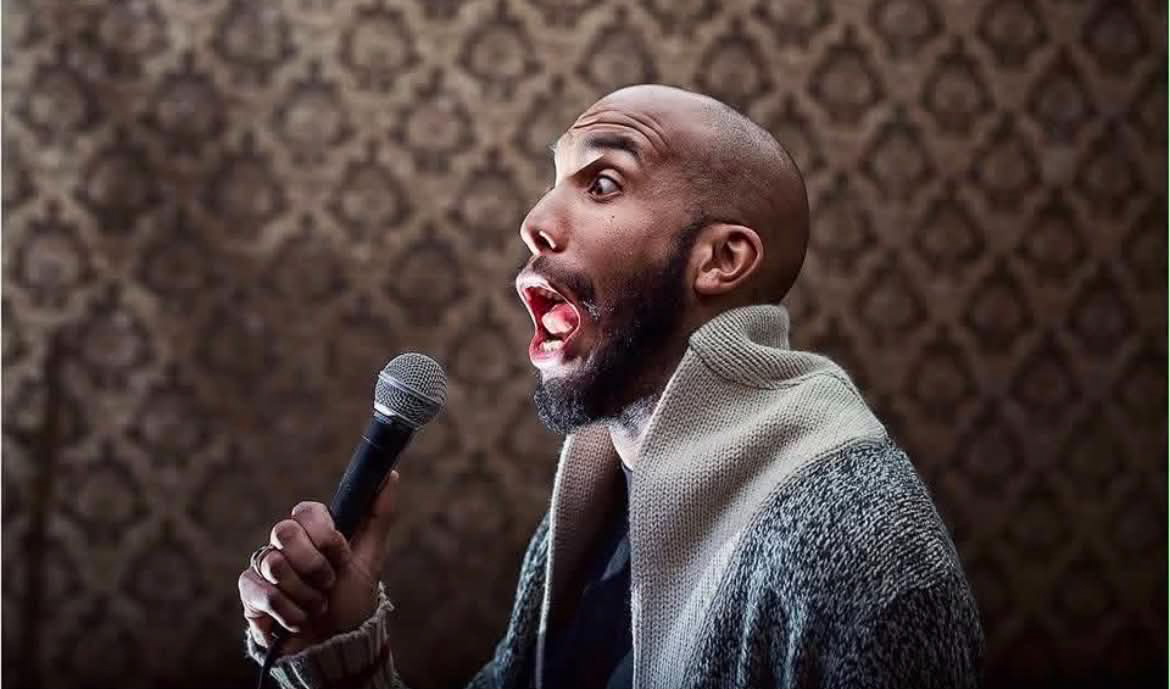
Austin comedy audiences hold their laughter like a confidence — measured, contained, released only when something has fully earned it. Walk into Cap City Comedy Club on a Friday night and you’ll feel the room calibrating, the crowd watching with the careful attention of people who have decided, collectively, to wait and see. Which is why what happened that particular Friday was worth paying attention to.
I had just returned from France. My Mexican American friend and I took seats in the front row, two older women settling in for a Friday night at Cap City Comedy Club, neither of us expecting to become part of the show. The comic on stage, a tall and unhurried Canadian named Michael Moses, spotted us immediately. He gestured toward the two empty seats beside us and observed that those were probably the dead husbands who were supposed to show up tonight. The room, which had been doing its careful Austin thing, cracked open. From that point forward, Michael Moses owned it.
We became an accidental Greek chorus for a set that had been building beautifully before Moses decided to make us part of it. What I saw that night was a performer operating well above the pay grade of a mid-bill opener — specific, unafraid, and possessed of the rarest quality in a comedy room: he was entirely himself.
Michael Moses, 36, arrived in Austin officially on May 16th of this year, after three years of navigating the American visa process from Alberta, Canada. The decision was methodical. While waiting for his visa to clear, he spent a month each in New York, Los Angeles, and Austin, treating each city as an audition. He first came to Austin in November 2025, no car, taking buses across town to reach shows, already feeling the difference. New York charged five dollars to perform at an open mic. Austin just said come on. “That first month I was here, I got on actual shows,” he says. “Austin was just like, okay, this will be a step up instantly.” He went back to Canada, waited out the visa, and returned for good in May.
He grew up in a town of 4,000 people in Alberta — white town, white mother, Black father who lived five hours away. Hockey, trades, and the unspoken civic agreement that this is the shape of a life and comfort is the appropriate response to it. Moses was constitutionally unsuited to that agreement. Every film, every image of a city skyline reinforced the same conviction: he was meant to be somewhere else entirely, doing something that did not yet have a name for him.
When I mentioned my own years of living as an outsider in Europe, where tolerance and acceptance are rarely the same thing, he recognized it immediately. “It’s light in front of your face and talk shit behind your back,” he said. “I started saying it to people’s faces. Why are we doing it behind their back? Just say it to me.” That instinct, to name what everyone is politely performing ignorance about, is the engine of everything he does on stage.
He found the form at nineteen, watching Eddie Murphy’s Delirious on a computer screen and experiencing something close to revelation. Dave Chappelle. Chris Rock. George Carlin and his famous inventory of words that television had declared off-limits. “Those things that shouldn’t be said,” Moses explains, leaning forward slightly. “Something that makes you go, oh wow, I don’t think you should have said that — but it’s said. It’s out there now.”
He moved through Ontario before landing in Austin, walking into Toronto clubs with the naive confidence of someone who had decided that preparation and presence were the same thing. On weekends he took buses to professional shows and sat in the back with a notebook, studying how comics lost a room and what they did to recover it, watching what separated one performer from the next. “Chris Rock said he was in a comedy club every night for fifteen years,” Moses recalls. “So I thought, okay, sixteen to twenty for me.”
Girlfriends came and went, frustrated by a man who considered a 9pm date a reasonable compromise given the 8pm show he needed to catch first. He kept going. Craft accumulates the way it does when someone refuses to treat it as anything other than the central project of a life.
His process is deceptively straightforward: he lives something, it lodges in him, and he finds himself having the same internal conversation about it at three in the morning until he figures out why. Right now the material is coming from fatherhood. His daughter arrived this year, the same year his visa cleared and the same week he married her mother, just before the baby came. He talks about the conditional nature of paternal love, about looking at his newborn’s cone-shaped head in the delivery room and taking a beat before committing.
He talks about his wife’s relationship with scarcity, the reflexive frugality of someone who grew up without, rendered with the affectionate precision of a man who has clearly thought about it a great deal. He talks about his mother’s second husband, a man Moses has never bonded with across decades of proximity. “Once you’re past seven years old,” he says, “it’s not really a stepdad anymore. It’s just some guidance.”
Austin is supplying new material faster than he can catalog it.
When I mentioned the city’s particular fondness for establishment dates — every bar, every restaurant, every reclaimed-wood taco counter displaying its founding year with the gravity of a historical marker — his eyes sharpened. “I walked into a shop with a plaque for best bar, 2007,” he said. “That’s nineteen years ago. Why is that still on the wall?” Because, I offered, it is all they have. The people who earned that award in 2007 have long since moved on, leaving the plaque as the sole custodian of a reputation that no longer requires defending.
I asked him to picture me walking onstage wearing New York State earrings. He pictured it. No, he couldn’t.
Moses has the particular advantage of someone who arrived without the local investment that makes these observations invisible to the people inside them. He came in May with a baby, a Canadian wife still navigating her own visa paperwork, a body of work about fatherhood and race and small-town escape, and the long-trained instincts of a man who has spent his adult life watching rooms carefully, waiting for the right moment to speak.
At Cap City that Friday, the moment arrived early. Two women in the front row were laughing too freely for the room’s usual register, and Moses pulled them in, and the audience unlocked, and for the remainder of the set he worked at full capacity — looser, sharper, the headliner leaning over afterward to say, with genuine respect, that now he actually had to work.
That is the only review that matters in any room.
Michael Moses performs regularly at Cap City Comedy Club and venues across Austin. Follow him on Instagram @itsmichaelmoses for show dates.