
The headline is a quote from a character in a play being staged in Austin this month. The brain has to do a lot of work to really understand it, but if just want to watch a madcap play with three live bluegrass musicians, that’s OK too.
Originally published by the Brothers Grimm in 1812, the Robber Bridegroom was adapted in 1942 by Eudora Welty as her first novel. By 1975 it became a ground breaking musical: It is the first one that broke from the traditional book; the first one that used bluegrass music, and the first example of ‘story theatre.’
I had a wide-ranging interview with the Director, Michael Cooper, on the history of this production, staged here in Austin by The Alchemy Theatre.
Tell me first of all, do you have a favorite piece of music in the show?
“I started out liking Nothing Up a lot, just because of the music. But then I ended up with Where Oh Where? It just fits the movement of the piece better than any other, because it’s all based in bluegrass music. And the roots of bluegrass carry over into the roots and the tempo of how the piece actually moves. So, Where-A-Where is my baby darling?, to me exemplifies the most rhythmic and tempo-wise that fits the whole piece of the whole tempo of the show.”
I noted that the performance has a lot of moving elements to it. “I always choose pieces that are a challenge to me and the company and to the Alchemy Theatre. So, it took me a year to put all of this together. I did lots and lots of research on the roots of bluegrass, how bluegrass fit. This is the first bluegrass musical written for Broadway, 1975.”
“Welty really brought out the metaphor of the American history, the cultural history of this piece. It shines a light on the good face and bad face of where America is today. When Welty wrote in ’42, she was writing about the good face and bad face: the bad face being the rise of fascism in America.
“There was fascism back then, of course, and it parallels the fascism now. And so, while I was working on this, it’s like, okay, you know, that’s how the history and universe works. It’s like it just comes up like that.
“And so today the musical shows the good face of America being the place of freedom, the bastion of freedom, and then it’s also a hot spot of violence right now. So, all of that is based on that Grimm folk tale: the good and the bad, the duality of good and bad. Good face, bad face.”
It is this duality that we see expressed in the lead character (the gentleman robber), played with abandon by Cameron La Brie. When he presents himself as a businessman, he is showing his good face to the world. But when he wears a mask, he comes the nameless Robber. It’s actually all very Shakespearean.
“It’s a very, very interesting piece of the history based in Grimm’s Fairy Tale, Robber Bridegroom, which is very, very dark and very gruesome. Welty took a lot of those dark moments and dark things about the fairy tale, kept them in this. But then the musical added the layer of looking at that through the lens of comedy. So, it made all the difference in the world, right?”
“And you can see it if you actually read the fairy tale” explained Cooper. “It is very short, and then the novella is beautifully written but still maintains a lot of the darkness about it because she wanted to instill that rise of fascism into what she was writing in ’42. It was a very popular novella. And then the composer and the book writer of this musical kind of ironed out or balanced the comedy and the darkness of it into this piece that was written in 1975.”
Patty LaPone and Kevin Kline opened it. Barry Bostwick took over in ’76, won a Tony for it, and the latest major revival was in 2016.
The concept of ‘story theatre’ may be new to some. It is where the ensemble does all of the changing of the environment, and all of the sound effects are all done by the human voice.
Cooper, who began his directing career in the 1970s, explained what it meant to him to direct Robber Bridegroom. “I really had studied story theatre, but had never done a story theatre piece. And I really wanted to find the right ensemble, to fulfil that, and found 11 amazing actors that could act, sing, and dance, and do bullfrogs and owls, and all that.”
“And I really wanted to try to take this brand of comedy, which is very physical, very broad, and make that an art form in itself. And have great fun doing it. And then, also invite the audience, so the audience feels like they’re building it too.”
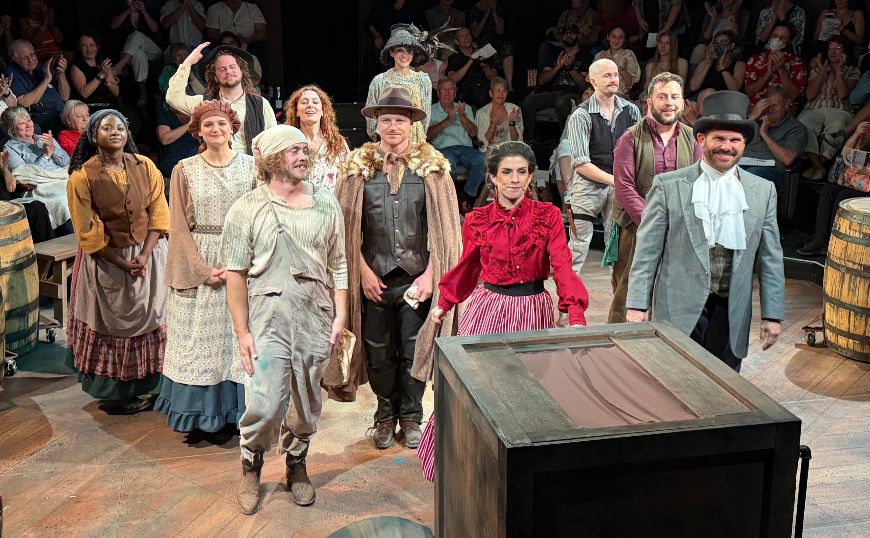
Photo by C. Cunningham:
The sterling cast. Cameron La Brie, centre with hat on. Rachel Pallante, in red dress, expressed the line I used as my headline. Sebastian Vitale, at far right. To the left of La Brie is Noah Steele, and between them in the back is Taylor Bini (the bridesmaid for the Robber).
The Robber Bridegroom is laying thru June 14 at The Whisenhunt (Zach Theatre) in downtown Austin.
Thealchemytheatre.org