
An Interview with Agnes Nkhata – International DJ, Artist, Writer and Humanitarian
How are you? I ask the question from my living room over Zoom, lightly, steam rising from a Texas coffee pot as my interview with Queen Agnes begins. Her laughter and radiant smile is immediate, full, and unpretentious. I sense what will become clear over the next hour: this woman is a wellspring of gratitude, courage, and legacy.
“My name is Agnes Nkata Blackwood. I was born in Malawi, Africa, which is known as the warm heart of Africa. I came to the United States with my mother when I was seven years old.”
Her mother came chasing education’s promise; her aunt was already on a Texas campus. “My mom worked really hard; three jobs here in Texas while going to college to make sure that my brothers and I were still able to go back home for the summer.”
It’s a detail that anchors Agnes’s life philosophy. Where others see scarcity, she sees lineage, sacrifice, and devotion. Gratitude is not an idea. It’s her breath, her mantra, her presence.
“I feel that thank you or gratitude is like the most important emotion, the most important word in any language. So I always teach people Zikomo. If you don’t remember anything about me, you remember Zikomo.”
In Malawi, gratitude calls out to itself. You don’t say “you’re welcome.” You echo: zikomo—zikomo. Gratitude answered by gratitude, a bridge built from two mouths speaking thanks.
Agnes carries not just her mother’s sacrifice but her grandfather’s vision. “Another really influential person on my journey has been my grandfather. His name was Agogo Winston “Timalechi” Zimba … the first civil engineer for the liberated Malawian government in the 60s.”
After retiring, he didn’t retreat into comfort. He returned to his home village and built what mattered most when titles faded:
“He opened up the first maize mill in our village. Then he built the first water well and created a school called the Timalechi Nursery School because he saw a need for the preschool-aged children to have a safe place to play and learn.”
What began as a daycare to keep toddlers from potential death or disappearance by wandering into rivers while their parents farmed and sewed grew into a preschool recognized by Malawi’s Ministry of Education.
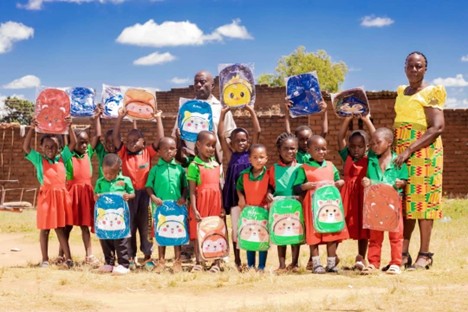
By 2015, when Agnes visited, she rode her bicycle down to the grounds and found devotion without tools. “They had no school materials, no desks, no chairs. But they had the best-behaved students. And the teachers were splitting about fifty U.S. dollars a month amongst the three of them, because most of the parents couldn’t afford the fees. Yet the principal and teachers still allowed the kids to come. That’s what my grandfather wanted.”
She returned to him with a plea: Let me raise funds. Let me help. He said yes. Providence intervened. That same year, provenance nominated me to become the president of the Malawians in Texas organization. Now I had a 501c3 to raise these funds properly.”
Since then, the Timalechi School has been steadily remade by hands on both sides of the ocean.
“We’ve been able to renovate the classrooms, hire more teachers. We built a gate around the property—because before it was just wide open, people were riding bicycles through. And we now have a security guard. This is all thanks to people right here in Texas who have been supporting the project.”
Leadership matters in daily weather. Agnes insists on naming the woman who keeps the books and makes ceremony out of continuity:
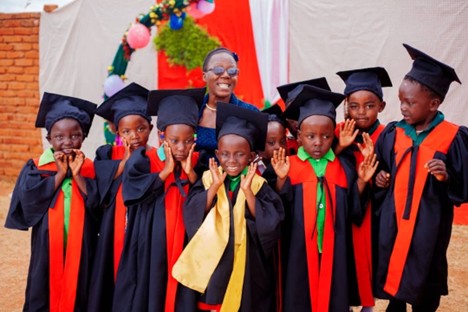
“Her name is Iness Chirambo, and she’s the principal. She was a widow, volunteering, and I asked if she’d like to be there every day. She said yes. At graduation, she used her own initiative to make caps, flowers, and certificates for the children. She’s doing an amazing job.”
The school is a living organism. Four classrooms now serve infants through pre-K. A music class teaches children to build instruments from recycled materials. Meals come not from donations but from the land.
“We grow our own maize and beans and vegetables, and that’s how we feed our children at the school. That’s called the Paula Project—paula is porridge. It funds the farm, pays the cook, and feeds the kids. It’s self-sufficiency. That’s what we’re going for.”
Agnes’s voice lifts with pride: this is no handout. This is inheritance cultivated.Yet needs remain, concrete and urgent. The nearest water well is half a mile away.“The teachers wake up at four in the morning to get water for the school and for their homes. We want the water on our property so we have a distribution system of clean running water right at the school.”
A proposal sits ready, fully costed. The will is there. The infrastructure is waiting for funding to turn dust into flow. And vision reaches beyond water to light.
“When they come to school, I want them to have electricity. I want them to have all the things so that they know this exists and that they deserve it. We’re getting tablets. We’re starting a technology room. Just because they’re in the village of Malawi doesn’t mean they shouldn’t have that head start too.”
Her dream is on the horizon: a generation who grows up knowing that dignity is not foreign.
Legacy threads every sentence and runs through her veins. Her father, Bright “Live Wire” Nkata—is the king of hybrid music. He pushed her on stage at 14. “You’re my daughter, you’re getting on stage,” he told her, handing down performance as inheritance. He died soon after, leaving her a room of guitars sold off by others, but not erased. “You cannot burn. You cannot sell legacy.”
Her grandfather left land that still feeds the children. Her mother Helen Zimba, an award-winning HIV Advocate left sweat in every shift worked to make sure summers still carried the smell of Malawi. And now Agnes, carries all of them forward through Timalechi.
“The motto of the school is: today’s students are tomorrow’s leaders. I want them to see something different than what they see at home. Most of them live in huts, no electricity, no running water. When they come to school, I want them to see something else. To know it exists. To know they deserve it.”
At one point in our conversation, the tears gather between us, ancestral and immediate. I tell her what I feel: “You are carrying that torch, Agnes. Yours is a family of integrity, of honor. Not many people can say that.”
She pauses. “Too many people… we want the world to become that. That more people wake up to the honor of being human. You are honored to be human.”
There it is. The story of a school in a Malawian village is also the story of us, if we choose to see it. A reminder that humanity is measured not in GDP but in whether a child has water close by, porridge for lunch, a principal who believes their life deserves a graduation cap.
Zikomo, says the child. Zikomo, answers the world.
Agnes is not simply raising funds for desks and pipes. She is raising a mirror.
“It’s really simple to be human. All you have to do is look into people’s eyes when you’re talking to them. That’s the first step: have compassion. When I went to my grandpa’s school, all I could think was—that could be me. It’s only one little string, which is my grandpa’s wonderful job, that kept me from being that child sitting on the floor in that school building, sharing loaves of bread.”
Programs at the school include: Sponsor a Student, the Phala Project: self-sustainable food program and the Water Project, scheduled to have clear running water at the school by 2027.
Who is rich I ask rhetorically recalling my days running a non-profit for AIDS awareness in South Africa? “The families in Soweto insisted I eat with them when they had nothing but maize. The villagers who welcomed strangers into homes of clay and straw. Who is poor?” Those who forget that being human is and honor. That’s who is poor.
Queen Agnes hasn’t forgotten. She’s building it, one desk, one gate, one bowl of porridge at a time.
An allegiance to life.
Visit the website: www.timalechischool.com
To make a direct donation visitt https://www.paypal.com/donate/?hosted_button_id=CZ48BYBDKR8YJ