
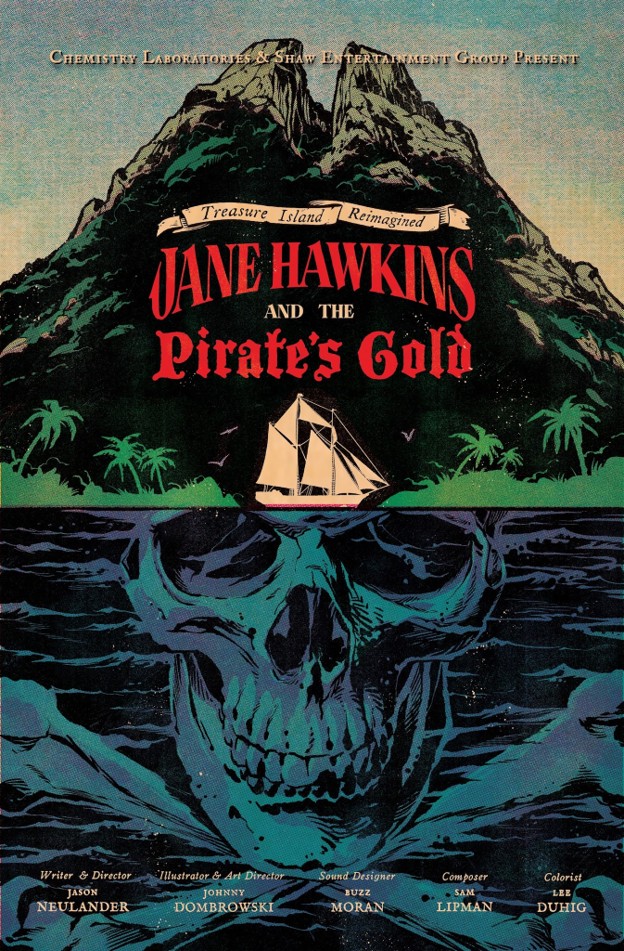
There is something wonderfully old-fashioned about Treasure Island Reimagined: Jane Hawkins and the Pirate’s Gold—even as its visual language looks like it has leapt straight out of a Roy Lichtenstein painting crossed with Manga. The premiere staged at the State Theatre in Austin, was written and directed by Austin theatre-maker Jason Neulander. It takes Robert Louis Stevenson’s classic pirate adventure and turns it into an extraordinarily original form of live theatre: part graphic novel, part radio play, part silent movie, with three actors creating an entire world in front of us.
The effect is a throwback to the “Radiospiels” (radio plays) of yesteryear, when audiences conjured entire landscapes, characters and action from voices and sound effects, or to the era of silent movies, when stage performers might sit at a piano or physically recreate scenes to accompany what appeared on the screen. Treasure Island Reimagined takes those ideas and puts them together in a form that feels entirely original.
At the center of the stage is a huge screen onto which Johnny Dombrowski’s illustrations appear panel by panel, carrying the audience through the story like the pages of a graphic novel coming to life. In front of it, Cheyenne Gibbs, Neulander and Dane Parker perform the story live. Gibbs plays Jane Hawkins, Kate Morgan and other pirates and privateers; Neulander becomes Billy Bones, Squire Trelawney and assorted mariners and miscreants; Parker takes on Dr. David Livesey, Ben Gunn and a collection of seamen and mutineers.
The sheer range of the three actors is one of the production’s great pleasures. They move effortlessly among male and female characters, Irish and British voices, upper-class and lower-class personalities, shifting accents, posture and physical presence as quickly as the story shifts from one character to another. Yet the acting extends well beyond voice and dialogue. Their bodies become part of the machinery of the production.
A piece of physical material can suddenly become a sound. A gesture can suggest an entire action. An object can transform into a sound-effect device. The performers create the creaks, crashes, footsteps, birdsongs, and other sonic details of the adventure while simultaneously inhabiting the characters producing them. The result is theatre in its most elemental sense: human beings on a stage using their bodies, voices and a handful of physical objects to make an audience see and hear an entire world.
That is particularly striking because the production deliberately embraces a handmade quality. The illustrations were created by hand without the use of AI (disclaimer at the start of the show), while the performers generate the action and sound in real time. There is an almost mischievous pleasure in watching a production achieve such a rich sensory effect through human ingenuity rather than layers of contemporary technology.
Neulander has been developing this “live action graphic novel” form for years. His earlier The Intergalactic Nemesis premiered in Austin in 2010 and subsequently toured the world for eight years. Treasure Island Reimagined takes that established theatrical language somewhere new, applying it to one of the foundational adventure stories of Western literature.
The story itself has also been given a significant turn. Neulander replaces Stevenson’s Jim Hawkins with Jane Hawkins, a girl whose desire for adventure collides with the realities of being a young woman in eighteenth-century England. In Neulander’s conception, Jane has to disguise her identity to get aboard the ship, and the possibility of becoming a pirate captain carries an entirely different meaning for her than it would for a boy.
That change gives the familiar pirate mythology another dimension without abandoning the ingredients that made Treasure Island endure: the one-legged pirate, the parrot, the treasure map, Long John Silver and the rollicking adventure at the heart of the original. Neulander has described his intention as making the classic relevant to a contemporary audience while preserving what made it classic in the first place.
What makes the production particularly engaging, however, is the collision between its old and new sensibilities. The story comes from the nineteenth century. The theatrical techniques echo those used in the early part of the 20th century. The visual aesthetic belongs to comics and contemporary graphic storytelling. And the audience experiences the immediate, almost primitive pleasure of watching people make things happen in front of them.
There is no distance between the mechanism and the magic. You can see the actors making the sounds, shifting characters, manipulating objects and responding to the images as they appear. Knowing how the trick is accomplished only makes the experience more enjoyable.
That is the great conceit of Treasure Island Reimagined: it turns the mechanics of storytelling into part of the story itself. The audience isn’t simply watching Jane Hawkins sail toward buried treasure. We are watching three actors, a graphic novel, a soundscape and a stage collaborate in real time to make that voyage exist.
And in an age when theatre can increasingly disappear behind technology, there is something refreshing about watching three humans do the work.
The show travels stateside to twenty other locations.