

There’s a particular courage required to write a play in which you are the fool. David Henry Hwang possesses that courage in abundance, and Yellow Face — now receiving a sharp, assured production under the direction of Sandy Lam — weaponized it to devastating effect.
The premise is fascinating, a high-wire act that moves from actual historical fact to dramatic interpretation, bending and reshaping itself to meet the demands of today’s over-the-top PC public — what I’ll simply call the censored. The juxtaposition is both exhausting and enlightening, and it is entirely the point. This is an exposé on Hollywood, on Broadway, and on the greater racism underlying how America was built. It is chilling, timely and it is, somehow, also funny.
Matthew Vo plays DHH, Hwang’s fictionalized stand-in, and he carries the role with coiled, combustible energy. DHH is a man perpetually straddling contradictions — his fury at the anti-Asian sentiment calcified into the bones of American theater set against his own uncomfortable complicity in the very systems he’s raging against. Vo makes you feel both the righteousness and the unraveling, sometimes within the same breath.
The story roots itself in the 1990 controversy over the casting of Welsh actor Jonathan Pryce in the Asian lead of Miss Saigon as the production transferred from London to Broadway. DHH is at the barricades, protesting what he rightly identifies as a travesty — a white man in yellowface playing an Asian character while Asian actors stood on the outside looking in. The argument that an Asian must play an Asian was aired, publicly debated, and ultimately discarded. The machine rolled on. Pryce would win the 1991 Tony Award for Best Actor in a Leading Role in a Musical.
Full disclosure: I was living in Europe when Miss Saigon first opened on the West End in London, and I bought a ticket. The show swept me away — emotionally, mentally, completely, despite the controversy swirling around it. I purchased the CD. I bought the tee-shirt. Having lived five years in Japan with deep-rooted sentiments toward Asia and its people, I went in knowing better and came out humming the score, anyway. I loved Miss Saigon. I still do, if I’m being honest. And sitting in the theater watching Yellow Face, I understood with an uncomfortable clarity that this makes me exactly the kind of audience Hwang is writing about — the person who can hold two contradictory truths simultaneously and find ways to make an uneasy peace with the tension.
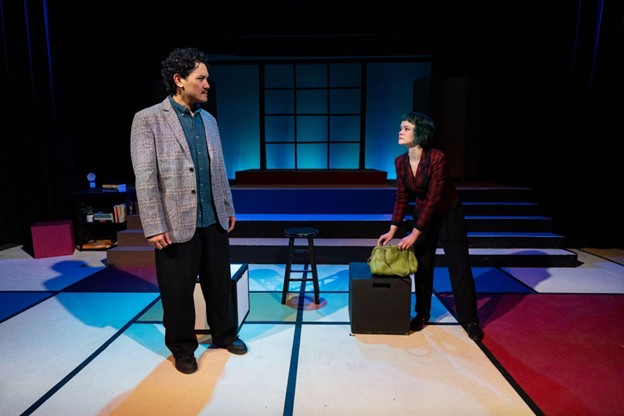
Then comes the topsy-turvy — and here I’ll stop, because the particular shape of DHH’s moral unraveling is something you should discover for yourself. What I will say is that the rationalizations required to sustain his subsequent choices grow more deliriously absurd with each scene until the play becomes a perfect parody of the very arguments DHH spent years dismantling. Whether consciously or not, he excuses what he condemned. The play refuses to look away from that. It’s uncomfortable, and it’s meant to stir indignation.
Into this volatile atmosphere steps the New York Times reporter, played with blade-sharp precision by Claire Shelton. She is not the neutral arbiter she presents herself as — not by a long shot. Her scenes crackle with the specific discomfort of watching two writers simultaneously right and wrong each other, each one’s hypocrisy quietly illuminating the other’s.
But the performance that lingers longest belongs to Norman Tran as HYH, DHH’s father. Here is the American Dream rendered in full — and then slowly, cruelly tested. Tran’s HYH is a Shanghai-born man who has built his life around the belief that America is the right place, the place where he belongs. He dreams in the register of Jimmy Stewart’s decency and Frank Sinatra’s fierce independence — My Way as personal manifesto, as immigrant credo. His story becomes the play’s moral center, and what happens to him carries the cold, clarifying force of history repeating itself. It calls to mind the Rosenbergs — sacrificed on the altar of political hysteria — and the WWII internment camps, and every subsequent moment when America has needed a convenient enemy and found one in its own citizens. The accusation simply changes costumes. One line stopped the room: “You’re an ethnic tourist.” Four words that contain multitudes.
Hwang has noted that anti-AAPI racism and hate have sharpened considerably since the play’s 2007 premiere, accelerated by the pandemic’s spike in anti-Asian attacks and the ongoing hostility between the U.S. and China. The culture moved toward this play — which is a polite way of saying the play was right all along.
Sandy Lam’s direction holds all of it together with a steady hand, navigating the tonal swings from farce to fury without letting either mode collapse the other. Ground Floor Theatre, Austin’s East Side home for diverse voices, is exactly the right house for this material — a nonprofit stage that has always believed theater belongs to everyone, now hosting a play that demands everyone reckon with what belonging actually costs in America.
Yellow Face is not a lecture. It’s a funhouse mirror — and the face looking back belongs to all of us. It runs February 12–28, 2026 at Ground Floor Theatre, 979 Springdale Road, Suite 122, Austin, TX, at the corner of Springdale and Airport. Performances are Thursday through Saturday at 7:30PM and Sundays at 5:00PM. For tickets and information visit groundfloortheatre.org/face